Bathroom Ceiling Paint Peeling? How to Fix It Permanently
Tired of paint flakes raining down during your shower? Learn why your bathroom ceiling paint is peeling and how to fix the underlying moisture problem permanently.
Full guide Interior: Paint, Drywall & Trim Learn how to patch drywall, choose the right paint, and update your interior trim.Few things ruin a relaxing morning shower quite like looking up and seeing flakes of paint hanging above your head. If you are dealing with bathroom ceiling paint peeling, you are experiencing one of the most common and frustrating homeowner headaches. It usually starts as a few small bubbles directly above the showerhead. Left ignored, those bubbles crack, expand, and eventually fall to the floor like snow.
Many homeowners try to solve this by simply brushing a fresh coat of paint over the damaged area. A few months later, the new paint fails, and the cycle repeats. To fix this permanently, you have to treat the root cause: trapped moisture. Bathrooms are high-humidity environments, and when steam has nowhere to go, it attacks your walls and ceilings.
We are going to break down exactly why your paint is failing, the correct materials needed to patch it, the best products for painting a peeling bathroom ceiling, and the step-by-step process to ensure your ceiling stays smooth and protected for years to come.
Why Is My Bathroom Ceiling Paint Peeling?
Before you pick up a putty knife, it helps to understand why the paint failed in the first place. Paint peels when the bond between the paint layer and the drywall (or the previous layer of paint) is broken. In a bathroom, this almost always comes down to a battle against water vapor, improper prep work, or cheap materials.
First, inadequate ventilation is the primary culprit. For optimal moisture removal, an exhaust fan should typically be rated for at least 50 cubic feet per minute (CFM) for bathrooms up to 50 square feet. When you take a hot shower, the room fills with steam. If your exhaust fan is undersized, broken, or simply not turned on, that steam rises to the ceiling and turns back into liquid water. This constant wetting and drying cycle causes the paint to swell, lose adhesion, and separate from the drywall surface.
Second, using the wrong paint finish sets you up for failure. Builders often use cheap, flat white paint on ceilings to hide drywall imperfections. Flat paint is highly porous. It acts like a sponge, absorbing moisture from the air. Over time, that moisture penetrates through the paint and degrades the drywall paper underneath. According to the EPA guidelines on moisture control, managing indoor humidity is crucial for preventing structural damage and mold growth, and your paint choice plays a large role in that defense.
Third, improper preparation by the previous painter is a major hidden factor. If the ceiling was painted over existing soap scum, aerosol hairspray residue, or fine drywall dust, the new paint never actually adhered to the drywall. As soon as humidity is introduced, that weak bond releases.
Last year, I noticed the paint directly above my own shower starting to bubble. I tested the airflow in my guest bathroom and realized the fan was just making a loud grinding noise, not actually moving any air. We replaced the motor for about $35, scraped the ceiling, and repainted. The peeling stopped completely because we finally addressed the trapped steam.
Can You Just Paint Over Peeling Bathroom Ceiling Paint?
If you are looking for a quick fix, you might be wondering if you can simply roll a fresh coat of paint right over the flaking areas. The short answer is no. Painting a bathroom ceiling peeling with loose flakes is a guaranteed recipe for failure.
When you apply wet paint over old, failing paint, the moisture in the new coat actually re-wets and softens the old layer. As you roll over the ceiling, the old paint will likely peel off and stick to your roller, creating a messy, textured nightmare. Even if it manages to dry, the new paint is only bonded to the failing layer beneath it. The added weight of the new paint will cause the entire section to pull away from the drywall and fall within a matter of weeks. You must remove the failing layer to give your new paint a solid foundation.
What to Do If You Find Mold Under the Peeling Paint
It is incredibly common to scrape away a bubble of paint and find black or green spots on the drywall paper underneath. Do not panic, but do not paint over it yet. Painting over mold does not kill it; it just gives the spores a dark place to multiply until they eat through your new paint job.
Before you proceed to patching, you must treat the area. Mix one part liquid bleach with three parts water in a spray bottle, or purchase an EPA-registered mold-killing spray from the hardware store. Lightly mist the dark spots, let the solution sit for 10 to 15 minutes, and gently wipe it away with a damp sponge. Allow the drywall to dry for a full 24 hours before applying any primer or joint compound.
The Essential Repair Toolkit
Fixing a peeling ceiling requires a bit of prep work. Having the right tools on hand makes the job much cleaner and faster. As of 2026, expect to spend about $45 to $75 on materials if you need to buy everything from scratch, depending on the quality of the paint you choose.
Do not skip the safety goggles. Scraping a ceiling means debris will fall directly toward your face, and dried paint chips can easily scratch an eye.
The Best Paint for a Bathroom Ceiling
Before starting the repair, you need to purchase the right materials. When painting a bathroom ceiling, standard flat interior paint will not survive the humidity. You need a product specifically formulated for wet environments.
Always choose a 100 percent acrylic latex paint. Acrylic resins are much more flexible and water-resistant than traditional vinyl-based latex paints. For the finish, avoid flat or matte. Instead, select a satin or semi-gloss finish. These glossier finishes create a harder shell that allows condensation to bead up and evaporate rather than soaking into the drywall.
Additionally, look for a premium paint that includes a built-in mildewcide. This chemical additive prevents mold and mildew spores from taking root on the ceiling surface, keeping your paint job looking fresh and clean. In 2026, a top-tier gallon of bathroom-specific paint (like Benjamin Moore Aura Bath & Spa or Sherwin-Williams Emerald) typically ranges from $60 to $85. While it costs more upfront than standard ceiling paint, it saves you from having to repeat this scraping process next year.
How to Fix Peeling Paint on a Bathroom Ceiling
Repairing the ceiling takes a weekend to complete, mostly because you need to allow proper drying time for the joint compound, primer, and paint. Rushing the drying process will trap moisture under your new layers, leading right back to bubbling.
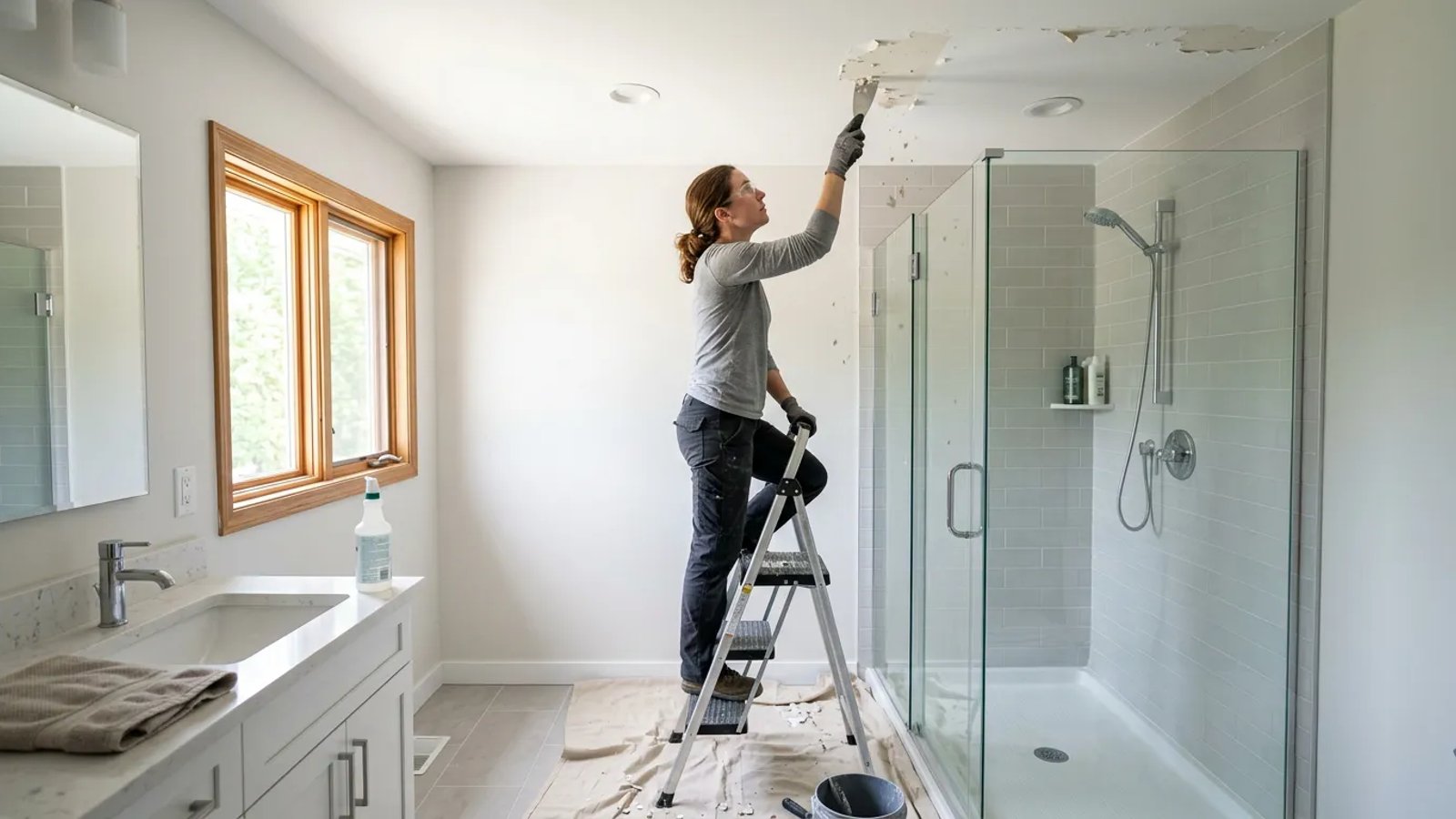
- Protect the room. Remove your shower curtain, towels, and rugs. Lay a canvas drop cloth over the tub or shower floor, and tape plastic sheeting over your vanity and toilet. Scraping and sanding will create a significant amount of fine dust that is notoriously difficult to clean out of grout lines.
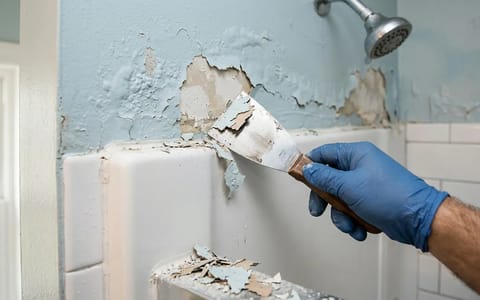
- Scrape the loose paint. Put on your goggles and mask. Take your metal putty knife and gently push it under the edges of the peeling paint. Keep the blade at a shallow 30-degree angle to avoid gouging the drywall. Continue scraping until you reach solid paint that refuses to lift. Do not worry if the scraped area ends up being much larger than the initial bubble; you only want firmly attached paint left on the ceiling.
- Clean the surface. Bathrooms accumulate aerosolized hairspray, soap scum, and airborne oils that prevent new paint from sticking. Wipe the scraped area and the entire surrounding ceiling with a damp sponge and a mild degreaser or TSP solution. Rinse with clean water and let the ceiling dry completely.
- Skim coat the edges. Once you finish scraping and cleaning, you will notice a distinct ridge between the bare drywall and the remaining old paint. If you paint over this now, the outline of the scraped area will be highly visible. Use your putty knife to spread a thin layer of lightweight joint compound over the transition edge. Feather the compound out so it creates a smooth, gradual slope.
- Sand it smooth. Let the joint compound dry completely, which usually takes 2 to 4 hours depending on the humidity in your home. Once dry, take your 120-grit sanding sponge and lightly sand the patched area using circular motions. Run your hand over the surface; if you can feel a ridge, sand a bit more or apply a second, thinner coat of compound. Wipe the ceiling down with a barely damp microfiber cloth to remove all dust.
- Apply a moisture-blocking primer. This step is non-negotiable. Bare drywall and joint compound will absorb moisture from your topcoat if not sealed, causing it to flash (look dull) or peel again. Brush or roll a coat of high-quality, moisture-blocking primer over the patched areas. For bathrooms, a stain-blocking primer like Zinsser Bulls Eye 1-2-3 or Kilz 2 works incredibly well. Let it dry according to the manufacturer's instructions, usually about 1 to 2 hours.
- Paint with the right finish. Finally, apply your topcoat. Choose your premium interior paint formulated for bathrooms, utilizing a 3/8-inch nap roller for the smoothest finish. Apply two thin coats, waiting at least 4 hours between coats for proper adhesion. A satin or semi-gloss finish will ensure water beads up and rolls off rather than soaking in.
Painting over peeling paint is like putting a band-aid on a wet sponge: it will not stick, and the problem will just keep growing.
How Long Should I Wait to Shower After Painting?
One of the most common mistakes homeowners make is taking a steamy shower the morning after painting. While modern latex paint feels dry to the touch in just an hour, it takes much longer to fully cure and build its moisture resistance. True curing can take up to 30 days.
You should wait an absolute minimum of 24 hours before showering or running hot water in the bathroom. If your bathroom is poorly ventilated or naturally damp, wait 48 hours. Exposing uncured paint to heavy steam is the fastest way to cause brand-new bubbles and ruin your weekend of hard work.
DIY vs. Hiring a Professional: 2026 Costs
If scraping a ceiling overhead sounds like a miserable way to spend your Saturday, you might be considering hiring out the work. Because this job requires multiple drying phases (compound, primer, and two coats of paint), a professional painter will usually have to visit your home on two consecutive days.
As of 2026, the typical range to have a licensed professional scrape, patch, prime, and paint a standard 50-square-foot bathroom ceiling is between $300 and $550. This price fluctuates based on your location, the height of the ceiling, and whether mold remediation is required. Compared to the $45 to $75 cost of DIY materials, doing it yourself offers significant savings, provided you have the patience for the prep work.
Stop the Peel: How to Control Bathroom Moisture
Now that your ceiling looks pristine, you need to protect your hard work. The best paint in the world will eventually fail if your bathroom routinely feels like a steam room. Controlling humidity requires a mix of good habits and functional equipment.
Start by evaluating your exhaust fan. Many homeowners turn the fan on when they step into the shower and turn it off the second they step out. This is a major mistake. The bathroom is still full of humid air. You should run your exhaust fan for at least 20 to 30 minutes after you finish showering. If remembering to turn it off is a hassle, replace your standard switch with a countdown timer switch. You can buy one at any hardware store for about $20 to $25, and it ensures the fan runs long enough to completely clear the room. In fact, many 2026 local building codes now require humidity-sensing switches for all new bathroom renovations.
Next, check your bathroom door. If your bathroom door is completely sealed at the bottom, your exhaust fan has to work twice as hard. Exhaust fans need "makeup air" to function. They push wet air out, but they need to pull dry air in from the hallway. Leave the bathroom door cracked open an inch or two while showering, or ensure there is at least a half-inch gap under the door.
Does Your Exhaust Fan Actually Work? The Tissue Test
Sometimes, a fan sounds like a jet engine but moves absolutely no air. This happens when the motor is failing, the fan wheel is caked in years of dust, or the ductwork in the attic has become disconnected or crushed.
You can verify your fan's performance in about ten seconds using the tissue test.
Turn your exhaust fan on. Take a single square of toilet paper and hold it up to the fan grille. Let go of the tissue. If the fan holds the tissue firmly against the plastic cover, your suction is adequate. If the tissue flutters and falls to the floor, your fan is failing to pull moisture out of the room.
If your fan fails the test, pull the plastic cover down (most are held by simple tension springs). Vacuum out any dust bunnies clogging the motor. If it is clean and still fails the test, you likely need a replacement motor. Fortunately, many manufacturers sell plug-and-play replacement motors that snap right into the existing housing without requiring drywall work or electrical rewiring. As of 2026, replacement motors generally cost between $35 and $60.
Fixing a peeling bathroom ceiling takes a little elbow grease, but doing it right the first time saves you from repeating the chore every spring. By properly scraping the old material, treating any hidden mold, sealing the drywall with a quality primer, and upgrading your ventilation habits, your bathroom ceiling will stay smooth, dry, and structurally sound.
- Painting directly over peeling paint guarantees another failure within months; you must remove the loose flakes first.
- Flat and matte paints absorb moisture, making them terrible choices for bathrooms. Always use satin or semi-gloss finishes.
- Your exhaust fan is your first line of defense against ceiling damage. Test its suction and let it run long enough to clear the humidity.