Dishwasher Not Draining After New Disposal? The 5-Minute Fix
Did you just install a new garbage disposal only to find your dishwasher backing up with water? Don't panic. You probably just forgot to remove the factory knockout plug.
Full guide Plumbing Learn how your home plumbing works and how to stop leaks before they ruin your house.You spent your Saturday morning wrestling a heavy appliance under the kitchen sink, finally got the mounting ring locked in, and felt a surge of DIY pride. But that pride quickly turned to panic when you ran your first load of dishes. Now, you are staring at a pool of murky, standing water at the bottom of your machine, frantically searching for why your dishwasher not draining new disposal installation is happening. You might be wondering if you broke the dishwasher pump, kinked a hidden hose, or somehow bought a defective disposal.
Take a deep breath. Your dishwasher is almost certainly fine, and your new garbage disposal is working exactly as it was manufactured to work. You have simply fallen victim to the most common, yet easily overlooked, plumbing mistake in the modern kitchen: forgetting to remove the factory knockout plug.
This tiny, molded piece of plastic has caused more frustration, ruined more weekend afternoons, and triggered more unnecessary calls to professional plumbers than almost any other home maintenance oversight. Let us walk through exactly what this plug is, why it exists, and how you can fix the problem in less than five minutes with tools you already own.
The Culprit: What Is the Garbage Disposal Knockout Plug?
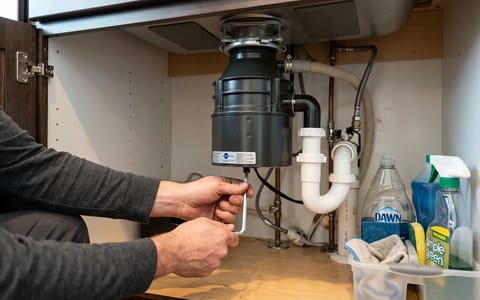
To understand why your kitchen is currently holding water hostage, you have to look at the anatomy of your new garbage disposal. On the side of the cylindrical unit, near the top, there is a small, protruding nozzle about 7/8-inch in diameter. This is the dishwasher inlet port. It is designed to receive the corrugated drain hose coming from your dishwasher, allowing the appliance to pump dirty wastewater directly into the disposal's grinding chamber before it flows out to your home's main sewer line.
Why would they block the very port you need to use? Because not every kitchen has a dishwasher. If a manufacturer shipped the disposal with an open hole, and a homeowner installed it without connecting a dishwasher hose, water and pulverized food waste would shoot straight out of the port and flood the cabinet interior the first time they turned it on. The plug keeps the unit watertight for homes without dishwashers. It is entirely up to the installer to "knock it out" if they plan to route a dishwasher drain through the unit.
Diagnosing the Problem: Is It Really the Plug?
If you are reading this right after installing a new InSinkErator, Moen, or Waste King disposal, the knockout plug is the primary suspect. The symptoms are incredibly consistent. Your dishwasher will run its normal wash cycle, sounding perfectly fine as it sprays water. However, when it reaches the drain cycle, you might hear the dishwasher drain pump straining, humming louder than usual, or making a strange gurgling noise.
The pump tries to force water through a hose that hits a solid plastic wall at the disposal end, leaving the water with absolutely nowhere to go. It backs up the hose and remains pooled in the bottom of the dishwasher tub. If the connection at the disposal inlet is not clamped tightly enough, the pressure might even cause a leak right at the hose connection under your sink.
If you did not explicitly take a hammer and screwdriver to your disposal before sliding the hose on, the plug is still there. It is time to roll up your sleeves and remove it.
Tools Required for This 5-Minute Fix
You do not need to be a master plumber to correct this oversight. In fact, you do not even need to uninstall the garbage disposal from the sink. Gathering a few basic household tools will make this a quick and painless process.
- A flathead screwdriver: You need one with a sturdy handle and a blade wide enough to rest solidly against the plastic plug. A 1/4-inch or 5/16-inch tip works perfectly.
- A hammer: A standard 16-ounce claw hammer is ideal, but any hammer will provide the necessary tapping force.
- Slip-joint pliers or needle-nose pliers: You will use these to retrieve the plastic plug from inside the disposal chamber later.
- A bucket or shallow pan: To catch any standing water currently trapped in the dishwasher drain hose.
- A dry towel: Because plumbing projects always involve a few rogue drips.
That little piece of plastic is responsible for more unnecessary plumbing service calls than almost anything else in the kitchen.
Step-by-Step: Fixing Your Dishwasher Not Draining New Disposal
With your tools gathered, clear out the cleaning supplies from under your sink so you have room to maneuver. The space will be tight, but this process is straightforward. Follow these steps carefully to clear the blockage safely.
- Disconnect the power. Safety first. Unplug the garbage disposal from the wall outlet under the sink. If your disposal is hardwired, go to your home's main electrical panel and flip the breaker for the kitchen disposal circuit to the "off" position.
- Remove the dishwasher drain hose. Place your bucket or towel directly underneath the dishwasher inlet port on the side of the disposal. Using a screwdriver or pliers, loosen the hose clamp securing the corrugated drain hose to the nozzle. Wiggle the hose back and forth while pulling firmly to slide it off. Keep the end of the hose pointed down into the bucket, as the backed-up water from your dishwasher will likely rush out.
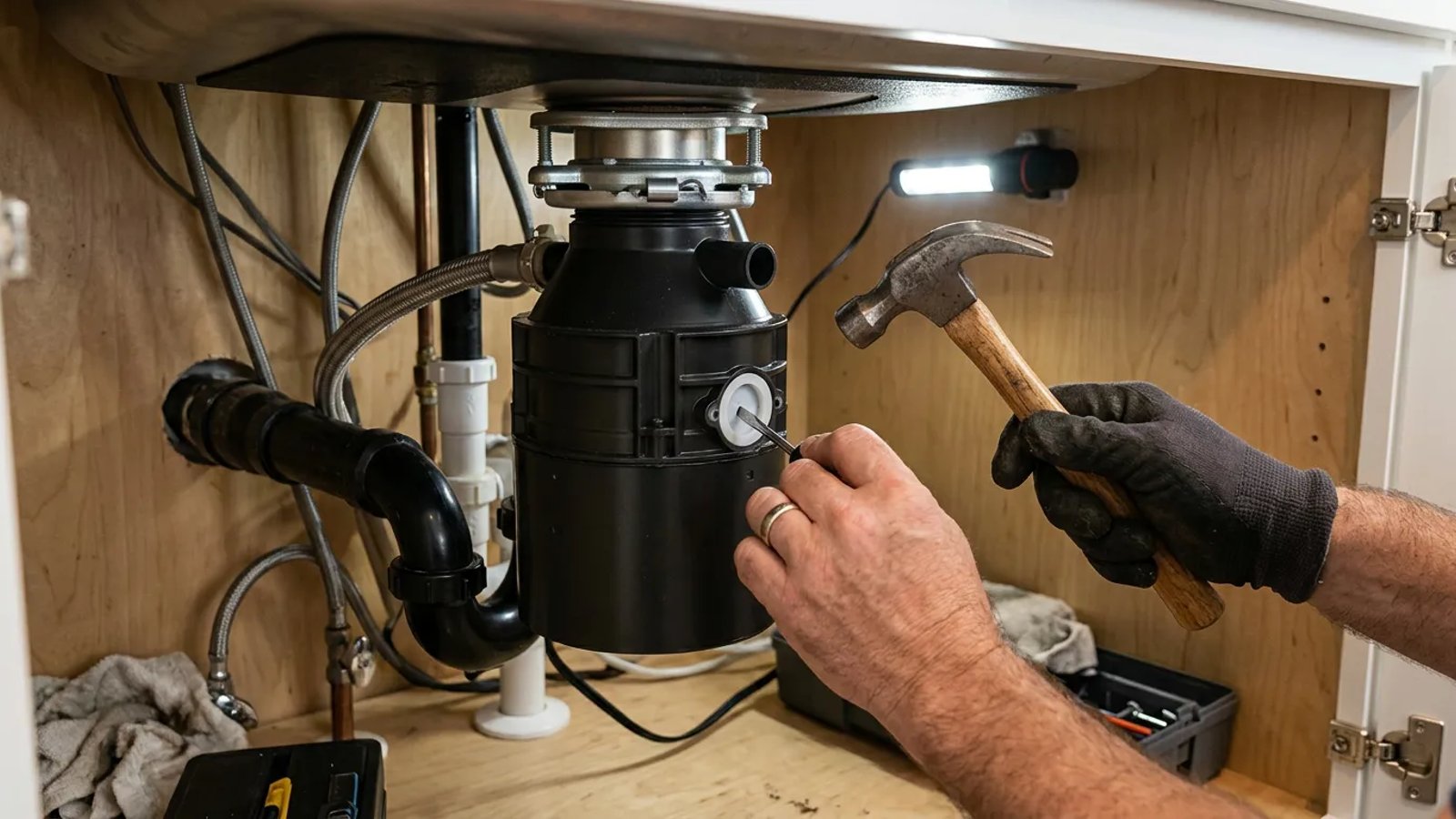
- Position your screwdriver. Look inside the exposed nozzle on the disposal. You will see the solid plastic wall of the knockout plug. Insert the tip of your flathead screwdriver into the nozzle so it rests squarely against the center or slightly off-center of that plastic disk.
- Knock out the plug. Hold the screwdriver firmly with one hand. With your other hand, take the hammer and give the handle of the screwdriver a sharp, solid tap. You do not need to swing like you are driving a framing nail, but you do need enough force to break the plastic tabs holding the plug in place. You will hear a distinct "pop" as the plug breaks free and falls into the grinding chamber.
- Retrieve the plastic plug. This is critical. Look down through the sink drain into the disposal chamber with a flashlight. Locate the loose plastic disk resting on the metal grinding plates. Reach in with your pliers (or your fingers, since the power is strictly disconnected) and pull the plug out. Throw it in the trash.
- Reconnect the drain hose. Slide the corrugated dishwasher hose back over the inlet nozzle. Push it on as far as it will go, ensuring it sits flush. Slide the hose clamp back into position over the nozzle and tighten it securely so it will not leak under pressure.
Dealing with the Standing Water in the Dishwasher
Once you have removed the plug and reconnected the hose, you still have to deal with the dirty water sitting in the bottom of your dishwasher. Fortunately, modern dishwashers have a built-in mechanism to handle this.
Restore power to the garbage disposal and ensure the breaker is back on. Next, close your dishwasher door and press the "Cancel" or "Drain" button on the control panel. Most models will initiate a forced drain cycle that lasts about 60 to 90 seconds. You should immediately hear the water flowing through the hose, entering the side of the disposal, and rushing down the drain. Open the dishwasher door to verify the tub is empty. If the water is gone, congratulations: you have successfully solved the problem.
Decoding 2026 Smart Dishwasher Error Codes
If you installed a newer appliance alongside your disposal, your machine might actually tell you exactly what is wrong. As of 2026, most smart dishwashers feature highly sensitive drain pumps that immediately detect the back pressure caused by a knockout plug. Instead of just humming quietly, they will pause the cycle and flash an error code on the digital display or push a notification to your smartphone. For example, a modern Bosch will typically flash an "E24" or "E25" drain error, while a newer GE model might display "888" or "h2o." If your brand new dishwasher throws a drain error on its very first run after a disposal upgrade, the knockout plug is almost guaranteed to be the culprit.
Secondary Suspects: What If the Plug Is Already Gone?
What if you take off the hose, look inside the nozzle, and realize the plug is already removed, but your dishwasher still refuses to drain? While the knockout plug is the culprit 90 percent of the time following a new disposal installation, there are a few other plumbing issues that can mimic this exact problem.
First, check the routing of your dishwasher drain hose. Plumbing code requires the hose to have a "high loop." This means the hose must travel up from the bottom of the dishwasher, loop up high as close to the underside of the countertop as possible, and then travel back down to connect to the disposal. If the hose is just lying flat on the floor of the cabinet, wastewater from your sink can actually backwash into the dishwasher, making it look like it is not draining. Secure the hose to the back of the cabinet with a zip tie or mounting bracket to create this high loop.
Second, inspect the hose for kinks. When installing the new disposal, it is very easy to accidentally crush or sharply bend the corrugated hose behind the unit. A severe kink will completely block the flow of water. Smooth out any sharp bends to restore the flow.
Understanding How Your Dishwasher and Disposal Work Together
To prevent future issues, it helps to understand the relationship between these two appliances. Your dishwasher relies entirely on its internal pump to push water out. It does not rely on gravity. The pump generates enough pressure to push the water up the high loop and into the disposal. Because the disposal sits higher than the bottom of the dishwasher, the pump works hard during every drain cycle.
When the water enters the disposal, it bypasses the main grinding mechanisms and flows directly into the drain pipe. However, if your disposal is heavily clogged with food waste, such as a massive amount of potato peels or coffee grounds, that blockage can back up past the dishwasher inlet port. If the disposal is clogged, the dishwasher cannot drain. Always run your disposal with plenty of cold water to ensure the chamber is completely clear before starting a dishwasher cycle.
Why You Shouldn't Feel Bad About This Mistake
If you are kicking yourself for missing this step during installation, give yourself a break. The instruction manuals for garbage disposals often bury the knockout plug removal step in tiny print halfway down the page. Furthermore, the plug is the exact same color as the surrounding plastic, making it incredibly difficult to see unless you are specifically looking for it under the dim lighting of a sink cabinet.
Even seasoned handymen and apprentice plumbers have forgotten to punch out the plug on a busy afternoon. The good news is that you caught the issue before it caused any real damage, you learned a valuable lesson about appliance plumbing, and you saved yourself a typical 2026 minimum service charge of $175 to $250 from a local plumber just to have them hit a screwdriver with a hammer.
Keep an eye on the hose connection under the sink for the next few days just to ensure the clamp is tight and there are no slow drips. With the plug gone and the water flowing freely, you can finally get back to enjoying your new kitchen upgrade and let the dishwasher do the heavy lifting.