How Often to Pump Your Septic Tank (And Signs It's Full)

Not sure when your septic tank was last pumped? Learn the standard timelines, the warning signs of a full tank, and the daily habits that prevent costly sewage backups.
Full guide Plumbing Learn how your home plumbing works and how to stop leaks before they ruin your house.Moving into a home with a septic system can feel like inheriting a mysterious underground time bomb. If you are used to a municipal city sewer, the idea that all your household waste is being stored and processed right in your own backyard is a major adjustment. Understanding exactly how often to pump a septic tank is the single most important thing you can do to prevent a catastrophic sewage backup. Getting this schedule right saves you thousands of dollars in drain field replacements and keeps your plumbing running smoothly year-round.
When I bought my first property on a septic system, I assumed it worked like city sewer—out of sight, out of mind. It wasn't until the inspector handed me a crude, hand-drawn map of my drain field and a strict three-year pumping schedule that I realized I was entirely responsible for my own personal waste treatment plant. Managing it doesn't have to be intimidating, provided you understand the basic mechanics and stick to a reliable maintenance routine.
The Anatomy of Your Septic System
Before you can understand the pumping schedule, you need to know what is actually happening underground. A standard septic system has two main components: the tank itself and the drain field (also known as a leach field). When water and waste exit your home, they flow into the septic tank, which is typically a large concrete, fiberglass, or polyethylene container holding between 1,000 and 1,500 gallons.
Inside the tank, the waste naturally separates into three distinct layers. The heaviest solids sink to the bottom to form the sludge layer. Fats, oils, and greases float to the top to form the scum layer. The mostly clear liquid in the middle is called the effluent. Naturally occurring anaerobic bacteria in the tank constantly eat away at the sludge and scum, breaking them down and slowing their accumulation.
As new wastewater enters the tank from your house, an equal amount of effluent is pushed out of the tank, through an outlet baffle, and into the drain field. The drain field consists of perforated pipes laid in trenches filled with crushed stone. The effluent slowly trickles into the soil, which naturally filters and purifies the water before it reaches the groundwater table. The entire system relies on keeping the solid sludge and floating scum inside the tank. If those layers get too thick, they escape into the drain field, clogging the soil and causing system failure.
The Golden Rule: How Often to Pump Your Septic Tank
The general rule of thumb for residential properties is to pump the septic tank every 3 to 5 years. However, that timeline is not a one-size-fits-all guarantee. Your specific schedule depends entirely on the mathematical relationship between the physical size of your tank and the number of people living in your home.
A family of four living in a home with a 1,000-gallon tank will typically need to pump their system every 2.6 years. If only two people live in that same house, the tank might easily go 5.9 years before needing service. Conversely, if you have a large family of six running constant showers, laundry, and dishwasher cycles into a smaller 900-gallon tank, you might be calling the pump truck every 18 months.
Another massive variable is the use of a garbage disposal (garburator). Grinding up food scraps and sending them down the drain dramatically increases the amount of solid waste entering the tank. Homes that heavily rely on garbage disposals accumulate sludge up to 50 percent faster than homes that compost their food scraps or throw them in the trash. If you use a disposal daily, you should automatically shave a year off your expected pumping interval.
Red Flags: Early Warning Signs of a Full Tank
While sticking to a calendar schedule is the best preventative measure, your home will usually give you warning signs if the system is struggling. Never ignore these red flags, as the difference between a sluggish drain and a raw sewage backup in your basement is often just a matter of days.
The most common early warning sign is slow draining across multiple fixtures. If a single bathroom sink is draining slowly, you probably just have a localized hair clog. But if your kitchen sink, shower, and washing machine are all draining sluggishly at the same time, the main line or the tank itself is likely backed up. You may also hear distinct gurgling sounds coming from your toilets or tub drains when other fixtures are used. This happens because air is struggling to vent through the clogged system, forcing bubbles back up through the water traps.
Foul odors are another major indicator. Hydrogen sulfide gas, which smells sharply of rotten eggs, should never be noticeable inside your home or out in your yard. If you step onto your back patio and catch a whiff of raw sewage, your tank's venting system is overwhelmed, or sewage is surfacing in the yard. Finally, look at the grass over your drain field. If you notice a specific rectangular patch of your lawn that is unusually lush, bright green, and growing much faster than the rest of the yard, it means nutrient-rich sewage is rising too close to the surface.
Locating and Prepping Your Tank for Service
If you have never had your tank pumped, you first have to find it. Start by looking for an "as-built" drawing of your property at your local health department or municipal office. If you don't have a map, go into your basement and locate the main 4-inch PVC or cast-iron sewer pipe exiting the foundation. The tank is usually buried straight out from that exit point, typically 10 to 20 feet away from the house.
Once you have a general idea of the location, you can use a 1/4-inch steel soil probe to gently poke the ground until you feel the solid, flat concrete lid. Many older tanks have lids buried one to three feet underground, which means you (or the septic company) will have to dig up the yard every time service is required.
To save money and landscaping headaches in the future, ask your technician to install a septic riser during your next pump-out. A riser is a heavy-duty plastic pipe that extends from the buried tank lid up to the surface of your lawn, capped with a secure, green lid that sits flush with the grass. It typically costs between $100 and $200, but it completely eliminates the labor of digging for all future maintenance.
The Pumping Process: What Happens and What It Costs
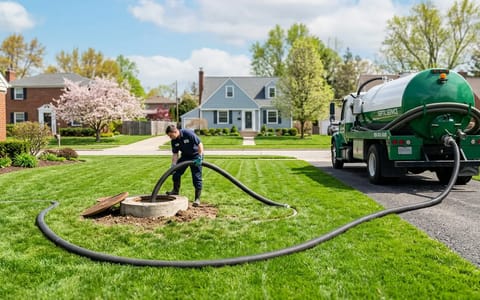
When the vacuum truck arrives in your driveway, the actual pumping process is relatively straightforward and usually takes between 30 and 60 minutes. Expect to pay between $300 and $600 for a standard pump-out, depending on your region, the size of your tank, and whether the technician has to dig to access the lid.
- Uncovering the lid. The technician will locate the tank and remove the primary access cover. If you don't have a riser, this involves digging a hole about two feet wide.
- Checking the liquid level. Before pumping, the technician observes the resting liquid level. If the water is sitting below the outlet pipe, the tank might have a structural leak. If the water is sitting high above the outlet pipe, the drain field is likely failing and not accepting water.
- Pumping and agitating. A massive vacuum hose is lowered into the tank. The technician will use a specialized tool called a "muck fork" to break up the dense sludge at the bottom, or they will pump some liquid back into the tank to agitate the solids, ensuring the tank is completely emptied.
- Inspecting the baffles. Once the tank is empty, the technician shines a flashlight inside to inspect the inlet and outlet baffles. These crucial PVC or concrete tees prevent scum from flowing into the pipes. If they are deteriorating, they must be replaced immediately.
A septic system is essentially a living, breathing underground stomach—treat it poorly, and it will eventually make you pay the price.
System Lifespan Hacks: Daily Habits That Save Thousands
Pumping your tank regularly is only half the battle. The daily habits of the people living in the house dictate whether your system will last 15 years or 40 years. The most destructive habit in modern homes is the use of "flushable" wipes. Despite what the packaging claims, these wipes are manufactured with synthetic fibers that do not break down in water. They accumulate in the sludge layer, tangle around the tank baffles, and frequently cause massive blockages. Your toilet is not a trash can; the only things that should go down it are human waste and septic-safe toilet paper.
In the kitchen, fats, oils, and grease (FOG) are the primary enemy. When warm bacon grease or cooking oil is poured down the sink, it remains liquid until it hits the cool environment of the septic tank. There, it solidifies into a dense, hard layer of scum that bacteria cannot easily digest. Always wipe greasy pans with a paper towel and throw it in the garbage before washing.
Water conservation is also a critical, often-overlooked factor. A standard washing machine uses 30 to 40 gallons of water per load. If you save all your family's laundry for Saturday and run six back-to-back loads, you are dumping over 200 gallons of water into the tank in a matter of hours. This rapid influx stirs up the sludge layer and forces unsettled, dirty water out into the drain field. Stagger your heavy water usage throughout the week to give the tank time to settle and separate.
Finally, skip the store-bought biological additives that promise to "eliminate the need for pumping." Human waste naturally provides all the bacteria a tank needs to function perfectly. Many of these commercial additives actually agitate the sludge, breaking it into smaller particles that don't settle properly, allowing them to float out into your drain field and cause clogs.
Maintaining a healthy septic system doesn't require a degree in plumbing or biology. By knowing the size of your tank, calculating your household's unique pumping schedule, and being mindful of what goes down your drains, you can easily keep your system running flawlessly. Set a calendar reminder right now for your next pump-out, keep a copy of your service records in a safe place, and treat your plumbing with the respect an underground ecosystem deserves.