How to Baby Proof Cabinets Without Drilling in a Rental
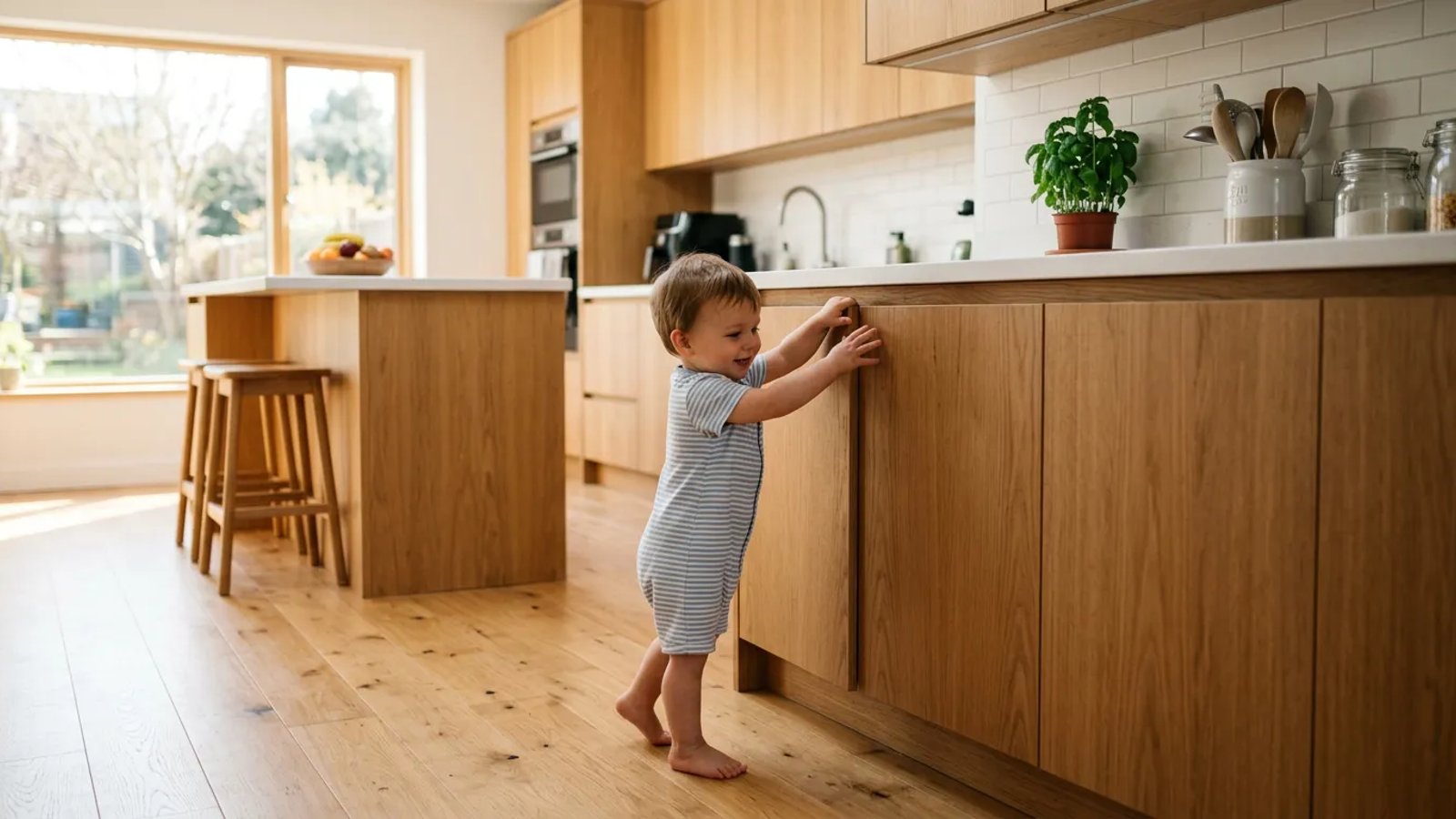
Protect your toddler and your security deposit. Learn how to baby proof cabinets without drilling using magnetic locks, adhesive straps, and safe removal techniques.
Welcome to the collision of two unstoppable forces: a newly mobile toddler and a landlord who rigorously inspects for property damage. As a renter, or simply a homeowner who loves their pristine cabinetry, you face a distinct challenge. You must secure hazardous cleaning supplies, heavy pots, and sharp objects while ensuring you get your security deposit back in full when your lease ends.
For decades, the only reliable way to keep kids out of lower cabinets was to drive metal screws into the wood. Today, adhesive technology has caught up with our parenting needs. You absolutely can baby proof cabinets without drilling, and you can do it in a single afternoon with a few basic supplies.
The Problem With Traditional Cabinet Latches
Let's look at the anatomy of a standard, old-school cabinet latch. Installing just one requires drilling two pilot holes into the cabinet frame and two into the back of the door. In an average kitchen with 15 lower cabinet doors, you are looking at drilling 60 individual holes.
Landlords despise this. When you move out and remove the latches, those holes remain. On solid wood, they are unsightly. On medium-density fiberboard (MDF) or particleboard cabinets wrapped in veneer (which are extremely common in rental units), driving screws near the edge often causes the material to split and crumble. A landlord might charge you a nominal fee per hole, or they might charge you to replace the entire damaged door, which as of 2026 can easily cost $150 to $300 per cabinet.
You need a solution that leaves zero trace. Fortunately, industrial adhesives have evolved.
Magnetic Adhesive Locks: The Renter's Best Friend
The undisputed champion of rental baby-proofing is the magnetic adhesive lock. These clever devices consist of two plastic pieces backed with heavy-duty 3M tape. The catch sticks to the inside of the cabinet frame, and the latch sticks to the inside of the door.
Because they are installed entirely on the interior, they are completely invisible from the outside. Your kitchen maintains its clean, adult look. When the door is shut, the latch hooks onto the catch. To open it, you simply hold a magnetic "key" (which looks like a small plastic knob) against the outside of the door. The magnet pulls the internal latch down, allowing the door to swing open.
They work on almost all standard cabinets up to about 1.5 inches thick. The only exception is cabinets with deep, recessed decorative panels where the wood is too thick for the magnet to engage.
How to Install Magnetic Locks Like a Pro
The secret to drill-free locks is not the lock itself; it is the preparation. If an adhesive lock fails, 90% of the time it is because the cabinet surface was dirty. Kitchens are inherently greasy environments. Even if your cabinets look clean, there is likely a microscopic layer of cooking oil on them.
- Clean the contact areas. Wipe down the inside of the cabinet door and the frame with a rag lightly dampened with 70% isopropyl rubbing alcohol. Let it dry completely.
- Use the alignment cradle. Most kits come with a plastic installation cradle. You snap the latch and catch together inside the cradle, peel off the adhesive backing, and stick the whole unit to the frame.
- Close the door to transfer the latch. Peel the backing off the door-side piece, then firmly shut the cabinet door against the cradle. The adhesive will grab the door in the exact right position.
- Apply pressure. Open the door, remove the cradle, and press firmly on both adhesive pads for 30 seconds to activate the bond.
- Let it cure. This is critical. Do not let your toddler test the doors immediately. 3M VHB tape requires 24 hours to reach its maximum holding strength.
Adhesive Strap Locks for Appliances and Drawers
Magnetic locks are perfect for standard cabinet doors, but what about the oven, the dishwasher, or a bank of drawers? For these, you will want to use adhesive strap locks.
These look like a flexible plastic strap with an adhesive pad on both ends. One end acts as an anchor, and the other end clips into a latch. You can stick one pad to the side of your refrigerator and the other to the front door, spanning the gap. To open the appliance, you squeeze the latch mechanism and pull the strap free.
Because the straps are flexible, they can wrap around corners. This makes them incredibly versatile for securing toilets, trash cans, and tricky corner cabinets. Just like the magnetic locks, surface preparation is key. Wipe the appliance surface with alcohol, stick the pads, and wait a full day before putting tension on the strap.
Tension Cords for Double Doors
If you have side-by-side cabinet doors with knobs or D-ring handles, you might not even need adhesive. Tension cords (sometimes called loop locks) are a brilliant zero-impact solution.
These function somewhat like a reusable zip-tie. You slide the plastic loop over both cabinet knobs, pull the cord tight, and push a sliding button to lock it in place. The doors are physically bound together and cannot be opened. To access the cabinet, you press a dual-button release to loosen the cord.
They take about three seconds to install, leave absolutely no residue, and are highly portable. I always recommend keeping a few of these in your travel bag for baby-proofing hotel rooms or short-term rentals on the fly.
Smart Adhesive Locks: The 2026 Upgrade
If you want to take your baby-proofing into the modern era, 2026 has brought a surge of Bluetooth-enabled adhesive cabinet locks to the market. These operate on the same heavy-duty 3M tape principles as magnetic locks, but they connect directly to your smartphone. Instead of hunting for a misplaced magnetic key, you can unlock specific cabinets with a tap on your screen or set them to auto-lock during certain hours. While they typically cost more than standard magnetic versions, they offer incredible convenience for frequently used cabinets.
The Crucial Step: Removing Heavy-Duty Adhesive Without Damage
Fast forward a year or two. You are packing boxes, cleaning the apartment, and preparing to hand the keys back to the landlord. It is time to remove the locks. If you grab the plastic latch and yank it as hard as you can, you will likely tear off a strip of paint or splinter the wood veneer. You just lost part of your deposit.
A hair dryer and a piece of dental floss are all that stand between you and a fully refunded security deposit.
The adhesive on these locks is designed to resist sudden, forceful pulls: exactly what a toddler does. However, it is highly vulnerable to heat and sustained, slow slicing.
Here is the foolproof method for damage-free removal:
First, plug in a hairdryer and set it to medium or high heat. Hold it about three inches away from the plastic lock and heat the area for 60 to 90 seconds. You want the plastic to feel quite warm to the touch, but not melting hot. The heat softens the adhesive polymer, changing it from a solid grip to a gooey consistency.
Next, wrap a long piece of dental floss around your index fingers. Slide the floss behind the plastic lock, flush against the cabinet wood. Using a gentle sawing motion, pull the floss down through the softened adhesive foam. The lock will pop right off into your hand.
You will be left with a thin layer of sticky foam residue on the cabinet. Do not scrape it with a knife or a metal putty knife. Instead, use your thumb to simply roll the adhesive back on itself. It will pill up into a little ball and peel away. If there is any slight tackiness left behind, a quick wipe with a citrus-based adhesive remover (like Goo Gone) and a paper towel will leave the wood looking brand new.
Keeping your curious explorer safe does not have to mean declaring war on your rental property's cabinetry. By utilizing high-quality magnetic locks, flexible straps, and tension loops, you can create a perfectly secure environment. And when the time comes to move on, a little heat and patience will ensure your kitchen looks exactly as it did the day you moved in.