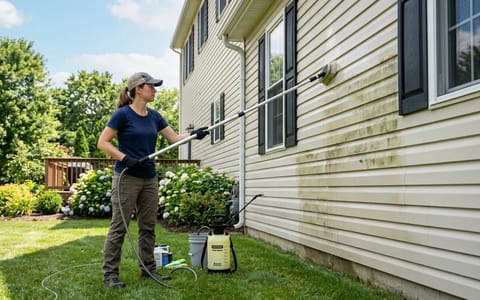
How to Pressure Wash Vinyl Siding Without Causing Water Damage
Learn how to safely pressure wash vinyl siding using the soft wash method to remove winter grime without causing expensive water damage or cracking panels.
Full guide Exterior: Siding, Garage & Decks Learn how to maintain your siding, garage doors, and decks to protect your home from the weather.Spring sunshine has a habit of highlighting exactly how much green algae, mildew, and brown dirt accumulated on your house over the winter. You might be tempted to drag out the heavy-duty equipment and blast it all away, but you need to be careful. If you want to pressure wash vinyl siding, treating it like a concrete driveway is a fast track to cracked panels and hidden structural rot.
Vinyl siding is designed to shed rain that falls from the sky, not repel high-velocity water jets shooting sideways or upwards. When water gets forced behind those overlapping plastic panels, it soaks the wood sheathing and insulation underneath. Since the space behind the siding gets very little airflow, that trapped moisture inevitably turns into toxic mold and expensive wood rot.
To get that fresh, clean curb appeal without damaging your biggest investment, you need to use a technique called "soft washing." This method relies on chemical cleaners to do the hard work of breaking down the grime, using the pressure washer only as a gentle delivery and rinsing system.
Why High Pressure and Vinyl Siding Don't Mix
Vinyl is a relatively thin, flexible plastic. It expands in the summer heat and contracts in the winter cold. To accommodate this movement, siding installers hang the panels loosely on nails rather than pinning them tight to the wall. This loose fit creates gaps at the seams, at the corners, and around windows.
Additionally, if you look closely at the bottom edge of a vinyl panel, you will see small slots called weep holes. These holes allow condensation that forms behind the siding to drain out. If you hit the siding with a 3,000 PSI blast of water, especially at an upward angle, you will shoot water directly through those weep holes and straight into your home's framing.
According to the Vinyl Siding Institute, you should always keep the water stream at eye level or point it downward, and never use a high-pressure, narrow-focused nozzle on the panels.
What Tools Do You Need to Soft Wash Siding?
You don't need a massive commercial rig to clean your house. A standard residential pressure washer—either gas or electric—will work perfectly, provided you use the right attachments to step the pressure down.
Here is exactly what you need to gather before you start:
- A pressure washer: An electric unit pushing 1,500 to 2,000 PSI at 1.2 to 1.5 GPM (gallons per minute) is ideal. If you have a powerful gas washer, you must use a wider nozzle and stand further back.
- The right nozzles: You need a black soap nozzle (65 degrees, very low pressure) and a white rinsing nozzle (40 degrees, gentle fan spray).
- Siding cleaner: You can buy commercial house wash that hooks directly to your pressure washer's downstream injector, or mix your own using 1 part bleach to 4 parts water and a squirt of dish soap in a pump sprayer.
- A soft-bristle siding brush: Attach this to an extension pole for stubborn algae spots.
- Safety gear: Safety glasses are non-negotiable. Chemical splash-back in the eyes will ruin your weekend.
How to Prep Your Home's Exterior
Preparation is the most overlooked step in exterior cleaning. When I washed my own two-story colonial last May, I learned the hard way that missing just one exposed exterior outlet can trip your breakers for the entire afternoon—and potentially create a serious shock hazard. Make sure you have a roll of 2-inch blue painter's tape and a handful of plastic bags ready for this crucial step.
Start by walking the perimeter of your house. Close every single window and push them down firmly to ensure the weatherstripping is seated. Remove window screens if possible; washing right through the screens traps dirt against the glass and leaves a messy grid pattern.
Next, grab a roll of blue painter's tape and some small plastic grocery bags. Wrap a bag around every exterior light fixture, security camera, and GFCI outlet, taping the edges tight to the siding. You don't want water or bleach finding its way into your electrical boxes.
Step-by-Step: How to Pressure Wash Vinyl Siding
With the house prepped and your safety glasses on, it is time to start washing. Pick a side of the house that is currently in the shade. If you apply soap to hot siding in direct sunlight, it will dry instantly and bake the dirt right onto the vinyl.
- Pre-rinse the siding. Snap the white 40-degree nozzle onto your wand. Standing about 3 to 4 feet away, lightly mist the siding with plain water. This cools the surface and helps the soap cling.
- Apply the soap from the bottom up. Switch to your black soap nozzle. Drop your siphon tube into the detergent bottle (or use a separate pump sprayer). Spray the soap mixture starting at the foundation and working your way up to the roofline. Working bottom-up ensures that if the soap runs, it runs over an already-wet, soapy surface, preventing permanent clean streaks.
- Let it dwell. The chemical needs time to work. Let the soap sit on the siding for 5 to 10 minutes. You will actually see the green algae turn brown or white as it dies. Do not let the soap dry. If it starts drying, mist it lightly with more water.
- Scrub stubborn spots. If you have thick mud or heavy mildew, take your soft-bristle brush on an extension pole and gently agitate the area. Let the brush do the work; don't scrub so hard that you flex the vinyl.
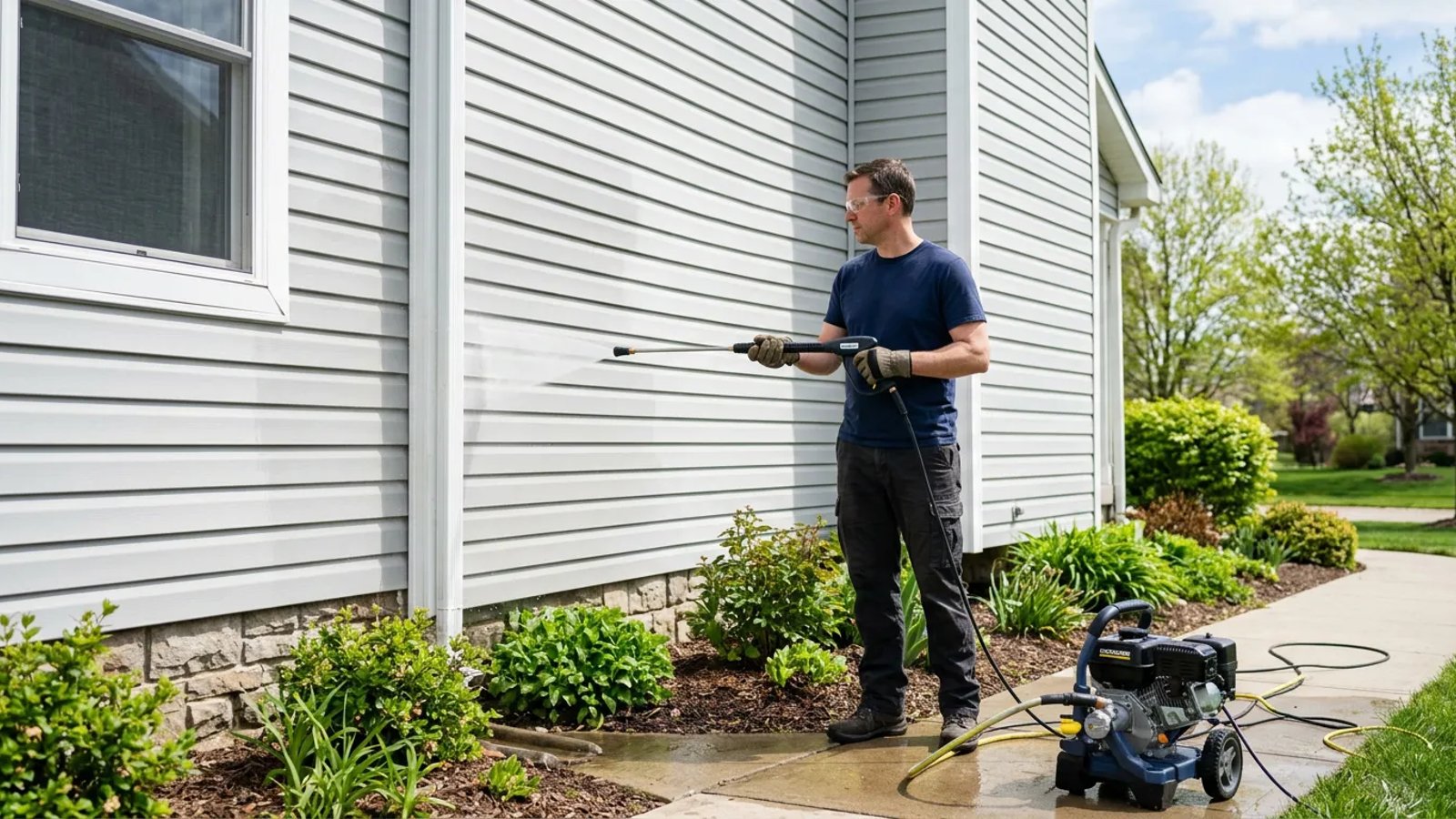
- Rinse from the top down. Switch back to the white 40-degree nozzle. Start at the very top of the siding and work your way down. Keep the wand angled slightly downward, sweeping smoothly back and forth. Keep the nozzle at least 2 feet away from the surface.
- Rinse the plants. Once the wall is clean, grab your garden hose and heavily rinse the plants and soil below to dilute any remaining chemicals.
The golden rule of soft washing: Let the chemicals do the heavy lifting, and use the pressure washer only as a gentle broom.
Common Mistakes That Cause Water Damage
Even with the right tools, bad technique can severely damage your home. The most common mistake homeowners make is spraying at an upward angle. If you are standing on the ground trying to clean the second story, you are naturally aiming the wand up. This forces high-pressure water directly into the weep holes at the bottom of the panels and under the overlapping horizontal seams.
To clean a second story safely, you have two options. You can use a telescoping extension wand that allows you to point the nozzle downward from the ground, or you can use a ladder. If you use a ladder, ensure it is on stable, level ground, and never hold the pressure washer wand with one hand while clinging to the ladder with the other. The recoil from squeezing the trigger can easily throw you off balance.
Another frequent error is spraying directly into the vertical seams where two pieces of siding overlap. Always take note of which way the siding overlaps. If the left panel sits over the right panel, you want to spray from left to right. Spraying from right to left will drive water straight into the seam.
Finally, never use a zero-degree (red) nozzle on your home. That pinpoint stream can cut through leather boots, and it will easily punch a hole directly through brittle, older vinyl siding. Stick to the white 40-degree tip for all your rinsing needs.
Taking the time to wash your home's exterior the right way not only makes your property look fantastic, but it also protects the structural integrity of the walls underneath. By keeping the pressure low, using the right detergents, and managing your angles, you can easily tackle this spring maintenance project in a single weekend.
- Use a 40-degree (white) or 65-degree (black) nozzle to keep pressure below 1,500 PSI.
- Let your cleaning solution dwell on the siding for 5 to 10 minutes to break down algae, but do not let it dry.
- Always spray at a slightly downward angle to avoid forcing water behind the siding seams.
- Pre-soak your foundation plants with plain water so they don't absorb the chemical runoff.