How to Prevent Wasp Nests Under Your Eaves This Spring
Mid-spring is the critical window to stop queen wasps from building nests along your roofline. Learn how to inspect your eaves, apply safe deterrents, and remove starter nests before they become a summer nightmare.
Full guide Pest Control Learn how to stop ants, mice, termites, and wasps from invading your home and know when to hire a pro.Finding a massive, buzzing wasp nest hanging directly over your front door in the middle of July is a nightmare most homeowners want to avoid. By the time a nest reaches the size of a football, you are dealing with hundreds, sometimes thousands, of aggressive insects that require extreme caution to remove. The secret to a sting-free summer isn't a stronger pesticide; it is timing. If you want to prevent wasp nests under eaves, the work has to happen right now, in mid-spring.
During May, the weather warms up enough to wake queen wasps from their winter hibernation. At this stage, they are entirely alone. Each queen is actively flying around your property, looking for a dry, sheltered 90-degree angle to start building her papery empire. By stopping her now, you eliminate the entire future colony.
Why Mid-Spring is Your Only Real Window for Wasp Nest Prevention
Understanding the lifecycle of a wasp colony makes it obvious why spring is the most critical season for exterior home maintenance. In the late fall, the entire wasp colony dies off, except for a few newly mated queens. These queens bury themselves under tree bark, inside wood piles, or deep within the cracks of your home's siding to survive the freezing winter.
When temperatures consistently hit about 60 degrees Fahrenheit (usually around early to mid-May), these queens wake up. For the first few weeks of spring, a queen is highly vulnerable. She has to gather wood fibers, chew them into pulp, and build a tiny, golf-ball-sized starter nest all by herself. She also has to forage for food to feed her first batch of larvae. This brief period is your golden opportunity.
Stopping a single queen in May prevents a colony of thousands in August.
Once that first batch of worker wasps hatches, the queen stops leaving the nest. She stays inside to lay eggs while the workers take over expanding the nest and defending it aggressively. By mid-summer, the nest grows exponentially. If you wait until July to look up at your roofline, you have already missed the prevention window and are stuck in the extermination phase.
Where Do Wasps Choose to Build?
Queens are looking for two specific things: protection from the rain and protection from predators. Your home's exterior provides dozens of perfect micro-climates that fit this description, often preferring sheltered 90-degree angles to begin their nest construction.
The most common hotspots include the underside of roof eaves, the deep corners of soffits, behind exterior window shutters, inside unsealed exterior light fixtures, and tucked just behind the lip of your gutters. They also love the joists under raised wooden decks and the ceilings of covered front porches.
Because they need a solid anchor point for their hanging nests, they naturally gravitate toward unpainted wood or textured surfaces where their paper pulp can easily grip. Smooth, slick surfaces are much harder for them to attach to, which is why you rarely see nests hanging directly from clean vinyl siding.
How to Safely Inspect Your Home's Exterior
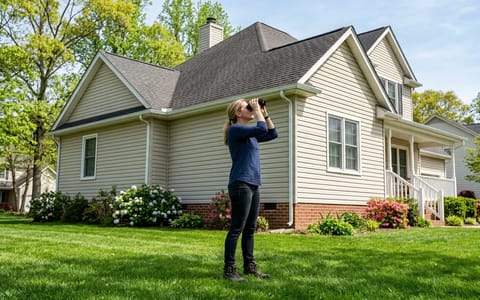
You should aim to perform a perimeter walk around your house once a week during May and early June. You do not need expensive equipment for this, but you do need to be thorough.
Start your inspection during the warmest part of the day, usually between 1:00 PM and 3:00 PM. This is when the queens are most active. You are not just looking for nests; you are looking for flight paths. If you see a single large wasp repeatedly flying to the exact same corner of your roofline, she is likely building a starter nest there.
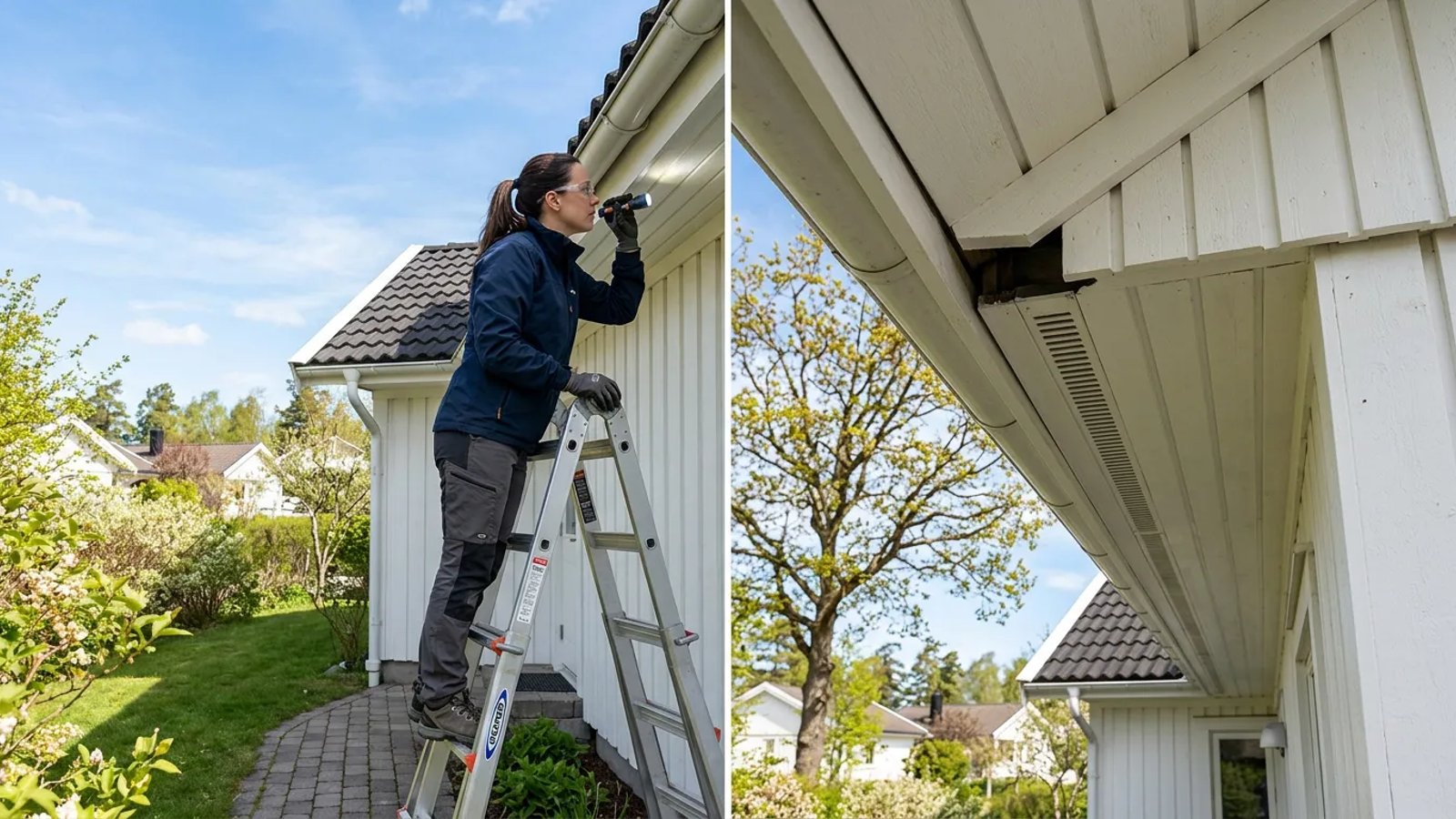
Pay close attention to any small gaps where your roof's fascia board meets the soffit. Wasps love to squeeze into gaps as small as a quarter of an inch to build nests inside the wall cavity, which is significantly harder to deal with than an exposed hanging nest.
Proven DIY Deterrents to Keep Queens Away
If you have a specific corner of your porch or roofline that seems to attract a new nest every single year, you can proactively make that spot unappealing. You do not need to spray toxic chemicals all over your house to achieve this.
Last spring, I tested a combination of decoy nests and peppermint spray on my own wrap-around porch after dealing with incredibly aggressive paper wasps the year prior. I sprayed the wooden corners of the eaves every two weeks, and for the first time in three years, we had zero nests form. It requires a bit of consistency, but the effort is minimal.
The Peppermint Oil Spray Method
Wasps have an incredibly strong sense of smell, which they use to locate food and navigate. Strong, pungent odors overwhelm their senses and make an area intolerable to them. Peppermint oil is widely considered the most effective natural wasp repellent.
To make your own deterrent spray, you will need a clean plastic spray bottle, pure peppermint essential oil (usually $10 to $15 at a health food store), liquid dish soap, and water.
- Mix the solution. Combine 2 cups of tap water with 15 to 20 drops of pure peppermint essential oil in your spray bottle.
- Add the binder. Squeeze in one tablespoon of liquid dish soap. The soap breaks the surface tension of the water and helps the oil stick to your wooden eaves rather than just evaporating immediately.
- Shake vigorously. Oil and water naturally separate, so give the bottle a hard shake for about ten seconds before every use.
- Apply to hotspots. Generously mist the corners of your eaves, porch ceilings, and the underside of deck railings. You want the wood to be slightly damp with the mixture.
Because this is a natural oil, it will break down in sunlight and wash away in the rain. You must reapply it every 10 to 14 days during the spring scouting season to maintain the scent barrier.
Hanging Decoy Nests
Paper wasps and yellow jackets are highly territorial. If a scouting queen flies into an area and sees that another colony has already claimed it, she will usually turn around and look for a different house. You can buy two-packs of artificial decoy nests online for about $15.
These look like gray, crumpled paper lanterns. Hang them under the corners of your eaves early in the spring before the real queens start building. While they are not a 100% guaranteed fix on their own, they add a great visual deterrent layer when combined with your peppermint spray routine.
How Do You Safely Remove a Starter Nest?
Even with great preventative measures, a determined queen might slip through your defenses and start building. If you spot a starter nest while doing your weekly inspections, you can usually remove it yourself safely, provided it is no larger than a golf ball.
If you are dealing with a simple, exposed starter nest with just the queen present, follow these steps to remove it safely:
- Wait for nightfall. Never attempt to remove a wasp nest during the heat of the day. Wasps are diurnal, meaning they are completely inactive and have poor vision at night. Wait until at least two hours after sunset.
- Wear heavy clothing. Even for a tiny nest, protect yourself. Wear a heavy winter coat, thick leather work gloves, jeans, and safety glasses.
- Use a red light. Wasps cannot see red light well. If you have a headlamp with a red-light setting, use that. If you only have a standard flashlight, never shine the beam directly at the nest, as the light will wake the queen. Keep the beam pointed slightly away.
- Knock it down quickly. Use a long-handled push broom or a telescoping painter's pole to swiftly scrape the nest off the eave. The goal is to detach the small paper stalk connecting it to the wood.
- Step back. Once the nest falls, immediately step back and walk away. The queen will be disoriented on the ground. Leave the area and let her fly away in the morning; without her nest, she will likely move on to a new territory.
- Clean the attachment point. The next day, wipe down the spot where the nest hung with your peppermint oil spray to mask any pheromones the queen left behind.
Long-Term Prevention and Maintenance
Physical exclusion is the ultimate long-term strategy. Wasps cannot build nests inside your soffits if they cannot get inside. Take a weekend this spring to walk your home's perimeter with a tube of high-quality exterior silicone caulk. Seal up any gaps around wire penetrations, plumbing vents, and where different siding materials meet.
If you have older wooden soffits with ventilation holes, ensure the metal mesh screens behind those holes are intact. Squirrels and birds often tear these screens during the winter, leaving wide-open doors for wasps in the spring. Replacing a torn piece of $5 wire mesh now is much cheaper than paying an exterminator to drill into your ceiling in August.
For more information on handling household pests without relying heavily on broad-spectrum chemicals, you can review the EPA's guidelines on safe pest management, which strongly emphasizes early exclusion over reactive poisoning.
By dedicating just 15 minutes a week to inspecting your eaves this May, mixing up a simple peppermint spray, and knocking down tiny starter nests before they grow, you take complete control of your home's exterior. A little bit of proactive work right now guarantees you can enjoy your patio all summer long without constantly looking over your shoulder.
- Timing is everything: tackling wasp prevention in May saves you from dangerous, expensive exterminations in August.
- Wasps hate strong scents; a simple DIY peppermint oil spray can effectively deter them from common nesting spots.
- Never attempt to remove a nest larger than a tennis ball yourself—call a professional for active, established colonies.
- Sealing tiny gaps in your soffits and fascia boards removes the sheltered environments queens seek out.