How to Soft Wash Vinyl Siding (And Avoid High Pressure Damage)
Blasting your vinyl siding with a high-pressure washer can force water into your walls and crack the panels. Learn how to soft wash your siding safely.
Full guide Exterior: Siding, Garage & Decks Learn how to maintain your siding, garage doors, and decks to protect your home from the weather.Whether it is spring cleaning or mid-summer maintenance, the urge to blast away dirt, spider webs, and green algae from our homes is completely understandable. There is something incredibly satisfying about watching a layer of grime vanish in an instant. But before you fire up that gas-powered pressure washer and point it at your house, you need to know that high water pressure and vinyl siding are a disastrous combination. If you want a pristine exterior without causing thousands of dollars in hidden water damage, you need to learn how to soft wash vinyl siding.
The Hidden Dangers of High PSI on Vinyl Siding
To understand why high-pressure washing is a bad idea, you first need to understand how vinyl siding is installed. Vinyl siding is not a waterproof seal but a water-shedding system. The panels hang loosely on the side of your house, allowing them to expand and contract with temperature changes. Along the bottom edge of each panel are tiny "weep holes" designed to let trapped moisture escape.
When you hit your siding with a typical 2026 gas-powered pressure washer blasting at 2,500 to 3,500 PSI, you easily overpower the design of the panels. The extreme force pushes water up and under the overlapping seams, shooting it directly through the weep holes and into your wall cavity. Once water gets trapped behind the siding, it soaks into your home's wood sheathing and insulation.
Beyond the hidden water damage, high pressure can physically destroy the plastic itself. An aggressive zero-degree or 15-degree nozzle can easily crack old, brittle vinyl, punch holes straight through the material, or strip away the factory UV-protective coating, leaving your siding looking chalky and faded.
What Soft Washing Actually Means
If high pressure is the enemy, what is the alternative? The answer is the soft wash method. Soft washing involves using specialized cleaning solutions to break down dirt, kill organic growth like algae and mildew, and lift stains, followed by a gentle, low-pressure rinse.
Soft washing relies on chemistry, not brute force, to melt away years of grime.
When we say low pressure, we mean it. A true soft wash uses water pressure under 500 PSI. For the average homeowner, the 40 to 60 PSI provided by a standard garden hose is more than enough to get the job done safely and effectively.
Your Soft Washing Gear List
You do not need expensive commercial equipment to soft wash your home. A quick trip to the hardware store is usually all it takes. Here is what you need:
- A standard garden hose with an adjustable spray nozzle.
- A 1-gallon or 2-gallon pump sprayer (this usually costs around $20 to $35 as of 2026). Alternatively, a hose-end sprayer works well for reaching higher areas.
- A siding cleaning solution (we will cover the recipe below).
- A soft-bristle brush attached to a telescoping extension pole (for stubborn spots).
- Safety gear including protective eyewear and rubber gloves.
Choosing the Right Siding Cleaner
The secret to soft washing is the cleaning solution. You can purchase pre-mixed commercial vinyl siding cleaners that attach directly to your hose, but many experienced DIYers prefer to mix their own highly effective batch.
A standard DIY soft wash recipe consists of one part liquid household bleach (to kill the algae and mold) mixed with four parts water. To help the mixture cling to the vertical siding instead of instantly running off, add a generous squirt of liquid dish soap (like Dawn) to act as a surfactant. Mix this gently in your pump sprayer.
New 2026 Guidelines for Eco-Friendly Soft Washing
As of 2026, many municipalities have introduced stricter runoff regulations to protect local waterways from harsh chemicals. While traditional bleach mixtures remain popular, many homeowners are now switching to EPA-Safer Choice certified sodium hypochlorite alternatives and biodegradable surfactants. These modern soft wash solutions are highly effective at breaking down algae and mildew without risking heavy fines for chemical runoff or damaging your delicate foundation plants.
Pre-Soaking and Protecting Your Landscaping
Before you spray a single drop of cleaner onto your house, you must protect the plants, shrubs, and grass directly below your work area. Bleach and commercial detergents can burn leaves and alter the pH of your soil.
The most crucial step is to heavily water all your foundation plants before you begin. By saturating the soil and the leaves with fresh water, you create a barrier. If any of your cleaning solution drips down, the plants will repel it rather than drinking it in. You should also rinse the plants periodically while you work, and give them one final, heavy soak when you are finished.
The Correct Soft Wash Vinyl Siding Technique
Now that your area is prepped and your solution is mixed, it is time to clean. The technique you use is just as important as the tools. Work in small, manageable sections (about 10 to 15 feet wide) so the soap does not dry on the siding before you have a chance to rinse it.
- Pre-rinse the section. Use your garden hose to wet down the vinyl siding with clean water. This cools the surface and helps the soap spread evenly.
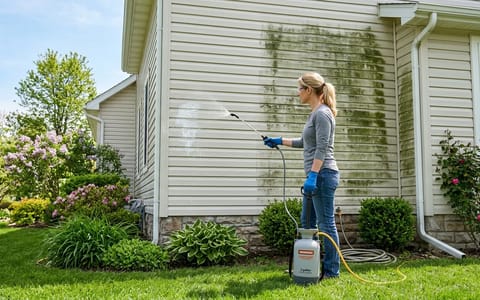
- Apply the cleaner from bottom to top. Using your pump sprayer, apply the soapy mixture starting at the bottom of the wall and working your way up. Applying from the bottom up prevents the dirty runoff from creating permanent streaks on the dry siding below.
- Let it dwell. This is the most important step. Allow the cleaning solution to sit on the siding for 10 to 15 minutes. You will actually see the green algae turn brown or yellow as the chemistry breaks it down. Do not let the solution dry; mist it with a little more water if it starts to evaporate.
- Agitate stubborn spots. If you have heavy mud splatters or thick moss, use your soft-bristle brush on an extension pole to gently scrub the area. Let the brush do the work; you do not need to scrub aggressively.
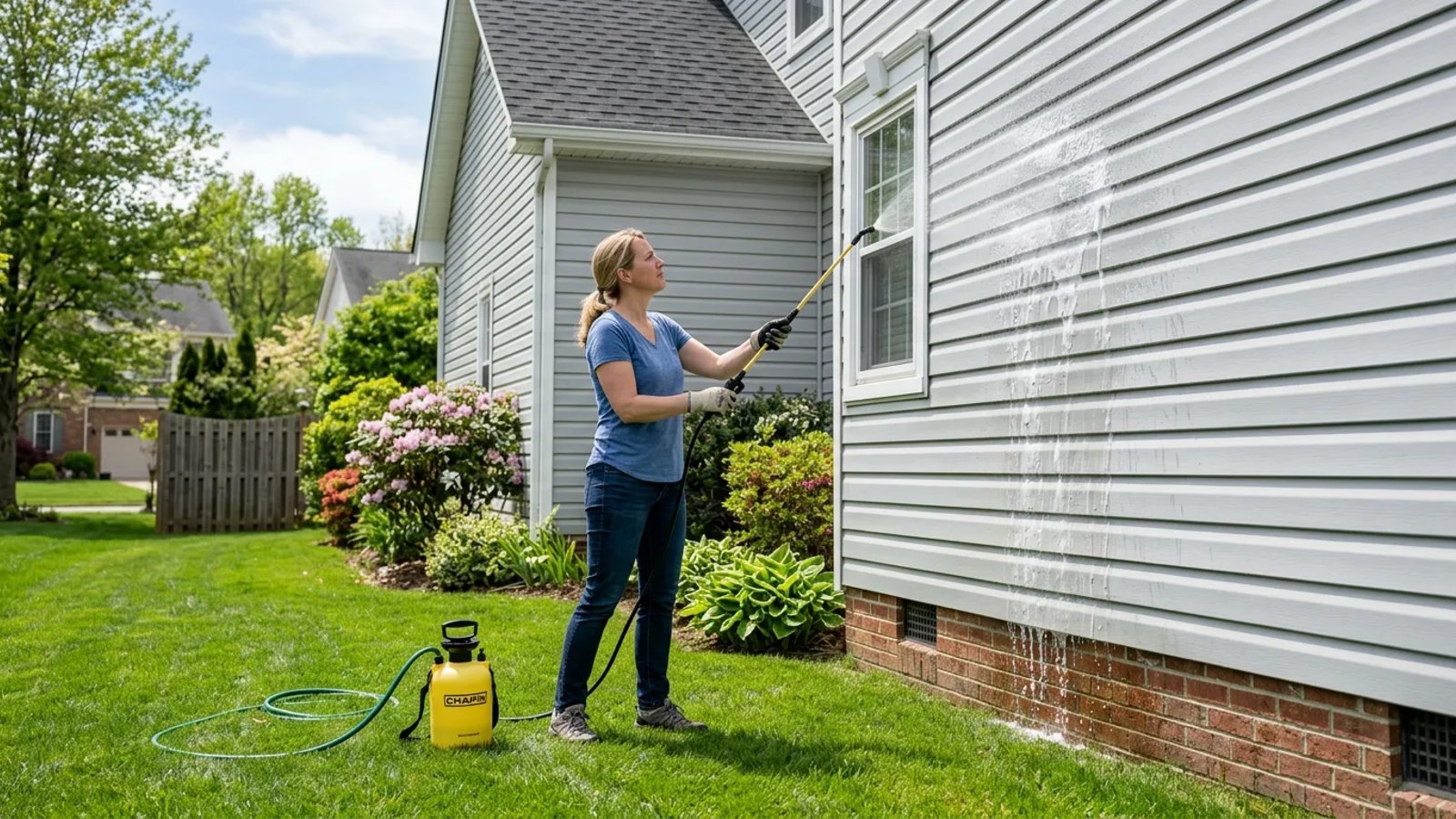
- Rinse from top to bottom. Grab your garden hose and rinse the section starting at the very top and working your way down. Crucial rule: Always angle your spray downward. Never point the hose upward into the overlapping seams or under the bottom edges, as this will force water behind the panels.
Knowing When to Put the Wand Down
Soft washing a standard single-story ranch or the lower level of a two-story home is a highly rewarding weekend project. I remember a neighbor who tried to clean his entire two-story colonial with a pressure washer while standing on a wobbly aluminum ladder. He ended up blowing a hole straight through his J-channel and nearly falling into his rose bushes. Do not be that guy.
Taking care of your vinyl siding the right way ensures it will protect and beautify your home for decades. By swapping out high pressure for a gentle soft wash, you are extending the life of your exterior, preventing hidden water damage, and keeping your home looking pristine for the seasons ahead. Keep up the great work around the house!