How to Reverse Your Ceiling Fan Direction for Summer
Learn how to reverse your ceiling fan direction for summer to create a cooling wind-chill effect, improve room comfort, and significantly lower your seasonal AC bills.
The first truly warm days of the year often prompt a familiar household ritual: walking into a stuffy room, reaching up, and yanking the ceiling fan pull chain. But instead of a refreshing breeze, you might find that the room feels just as stagnant as before, despite the blades spinning at full speed. The problem is rarely a failing motor or a weak air conditioning system. More often than not, the culprit is simply the fan's directional setting.
Learning how to reverse ceiling fan direction is one of the quickest, most effective ways to optimize your home's cooling system for the warmer months ahead. During the winter, your fans were likely set to run clockwise to gently push trapped warm air down from the ceiling. When the weather heats up, they need to run counterclockwise. This simple, five-minute task can dramatically improve your indoor comfort and significantly reduce your seasonal energy bills.
The Aerodynamics: Why Fan Direction Matters
To understand why this small adjustment makes such a massive difference, we have to look at the simple physics of airflow. Ceiling fan blades are not flat; they are set at an angle, known as the blade pitch, which typically ranges from 12 to 15 degrees. This pitch allows the blades to scoop and move air as they rotate.
When a fan spins counterclockwise (the summer setting), the leading edge of the angled blade scoops the air and forces it directly downward. This creates a concentrated column of moving air that hits the floor and spreads outward. While this moving air does not actually lower the ambient temperature of the room by a single degree, it creates a powerful wind-chill effect on your skin. The breeze accelerates the evaporation of natural moisture on your body, making the room feel up to 4 degrees cooler than the thermostat reads.
Conversely, when the fan spins clockwise (the winter setting), the blades pull air upward toward the ceiling. This creates a gentle updraft that displaces the warm air naturally trapped near the ceiling, forcing it down the walls and back into the living space without creating a drafty breeze. Leaving your fan on this winter setting during a hot day will completely neutralize the cooling effect you are looking for.
First Things First: Clean Before You Switch
Before climbing a ladder to hunt for the directional switch, complete one crucial preparatory step. Over the winter months, as your fan spun clockwise on low speed, the leading edges of the blades quietly collected a thick layer of household dust, pet dander, and airborne grease.
I remember the first time I tried flipping the switch on my living room fan without cleaning it first. A winter's worth of accumulated gray fuzz immediately rained down onto my freshly vacuumed rug and upholstery. Because the fan will be moving air in a completely new direction, any loose debris will be instantly dislodged.
For fans in kitchens or dining areas, the dust is often bound to the blades by aerosolized cooking oils. In this case, a dry pillowcase will not be enough. You will need to spray a microfiber cloth with a mild all-purpose cleaner or a mixture of warm water and a few drops of dish soap. Wipe each blade down thoroughly, taking care not to apply too much downward pressure, which can bend the blade brackets and cause the fan to wobble later.
Step-by-Step: How to Reverse Ceiling Fan Direction
Once the blades are perfectly clean, you are ready to make the switch. The exact method you use will depend entirely on the age and style of your ceiling fan.
- Turn off the power completely. Never attempt to reverse a fan while it is in motion. Turn off the wall switch and wait for the blades to come to a complete, dead stop. This protects both your fingers and the fan's internal motor gears.
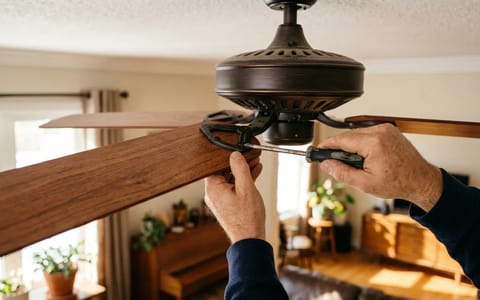
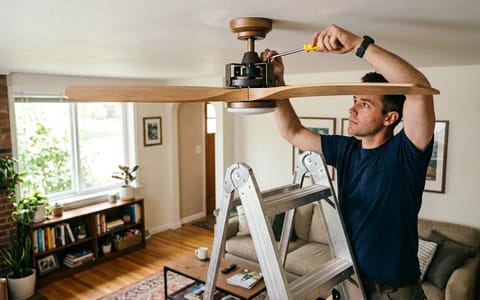
- Locate the directional switch. For traditional AC motor fans, look for a small black or metallic toggle switch on the side of the motor housing, usually located just above the light fixture. If your fan has a remote control or is a smart device, the reverse function will be a button on the remote (often indicated by two curved arrows) or a toggle within the smartphone app.
- Flip the switch. If the toggle switch is vertical, push it DOWN for summer (counterclockwise). If the toggle switch is horizontal, push it to the LEFT for summer. Ensure the switch clicks firmly into place; if it is stuck in the middle, the fan will not turn on.
- Test the rotation. Turn the power back on and set the fan to its lowest speed. Stand directly underneath it and look up to verify the direction.
Automating Your Comfort with Smart Tech
As of 2026, the widespread adoption of unified smart home standards like Matter means you might not even need to think about manually reversing your fan. Modern DC-motor smart fans can automatically switch directions based on your smart thermostat's seasonal mode. If you have a connected home setup, check your app settings to link your fan's rotation to your cooling system. This ensures your fan always spins counterclockwise the moment your air conditioning kicks in for the season.
Verifying the Spin: Which Way is Counterclockwise?
It sounds simple, but staring up at a spinning object can sometimes play tricks on your eyes, making it difficult to determine which way it is actually rotating. To verify you have successfully reversed your ceiling fan direction, stand directly beneath the center of the fan and look straight up.
Watch a single blade as it passes the front of your field of vision. The blade should be moving from your top right across to your top left. If you imagine the face of a clock on the ceiling, the blades should be sweeping backward from 12, to 9, to 6. More importantly, when the fan is turned up to medium or high speed, you should immediately feel a strong, direct breeze hitting your face and shoulders.
Turning Airflow Into Energy Savings
The primary reason homeowners want to reverse ceiling fan direction is to stay cool, but the secondary benefit is the substantial financial savings. However, a ceiling fan alone does not save energy. In fact, running a 75-watt ceiling fan continuously will only add to your electricity bill. The savings come entirely from how you interact with your home's central air conditioning system.
Because the counterclockwise rotation creates a wind-chill effect that makes you feel up to 4 degrees cooler, you can safely adjust your thermostat upward without sacrificing an ounce of comfort. If you normally keep your home at 72 degrees in the summer, you can bump the thermostat up to 76 degrees as long as the ceiling fans are running in the rooms you are occupying.
As of 2026, the Department of Energy notes homeowners can save roughly 1% to 3% on their cooling costs for every degree they raise the thermostat during the summer. By utilizing your ceiling fans effectively, you could potentially shave 10% or more off your monthly AC bill. Over the course of a four-month cooling season, that simple flip of a toggle switch translates to real money kept in your wallet.
Ceiling fans cool people, not rooms. Running a fan in an empty room is like leaving the lights on when nobody is home.
Troubleshooting Common Fan Issues
Sometimes, reversing the direction of an older fan can reveal hidden maintenance issues. Because the motor is now generating torque in the opposite direction, components that were perfectly settled in the winter configuration might suddenly protest.
The most common issue is a new, noticeable wobble. When a fan wobbles, it is usually because the blades are slightly out of balance or the screws connecting the blades to the motor irons have vibrated loose. Grab a Phillips-head screwdriver and gently tighten every visible screw on the blade brackets and the light kit. If the wobble persists, you can purchase a blade balancing kit, which carries a typical 2026 price of $6 to $8 at local hardware stores. These kits use small, weighted adhesive clips that you attach to the top of the offending blade to smooth out the rotation.
You might also hear a faint clicking or ticking sound after reversing the fan. This is often caused by the pull chains swaying and tapping against the glass light globes in the downward breeze. Shortening the chains or installing heavier decorative pulls will usually solve the problem instantly.
Taking a few moments to clean your blades and reverse your ceiling fan direction is a minor maintenance chore with a major payoff. By ensuring your fans are pushing air downward, you will maximize your home's airflow, ease the heavy burden on your air conditioning unit, and keep your living spaces perfectly comfortable all summer long. Just remember to flip the switch back when the autumn chill returns.