How to Secure Furniture Without Drilling in a Rental
Protect your newly mobile toddler and your security deposit. Learn the safest ways to secure heavy furniture and TVs in a rental apartment using heavy-duty adhesives, strategic placement, and minimal-damage anchors.
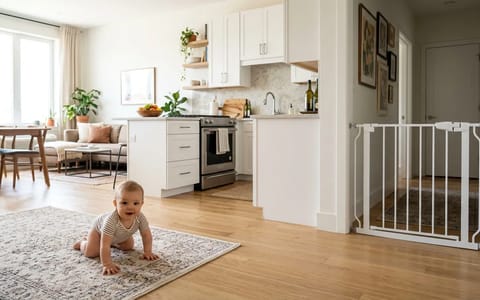
Renters face a tough spot when babies start pulling up on things. You desperately want to secure furniture without drilling to keep your child safe from falling dressers and wobbly bookshelves, but your lease specifically forbids drilling large holes into the wall studs. It is a stressful balancing act between protecting your newly mobile toddler and protecting your security deposit.
When my oldest started walking in our rented duplex, I tested three different adhesive anchor kits on a spare piece of drywall. I quickly learned that surface preparation is the difference between an anchor that holds firm and one that peels off with a light tug. You do not have to choose between safety and your deposit. You just need to understand the physics of tipping and the exact materials that landlords tolerate.
Navigating Your Lease: Rules for Anchoring Furniture in a Rental
Before you buy any supplies, you need to know exactly what your property manager allows regarding anchoring furniture in a rental. Most standard lease agreements include a "no alterations" clause, which typically bans structural changes and large wall holes. However, many local tenant rights laws protect your ability to baby-proof your home, sometimes overriding strict lease clauses.
If you are unsure, send a quick email to your landlord. Explain that you are anchoring furniture in a rental unit to comply with current child safety guidelines. Offer to use minimal-damage methods or promise to patch any holes professionally before moving out. Getting this permission in writing often eliminates the worry of losing your deposit, allowing you to focus completely on safety. As of 2026, many property management companies charge between $50 and $150 per drywall hole if they have to patch and paint it themselves, making proactive communication essential.
Why Are Traditional Anchors a Problem for Renters?
According to the U.S. Consumer Product Safety Commission's Anchor It! campaign, a child is injured by falling furniture or a falling TV every 46 minutes. The standard advice is simple: find a wall stud, drill a pilot hole, and drive a 2-inch lag screw through a heavy-duty bracket. This creates an unbreakable bond.
But in a rental apartment, finding a stud isn't always possible where you want to place the furniture. Worse, driving thick lag screws leaves half-inch holes in the drywall. Many property management companies explicitly ban this in the lease agreement, threatening to withhold hundreds of dollars from your deposit for wall repairs. Because of this, many parents simply skip anchoring altogether, hoping for the best. That is a risk you do not have to take.
Comparing the Best Furniture Anchors for Renters
When you start shopping for furniture anchors, the options can feel overwhelming. To make the best choice for your rental space, you need to match the specific anchor type to the weight of your furniture and your wall material.
- Adhesive Furniture Anchors: Best for lightweight items under 20 pounds, such as small nightstands or hollow-core bookcases. They use industrial VHB tape and require zero tools, but they can peel paint if applied incorrectly. As of 2026, a reliable high-strength adhesive kit costs between $15 and $25.
- Minimal-Damage Steel Hooks: Perfect for medium-weight furniture up to 50 pounds. These push-pin style hooks curve behind the drywall and leave a microscopic hole. They are the best middle ground for renters, typically running $10 to $15 for a multi-pack.
- Tension Rods: These vertical poles wedge between the top of a sturdy bookcase and the ceiling. They handle over 100 pounds of tipping force and are great for tall, heavy bookcases, but they do not work on vaulted ceilings or short dressers. Expect to pay $30 to $60 per rod in current 2026 hardware markets.
- Traditional Anti-Tip Straps: Best for heavy, solid-wood dressers over 50 pounds. These require finding a stud and drilling a pilot hole. If your landlord insists on safety first, this is the gold standard. Steel cable versions have largely replaced nylon straps in 2026 safety standards and usually cost around $20.
How to Choose the Right Furniture Anchors for Your Space
Typing "furniture anchors" into a search engine yields thousands of results, making it difficult to know which product actually works. Choosing the right anchor comes down to three concrete factors: the weight of your furniture, your wall material, and the depth of your baseboards.
First, weigh your furniture mentally. Is it a 15-pound particleboard shelf or an 80-pound solid oak dresser? Adhesives fail on heavy oak, while heavy-duty steel cables are overkill for a tiny shelf. Second, test your wall material. Find a hidden spot near the floor and push a standard thumbtack into the wall. If it slides in easily, you have standard drywall, which is perfect for minimal-damage steel hooks. If the pin bends and refuses to enter, you likely have plaster or brick walls. Plaster walls instantly rule out push-hooks and make adhesive anchors your most viable no-drill option.
Finally, measure your baseboards. If your baseboards are thicker than one inch, your furniture will sit far away from the wall. You will need furniture anchors with adjustable straps or extra-long steel cables to bridge that wide gap safely.
Can You Secure Furniture Without Drilling?
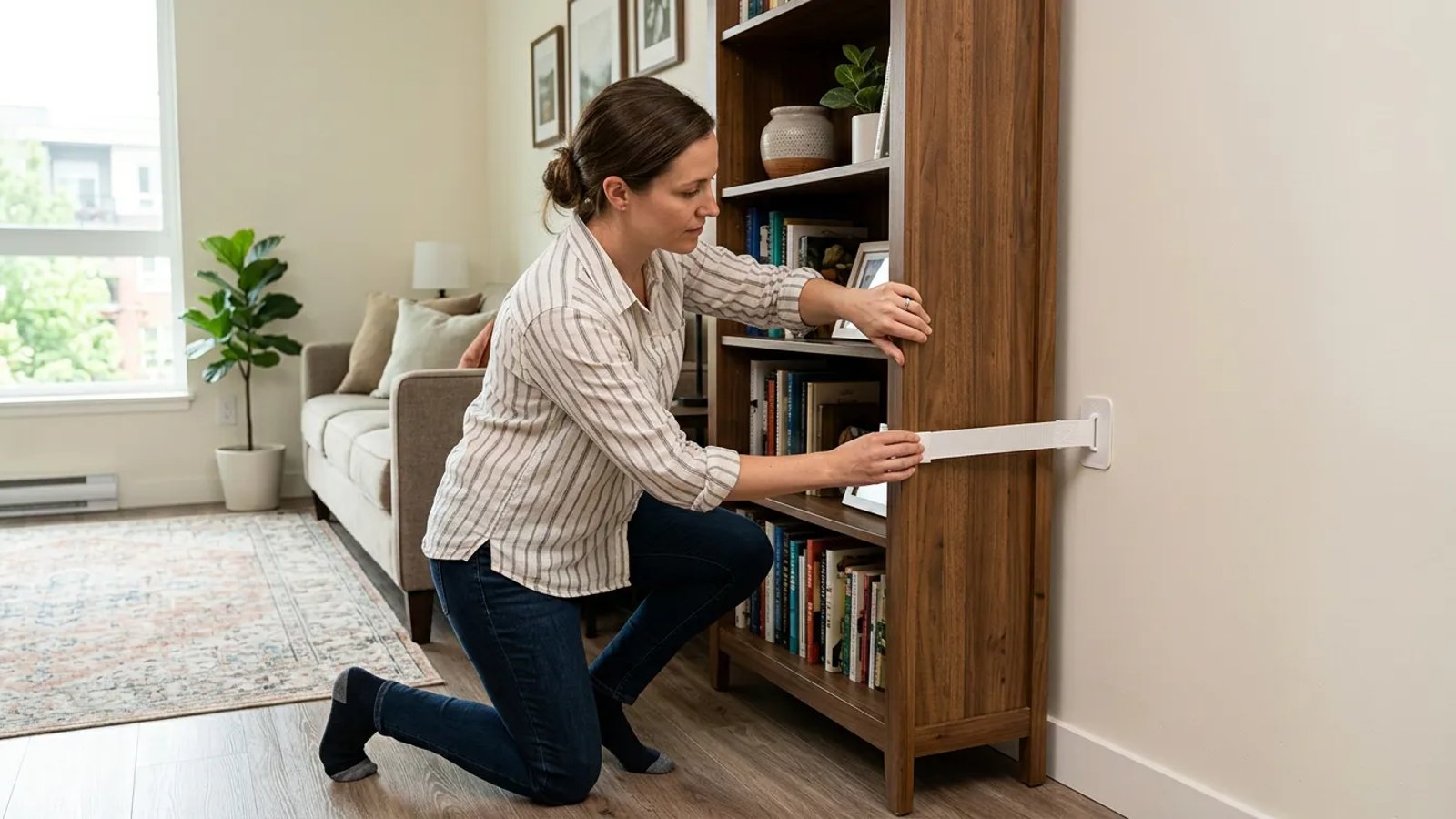
Yes, you can secure furniture without drilling large, damaging holes, but you have to manage your expectations. When we talk about "no-drill" anchoring, we are primarily talking about high-strength adhesive straps. These products use industrial double-sided foam tape, typically 3M VHB (Very High Bond), often rated to hold several pounds per square inch, to stick a plastic anchor pad to the wall and another to the furniture.
Adhesives have high shear strength, meaning they resist sliding down the wall very well. However, they have lower peel strength. If a 40-pound toddler hangs from the top drawer of a heavy dresser, the force pulls the adhesive directly away from the wall. If the wall is textured, or if the paint is old and flaking, the adhesive might hold, but the paint itself will rip right off the drywall paper, bringing the anchor down with it.
How to Apply Adhesive Anchors for Maximum Hold
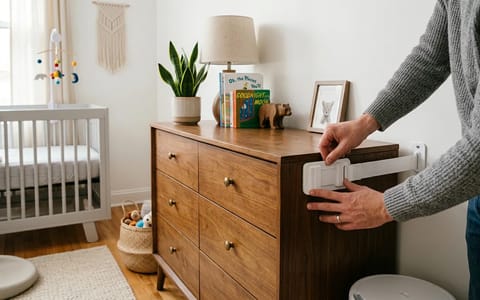
If you are using adhesive straps for lighter furniture, the application process dictates whether the anchor will succeed or fail. You cannot simply wipe the wall with a paper towel and stick the pad on.
- Clean the wall with isopropyl alcohol. Standard household cleaners leave a slippery residue. Wipe the wall and the back of the furniture with 70% rubbing alcohol and let it dry completely for at least 10 minutes.
- Mark your placement carefully. Once VHB tape touches the wall, it bonds instantly. Use a pencil to mark exactly where the wall pad should go. Keep it hidden just below the top line of the furniture.
- Press firmly for 60 seconds. The adhesive is pressure-sensitive. Pressing hard forces the microscopic glue particles into the pores of the paint.
- Wait 72 hours before attaching the strap. Do not connect the furniture to the wall immediately. The adhesive needs three full days to reach 100% of its holding strength.
To remove these pads when you move out, do not pull them. Heat the plastic pad with a hair dryer on high for two minutes to soften the glue. Then, take a piece of dental floss, slip it behind the pad, and saw back and forth through the foam. You can roll the remaining adhesive off the wall with your thumb.
Strategic Placement: Letting Gravity Do the Work
Before you even apply an anchor, you can drastically reduce the tip-over risk by changing how the furniture sits in the room. The goal is to move the center of gravity as low and as far back as possible.
Gravity is your first line of defense. Load the heaviest items in the bottom drawers to shift the center of mass toward the floor.
First, always put heavy items, like winter sweaters, thick blankets, and books, in the bottom drawers or lowest shelves. Keep lightweight items like socks and diapers at the top. Second, look at your baseboards. Thick baseboards push the bottom of a dresser away from the wall, creating a natural forward lean. To counter this, slide a few wooden shims or heavy rubber furniture pads under the front legs. This tilts the furniture slightly backward against the wall, forcing a child to pull significantly harder to tip it forward.
The Ultimate Fallback: Minimal-Damage Anchors
If you have a heavy, solid-wood dresser, adhesives are not enough. But you still do not need to drill massive holes. The best compromise for renters is using minimal-damage wall anchors. These are specialized steel hooks or pins that push through the drywall and curve upward behind it, locking into place without needing a wall stud.
Brands like Monkey Hooks or Hercules Hooks leave a hole that is only 1/16 of an inch wide, which is roughly the size of a pushpin. Standard residential drywall is typically 1/2-inch thick, which is exactly what these hooks are designed to grip. Because they leverage the back of the drywall, a single hook can hold up to 50 pounds of shear weight. You can loop a heavy-duty zip tie or a steel cable through the eyelet of the hook and attach the other end to the back of your dresser.
When it is time to move out, you simply pull the hook out. The tiny pinhole can be filled with a single dab of lightweight spackle on the tip of your finger. Wipe away the excess with a damp rag, and the hole completely vanishes. Landlords are looking for large drywall blowouts, not microscopic pinholes.
What About Securing Flat-Screen TVs?
Modern TVs are incredibly light, which makes them easy to tip over if a toddler bumps the media stand. If your lease prohibits wall-mounting a TV, you have two safe options.
The first is to buy a third-party VESA tabletop stand. The flimsy plastic feet that come in the box with most TVs are practically useless. A heavy-duty aftermarket stand bolts directly into the mounting holes on the back of the TV (check your manual for the exact VESA pattern, typically 200x200 or 400x400 millimeters) and features a wide, heavy tempered-glass base that is very difficult to tip.
The second option is to use nylon anti-tip straps. Instead of attaching the straps to the apartment wall, bolt one end to the back of the TV and screw the other end directly into the solid wood back of your media console. You own the media console, so you can drill into it safely. This secures the TV to a heavy base, completely bypassing the rental walls.
Common Mistakes When Anchoring Furniture in a Rental
Even with the best intentions, anchoring furniture in a rental can go wrong if you skip crucial steps. Avoid these common pitfalls to ensure your safety measures actually hold up under pressure.
The most frequent mistake is relying on a single anchor. Always use at least two furniture anchors per piece of furniture, placing them toward the outer edges rather than clustering them in the center. This prevents the furniture from twisting or pivoting if a child pulls on one side.
Another major error is attaching anchors to flimsy backing materials. Never screw an anti-tip strap or stick an adhesive pad onto the thin cardboard or hardboard backing of a bookcase. That material will instantly rip out under a child's weight. Always attach your furniture anchors directly to the thick, solid wood frame at the top of the unit.
Patching Up on Move-Out Day
Living in a rental does not mean compromising on your child's safety. By combining smart physics, like bottom-loading your drawers, with high-quality adhesives for light items and pin-sized hooks for heavy dressers, you can make your apartment incredibly safe. Keep a small $5 tub of pink-to-white spackle in your closet. On the day you hand your keys back, spend ten minutes dabbing those tiny holes. Your child stays safe, and you get your full deposit back.
- Surface preparation is everything; standard household cleaners leave a residue that causes adhesive anchors to fail.
- Adhesive anchors rely on peel strength, meaning they are best suited for preventing a tip, not supporting the full climbing weight of a child.
- A 1/16-inch hole from a heavy-duty wire hook anchor takes 30 seconds to patch and is rarely noticed by landlords during move-out inspections.
- Always check your baseboards; thick baseboards can push furniture away from the wall, increasing the tipping leverage.