How to Soundproof a Home Office Door (Without Replacing It)
Struggling with household noise while working from home? Learn how to soundproof your home office door using cheap, high-impact DIY fixes that block air gaps and add mass.
Full guide Interior: Paint, Drywall & Trim Learn how to patch drywall, choose the right paint, and update your interior trim.Working from home is tough when you hear every conversation, television show, and dog bark in the living room. For those needing a quieter workspace, learning how to soundproof home office door is a highly effective solution. When household noise bleeds into a workspace, most people immediately blame thin drywall. However, nine times out of ten, the real culprit is right in front of you: the office door.
Standard interior doors are built for privacy, not acoustics. They are lightweight, hollow, and installed with visible edge gaps. Before spending hundreds of dollars ripping out the frame for a heavy, solid-core door, you can tackle the problem using inexpensive materials. The secret to a quiet workspace is understanding how sound travels and systematically cutting off its pathways.
Why Does Sound Leak Through Closed Doors?
To fix a noise problem, treat sound like water. Even a tiny 1/16-inch gap lets a surprising amount of noise through. If water can flow through a crack, sound waves can travel through it. Airborne noise, like voices, music, and typing, rides on air currents.
Look at your closed office door. You likely have a 1/2-inch to 3/4-inch gap at the bottom to allow for carpet clearance and HVAC air circulation. You also have a 1/8-inch gap running up the sides and across the top of the door jamb. If you combined all those tiny perimeter gaps into a single opening, it would equal a hole in your wall roughly the size of a standard brick. You would never expect a room to be quiet with a brick-sized hole in the wall, yet that is exactly what a standard interior door provides.
If air can get through a gap, sound will ride right along with it. Block the air, and you block the noise.
To soundproof a home office door effectively, you must do two things: seal the air gaps to stop airborne noise, and add mass to the door to stop impact noise and low frequencies.
Soundproof Home Office Door: Sealing the Perimeter
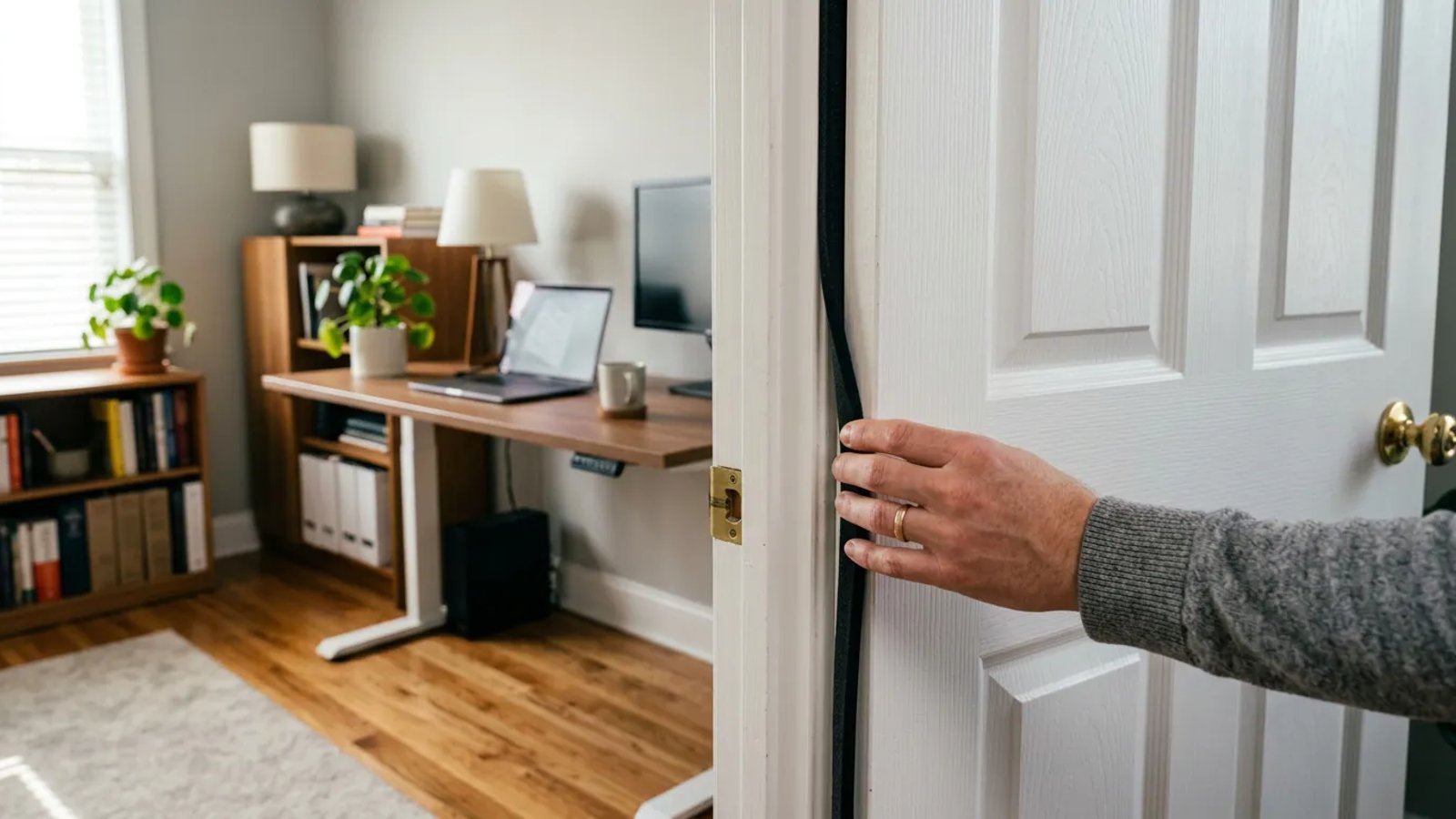
The fastest way to drop the decibel level in your office is to install weatherstripping around the door jamb. Use high-density, closed-cell foam tape or a silicone bulb seal. Avoid open-cell foam; it feels like a cheap sponge and allows air to pass right through it.
While weatherstripping is typically used for exterior doors to stop drafts, the latest 2026 Energy Star guidelines for weatherstripping apply perfectly to interior soundproofing. A tight seal stops air movement, which in turn stops sound.
- Clean the door stop. The door stop is the thin strip of wood inside the jamb that the door rests against when closed. Wipe it down with rubbing alcohol and a rag to remove dust and finger oils. Let it dry completely.
- Measure and cut. Measure the top and sides of the door frame. Cut your weatherstripping to length using sharp scissors.
- Apply the seal. Peel off the adhesive backing a few inches at a time. Press the weatherstripping firmly against the door stop so that when the door closes, it slightly compresses the foam.
- Test the latch. Close the door. You should feel slight resistance, but the door should still latch securely. If you have to slam it, your foam is too thick.
How Do You Block the Bottom Gap?
The gap at the floor is the largest acoustic leak in the room. Sealing the sides of the door does little good if sound floods underneath it. You have two main options here, depending on your budget and whether you rent or own.
The Draft Stopper (Renter-Friendly): A slide-on draft stopper is a fabric or silicone sleeve that slips under the bottom of the door. It features two foam tubes (one on the inside and one on the outside) that hug the door and drag along the floor. As of 2026, they cost around $18 at most hardware stores, require zero tools to install, and block a surprising amount of high-frequency noise.
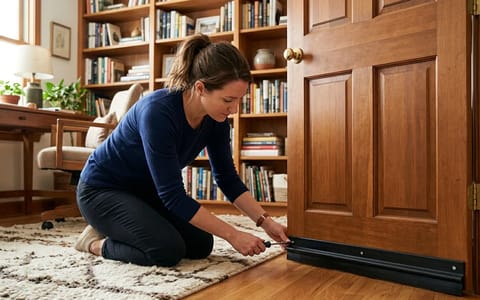
The Drop-Down Door Sweep (Pro-Level): For a cleaner look and better performance, install a surface-mounted drop-down sweep. This is a metal track you screw into the bottom of the door. It contains a hidden rubber seal on a spring mechanism. When the door is open, the seal lifts up so it does not drag on your floor. When you close the door, a plunger hits the door frame, dropping the heavy rubber seal tightly against the floor.
Adding Mass to a Hollow Core Door
Most interior doors are "hollow core." They consist of a cardboard honeycomb structure sandwiched between two thin sheets of wood veneer. Because they lack density, they act like a drum, picking up sound waves from the hallway and vibrating them right into your office.
To stop this, you need to add mass. When I soundproofed my own home office in 2025, I tested a heavy velvet blackout curtain hung on a tension rod mounted just inside the room. The thick, dense fabric absorbed the mid-range frequencies beautifully, dropping the sharp noise of my kids playing in the hallway down to a dull, easily ignored mumble. It cost about $40, took five minutes to put up, and I can pull it aside when I don't need it.
If you prefer a permanent solution, you can mount acoustic panels or mass loaded vinyl (MLV) directly to the back of the door. MLV is a heavy, flexible material used in recording studios and industrial soundproofing. Cutting a sheet of MLV to size and stapling it to the room-facing side of your door will dramatically increase its density. You can then cover the industrial-looking black vinyl with a nice fabric or lightweight wood trim.
New for 2026: Peel-and-Stick PET Felt Panels
If mass loaded vinyl sounds too industrial, 2026 has brought a surge in affordable, eco-friendly PET felt acoustic panels. Made from recycled plastics, these lightweight hexagonal or square tiles stick directly to your door using heavy-duty adhesive. While they do not block heavy impact noise as effectively as MLV, a typical 2026 range of $40 to $70 will cover the back of a standard door, significantly cutting down on high-frequency hallway chatter and reducing room echo.
How Can You Test the Seal?
Once you install your weatherstripping and door sweep, it is time to test your work. Acoustic professionals use specialized equipment, but you can get a highly accurate reading using just your smartphone.
Wait until evening, or close your office blinds. Turn off all the lights inside your home office so the room is pitch black. Have someone stand out in the hallway with a bright LED flashlight and slowly trace the perimeter of the closed door.
Stand inside the dark office and look for light leaks. If you see a beam of light shooting through a corner of the door jamb or underneath the sweep, that is exactly where sound is getting in. Readjust your weatherstripping in those specific spots until the light is completely blocked.
You do not need a professional recording studio to have a productive workday. By focusing purely on the air gaps and adding a bit of strategic weight to your door, you can create a quiet, focused environment without tearing your house apart.
- Treat sound like water: if light or air can get through a gap, noise will follow.
- You can cut office noise significantly just by weatherstripping the door frame and sealing the bottom gap.
- Hollow-core doors act like drums. Adding a heavy blackout curtain is a cheap, renter-friendly way to deaden the sound.
- Test your work by turning off the office lights and having someone shine a flashlight around the closed door from the hallway.