How to Turn On Your Sprinkler System Safely This Spring
Ready to water your lawn this spring? Learn how to safely turn on your sprinkler system without causing water hammer or expensive underground leaks.
Full guide Landscaping, Drainage & Outdoor Master your yard with simple tips for proper drainage, healthy lawns, and safe trees.As spring temperatures climb and the ground thaws, your lawn begins waking up from winter dormancy. With summer heat approaching, grass demands consistent watering to establish deep, drought-resistant roots before scorching weather arrives. Naturally, many homeowners rush outside on the first sunny weekend to reactivate their irrigation systems, eager to restore their yards to peak condition.
However, bringing an irrigation system out of hibernation requires patience. Well-meaning homeowners often throw the main water valve wide open, assuming the system is ready. Unfortunately, this split-second action frequently results in a loud bang, blown underground fittings, and a flooded yard. To turn on your sprinkler system safely, you must understand water pressure mechanics and take a methodical approach to pressurizing your lines.
The Hidden Danger of Water Hammer
To understand why a slow startup is critical, look at what happens inside your irrigation pipes during winter. When you or a professional winterized your system last fall, all the water was blown out of the underground PVC and poly pipes using an air compressor. Right now, those pipes are completely empty.
Water is heavy, dense, and incompressible. Municipal water supplies typically feed into residential homes at a pressure ranging from 40 to 80 PSI (pounds per square inch). If you open your main irrigation valve all at once, a solid wall of highly pressurized water rushes into those empty pipes at top speed. Because air compresses and water does not, the water accelerates rapidly until it hits a closed zone valve, an elbow joint, or a sprinkler head.
When that wall of water suddenly stops, the kinetic energy has nowhere to go. This creates a massive shockwave known as a "water hammer."
Opening an irrigation valve too quickly sends a wall of water crashing into empty pipes at 60 PSI, turning your sprinkler lines into an underground explosion.
A severe water hammer can easily shatter PVC joints, blow off sprinkler heads, and crack expensive brass backflow preventers. A single shattered manifold can result in a repair bill in the typical 2026 range of $450 to $1,000, not to mention the cost of the water flooding your yard and the time spent digging up mud. I learned this the hard way a few years ago when I let a helpful neighbor open my main valve while I was checking the controller. We spent the rest of the weekend digging up a shattered PVC manifold in the mud.
Step 1: Locate Your Hardware and Close the Drains
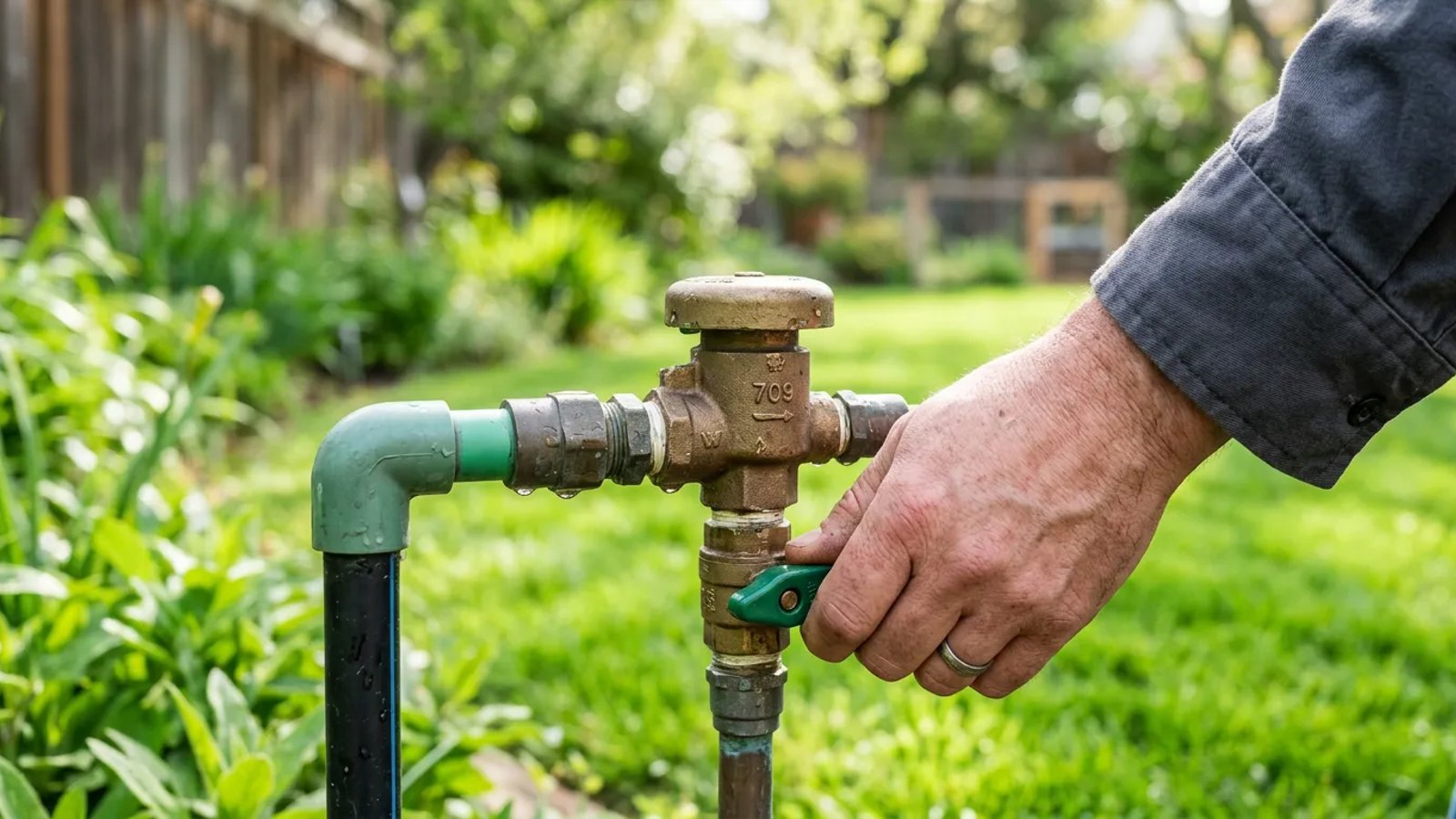
Before you touch the main water supply, you need to prepare the exterior plumbing. Your irrigation system connects to your home's main water line, usually passing through a backflow preventer. This device, often a Pressure Vacuum Breaker (PVB) or a Reduced Pressure Zone (RPZ) assembly, prevents contaminated yard water from siphoning back into your home's drinking water.
During the winterization process, the manual drain valves on the backflow preventer are usually left open at a 45-degree angle to prevent trapped water from freezing and cracking the brass housing. If you turn the water on while these are open, you will instantly get a face full of high-pressure water.
Take a flathead screwdriver and locate the small test cocks (bleed screws) on the side of the backflow preventer. There are usually two or four of them. Turn the slotted screw heads so they are perpendicular (at a 90-degree angle) to the nozzle opening. This indicates they are fully closed.
Next, check the two large ball valves on the backflow preventer itself. One is located on the pipe bringing water into the device, and the other is on the pipe leading out to your yard. Ensure both of these handles are turned perpendicular to the pipe, meaning they are closed. Finally, check your basement or utility room for the indoor shutoff valve. If there is a small drain cap or petcock near the indoor shutoff, make sure it is tightly closed as well.
Step 2: Pressurizing the Main Line Safely
With all drains sealed, you are ready to introduce water into the system. Patience is mandatory here. The goal is to let water trickle into the empty pipes slowly, allowing trapped air to escape gradually without causing a shockwave.
- Open the indoor valve slowly. If your main shutoff is indoors, turn the handle incredibly slowly. If it is a gate valve (a round knob), turn it counter-clockwise one full rotation and wait. If it is a ball valve (a lever), turn it just slightly off the perpendicular position.
- Listen for the water. You will hear a hissing or rushing sound as water begins to flow through the pipes toward the backflow preventer. Wait completely until this sound stops. It may take a minute or two.
- Open the indoor valve fully. Once the sound stops, the pipe between your house and the backflow preventer is full and pressurized. You can now open the indoor valve the rest of the way.
- Move outside to the backflow preventer. Locate the first ball valve (the one closest to the water source). Turn the handle very slowly, stopping at a 45-degree angle. Again, listen for the rushing water. Wait until the sound stops.
- Open the first outdoor valve fully. Once the pressure equalizes, turn the handle parallel to the pipe.
- Repeat for the second outdoor valve. Turn the second ball valve (the one leading to the yard) to a 45-degree angle. This is the most critical step, as this valve feeds the entire underground main line. You will hear a significant amount of water rushing into the yard. Wait 3 to 5 minutes until the sound completely stops before turning the handle fully parallel to the pipe.
By taking 10 to 15 minutes to complete this process, you ensure that the water pressure builds up gradually, completely eliminating the risk of a destructive water hammer.
Step 3: Run a Manual Test Cycle
With the main line safely pressurized, water now waits at the individual zone valves buried in your yard. Next, test the system electronically at your irrigation controller.
Most modern controllers feature a "Manual Test" or "Test All Zones" setting. Run each zone sequentially for 2 to 3 minutes. This short duration is enough to purge remaining air from the lateral lines, pop the sprinkler heads up, and give you a visual read on system performance without wasting excess water.
As you start the first zone, you will likely hear sputtering, coughing, and hissing from the sprinkler heads. This is completely normal. It is simply trapped air escaping through the nozzles as water pushes in behind it. Within 30 to 60 seconds, the sputtering should stop, and a steady, even spray of water should emerge.
Step 4: Walk the Yard and Inspect for Damage
While the manual test cycle runs, you cannot stay in the garage. Put on a pair of waterproof boots and physically walk your yard, inspecting every single zone. Winter freezes, snowplows, and lawn aerators can cause significant damage to irrigation components.
As you walk the property, keep an eye out for three specific problems:
- Geysers: If a sprinkler head was sheared off by a snow shovel or lawnmower, water will shoot straight up into the air like a geyser. This wastes hundreds of gallons of water and drops the pressure for the rest of the zone. The broken head will need to be dug up and replaced.
- Bubbling water or swampy areas: If you see water bubbling up through the grass, or notice a section of the lawn feeling unusually spongy and saturated, you likely have a cracked underground lateral line. The water is escaping beneath the soil surface.
- Heads that fail to pop up: Sometimes, dirt and debris wash over the sprinkler heads during winter, preventing the internal spring from pushing the nozzle up. Pressing lightly on the top of the head with your foot can sometimes break the dirt seal. If it still won't rise, the head may be clogged or the internal seal may be blown.
Meeting 2026 Smart Irrigation Standards
As of 2026, many municipalities across the US and Canada have updated their water conservation codes, requiring EPA WaterSense-certified smart controllers for all active irrigation systems. If your controller is an older dial model, spring is the perfect time to upgrade. Modern smart controllers automatically adjust watering schedules based on real-time local weather data, keeping your lawn healthy while ensuring you remain compliant with strict new drought restrictions.
Step 5: Adjusting Sprinkler Heads for Efficiency
Once you have confirmed that the pipes are intact and the heads are functioning, the final step is fine-tuning the spray patterns. Over winter, freezing and thawing soil can shift the angle of your sprinkler heads. You want to ensure you are paying to water your grass, not your driveway, sidewalks, or the side of your house.
For standard pop-up spray heads, adjusting the direction is usually as simple as gripping the ribbed stem of the pop-up tightly with your fingers and twisting it left or right until the spray aligns with the edge of the lawn. If the head is spraying too far, look for a small metal screw in the center of the top nozzle. Turning this screw clockwise with a small flathead screwdriver will diffuse the water and reduce the spray distance.
For gear-drive rotors (the large heads that sweep back and forth across large areas), you will need a specific sprinkler adjustment tool or a small flathead screwdriver, depending on the brand (Hunter, Rain Bird, Toro). Insert the tool into the top of the rotor to adjust the right-side stop and the overall arc of the sweep. It takes a bit of trial and error, but spending 20 minutes adjusting your heads can save thousands of gallons of water over the summer.
Taking the time to safely pressurize your lines, inspect for winter damage, and dial in your spray patterns ensures your lawn will get the hydration it needs without the headache of unexpected plumbing repairs. A methodical spring startup sets the foundation for a healthy, green yard all season long.