Kitchen Sink Draining Slowly? How to Clear the Clog Fast
A slow-draining kitchen sink is frustrating, but you don't need harsh chemicals to fix it. Learn a simple, three-step DIY process to clear grease and food blockages safely.
Full guide Plumbing Learn how your home plumbing works and how to stop leaks before they ruin your house.You just finished cooking a heavy meal, the plates are stacked, and you turn on the tap to wash up. Within seconds, a pool of murky, gray dishwater is creeping up the sides of the basin. Finding your kitchen sink draining slowly is a common homeowner headache. The instinct is usually to panic or reach for industrial-strength drain cleaner. Stop right there. Pouring harsh chemicals down your pipes is often the worst thing you can do for your plumbing.
Chemical drain cleaners rely on volatile, heat-generating reactions to burn through blockages. While this sounds effective, the intense heat can warp plastic PVC pipes, destroy rubber gaskets, and accelerate corrosion in older metal plumbing. Worse, if the chemical fails to breach the clog, you are left with a basin full of toxic water that makes manual repairs dangerous.
Instead, we will walk through how to clear this blockage safely using simple physics and basic household tools. By following a step-by-step approach, you can restore your sink to perfect working order in under 15 minutes. This saves you a frustrating evening and a costly plumber call-out fee, which averages $175 to $200 as of 2026.
Understanding Why Your Sink is Backing Up
Before fixing the problem, you should understand what is happening underneath your countertop. Open your base cabinet and look inside. You will see a curved piece of pipe that dips down and comes back up before heading into the wall. This is the P-trap. Its primary job is to hold a small amount of water at all times. This water acts as a plug to prevent foul-smelling sewer gases from rising out of the drain and into your kitchen.
Because of its curved shape, the P-trap is the most common spot for clogs to form. When you wash dishes, liquid fats, oils, and grease wash down the drain. As soon as those fats hit the cooler pipes (usually around 60 to 70 degrees Fahrenheit), they congeal into a sticky paste along the pipe walls. This sticky layer acts like flypaper for other debris. Coffee grounds, food scraps, rice, and eggshells stick to the grease, creating a bottleneck over time.
When your kitchen sink drains slowly, the bottleneck has grown large enough to restrict water flow, though a tiny channel still exists. This is the perfect time to act before that channel closes completely.
Step 1: The Boiling Water and Baking Soda Flush
Since kitchen clogs are almost always organic matter held together by congealed grease, the logical first step is melting that grease. You do not need heavy machinery for this. You just need targeted heat and a mild abrasive. This method is highly effective for partial clogs and slow drains.
First, wait for the standing water in the sink basin to drain completely. If it takes an hour, let it take an hour. Once the basin is empty, pour half a cup of dry baking soda directly down the drain. Baking soda is a mild alkali that helps break down organic matter and acts as a gentle scrubbing agent.
Next, bring a full kettle of water to a rolling boil at 212 degrees Fahrenheit. Slowly and carefully pour the boiling water directly down the drain over the baking soda. Pour in stages to give the hot water time to work its way into the clog. The intense heat melts the congealed fats binding the clog together, while the baking soda scrubs the pipe walls clean.
Let the mixture sit for about five minutes, then run your hot water tap at full blast to see if the flow has improved. If the sink is still draining slowly, move on to the next step.
Step 2: How to Plunge a Double-Basin Sink Correctly
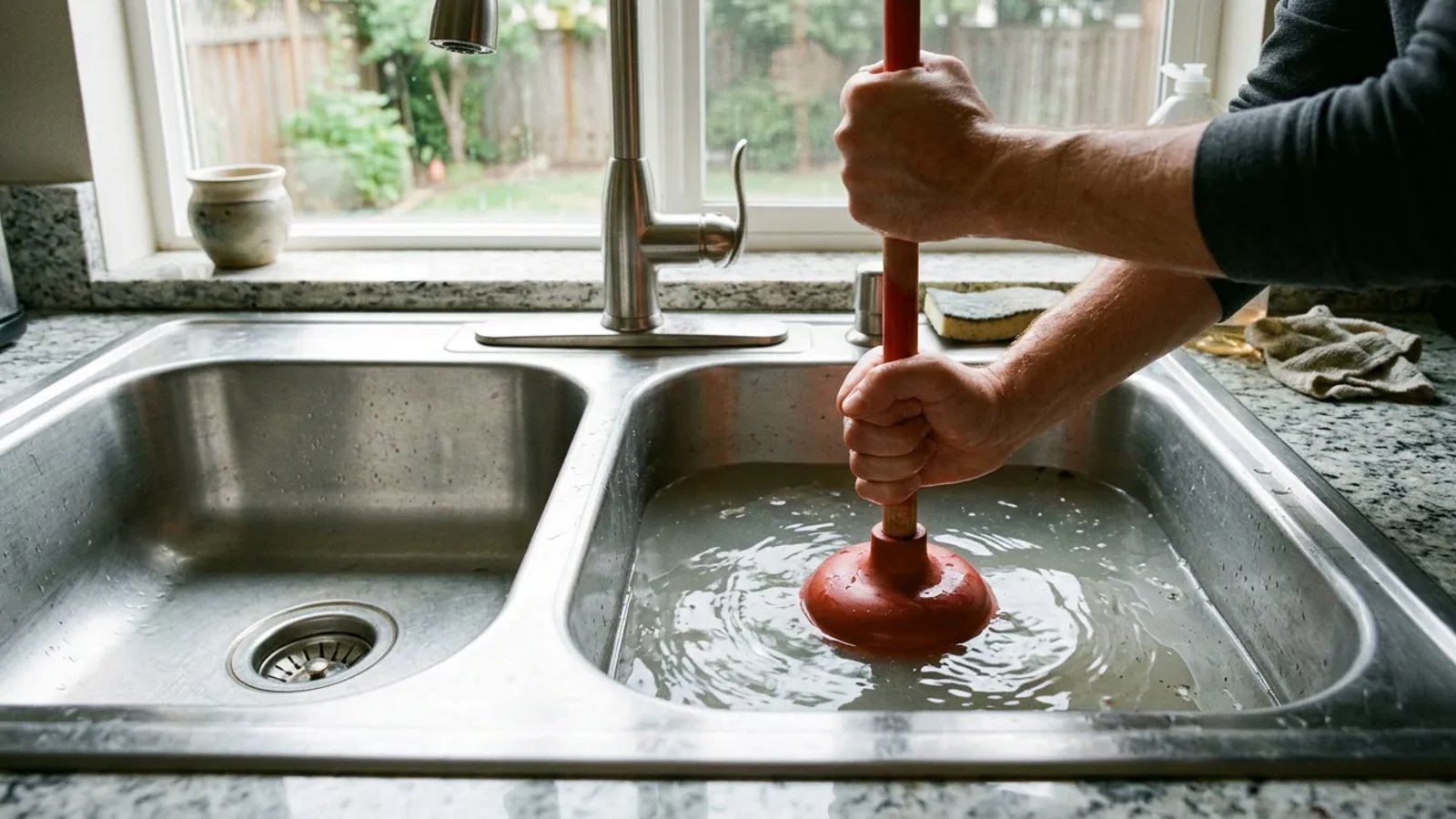
If melting the grease fails, you need physical force. Plunging uses hydraulic pressure to force the blockage back and forth until it breaks apart. However, plunging a kitchen sink is where most DIYers make a critical mistake, especially with a double-basin sink.
Because your plumbing system is connected, pushing down on one drain in a double sink forces air and water pressure out the second drain, bypassing the clog. To make a plunger work, you must create an airtight seal.
Take a wet dishcloth or rag and stuff it tightly into the second drain opening. If your sink has an overflow hole, plug that with a wet rag as well. You need all the pressure directed downward toward the P-trap.
The secret to effective plunging isn't just pushing hard; it's maintaining an airtight seal so the water does the heavy lifting.
Ensure you use the correct plunger. You want a standard cup plunger with a flat rubber bottom, not a flange plunger with a narrower rubber flap designed for toilets. Place the cup plunger over the drain, ensuring the rubber rim makes full contact with the sink basin. Run a few inches of water into the sink to cover the lip of the plunger. Water does not compress like air, so plunging with water transfers significantly more force to the clog.
Pump the plunger forcefully straight up and down 10 to 15 times while keeping the seal tight against the sink basin. On your final pump, pull the plunger up sharply to break the seal. If the water suddenly swirls and rushes down the drain, you successfully dislodged the blockage. Run hot tap water for a full two minutes to flush the broken debris into the main sewer line.
Step 3: Removing the P-Trap by Hand
If boiling water and plunging fail, the clog is likely a solid mass lodged tightly in the P-trap. Fortunately, modern plumbing is designed to be taken apart easily. You do not need to be a contractor. You just need a bucket, a towel, and perhaps a pair of slip-joint pliers if the fittings are tight.
I remember the first time I had to do this in my own home. I was nervous about causing a leak, but once I realized the P-trap is just held together by threaded plastic nuts, it took away all the intimidation. Plus, that same curve in the pipe once saved my wife's wedding ring from being lost to the city sewer system.
With your area prepped, follow these steps to manually clear the pipe:
- Locate the slip nuts. Find the two threaded rings holding the curved P-trap to the straight pipes above and behind it. These are usually made of white or black PVC plastic.
- Loosen the nuts. Turn the nuts counterclockwise to loosen them. In most cases, you can do this by hand. If they are stuck, gently use slip-joint pliers, being careful not to crack the plastic.
- Catch the water. As you loosen the nuts, the standing water trapped in the pipe will begin to leak out into your bucket. This is normal. Let it drain completely.
- Remove the trap. Once the nuts are fully unthreaded, pull the curved piece of pipe straight down and out. Take it to a trash can and use a wooden skewer, a butter knife, or a gloved finger to push out the compacted grease and debris.
- Clean and replace. Wash the P-trap out in a different sink or outside with a hose. Ensure the rubber or plastic washers are still in place on the pipe ends, then reattach the P-trap, hand-tightening the slip nuts securely.
Once reassembled, run the hot water tap. Check underneath the sink with a flashlight to ensure there are no drips coming from the slip nuts. If you see a drip, simply tighten the nut another quarter turn.
The Modern Alternative: Bio-Enzymatic Cleaners
If you prefer to avoid disassembling your plumbing, there is a safer chemical option. As of 2026, plumbing codes and professionals heavily favor bio-enzymatic drain cleaners over traditional caustic solutions. These modern cleaners use natural bacteria and enzymes to digest fats, proteins, and carbohydrates without generating dangerous heat. While they take longer to work than harsh chemicals, they are completely safe for all pipe materials, septic systems, and the environment. Pour a dose down the drain before bed and let the enzymes digest the clog overnight.
How to Prevent Future Kitchen Clogs
Now that your sink is draining perfectly, the goal is to keep it that way. The best defense against a slow-draining kitchen sink is a proactive offense. Prevention is simple and requires no special products.
First, change how you handle grease. Never pour cooking oil, bacon fat, or meat drippings down the drain. Instead, pour them into an old glass jar or a designated grease can. Once the grease solidifies, throw it in the household trash. Before washing greasy pots and pans, wipe them out thoroughly with a paper towel to remove the heavy residue.
Second, establish a weekly maintenance routine. Once a week, squirt a generous tablespoon of grease-cutting liquid dish soap directly into the drain. Follow this with a full kettle of boiling water poured slowly down the drain. The dish soap acts as an emulsifier, binding to the minor fat deposits that have accumulated over the week, while the boiling water flushes them safely out of your plumbing system before they can solidify into a problem.
By treating your drains with a little care and knowing how to tackle minor blockages with basic household items, you can keep your kitchen plumbing flowing smoothly year-round without ever needing to rely on damaging chemicals.