Whole House Low Water Pressure? How to Find the Cause Fast
Frustrated by a sudden drop in water flow? Learn how to troubleshoot whole house low water pressure by checking your main shutoff, PRV, and water meter before calling a plumber.
Full guide Plumbing Learn how your home plumbing works and how to stop leaks before they ruin your house.Turning on the shower and getting a sad, sputtering trickle is incredibly frustrating. Worse, if you walk to the kitchen sink and find the exact same problem, panic usually sets in. You start picturing burst pipes inside your walls or a plumbing bill that rivals a mortgage payment.
But before you call a contractor, take a breath. Sudden whole house low water pressure usually stems from a single, central chokepoint rather than a catastrophic plumbing failure. Most of the time, the fix is simple, takes less than ten minutes, and requires nothing more than a flashlight and an adjustable wrench.
I will walk you through the most common culprits. We will start with the easiest fixes and work our way up to slightly more technical checks, ensuring you do not spend money on a service call for a valve you could have turned yourself.
What Causes Whole House Low Water Pressure?
If only one faucet is acting up, the problem is localized. This usually points to a clogged aerator or a bad cartridge. But when the flow is weak everywhere, you have to look at the systems that feed the entire property. Water enters your home through a single main line, passes through a meter, a main shutoff valve, and usually a pressure regulator before branching out to your bathrooms and kitchen. Ideally, your home's water pressure should be between 50 and 70 psi.
Any restriction along this main entry path will drop the pressure for every fixture in the building. The most frequent offenders are valves that have been accidentally bumped, a failed regulator, or a hidden leak draining the pressure before it reaches your taps.
Step 1: Inspect the Main Water Shutoff Valve
This sounds almost too obvious, but it is the number one reason for a sudden drop in water flow. If you recently had a plumber out, or if someone was working in the basement, crawlspace, or utility closet, the main water shutoff valve might have been turned off and not fully reopened.
Recently, a neighbor of mine spent $250 on a typical 2026 emergency weekend service call only to find out the technician who serviced his HVAC system the day before had accidentally bumped the main water valve, leaving it 80% closed.
Locate your main shutoff. It is usually found in the basement near the front foundation wall, in a utility closet, or outside near the street in a meter box. You will encounter one of two types of valves:
- Ball Valve: This has a straight, lever-style handle. When the valve is fully open, the handle must be completely parallel to the water pipe. If it is sitting at an angle, your flow is restricted. Push it until it aligns perfectly with the pipe.
- Gate Valve: This looks like a round wheel (similar to an outdoor garden hose spigot). Turn the wheel counterclockwise as far as it will go. Sometimes these valves get sticky. If it feels stuck, do not force it with a wrench, as the internal stem can snap. Gently work it back and forth to open it fully.
Step 2: Test and Adjust the Pressure Reducing Valve (PRV)
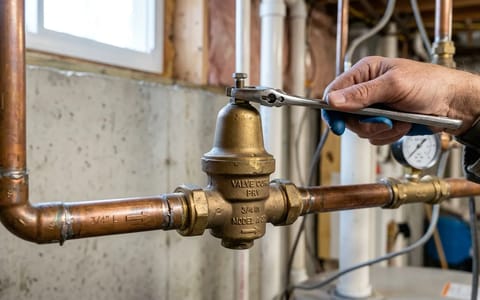
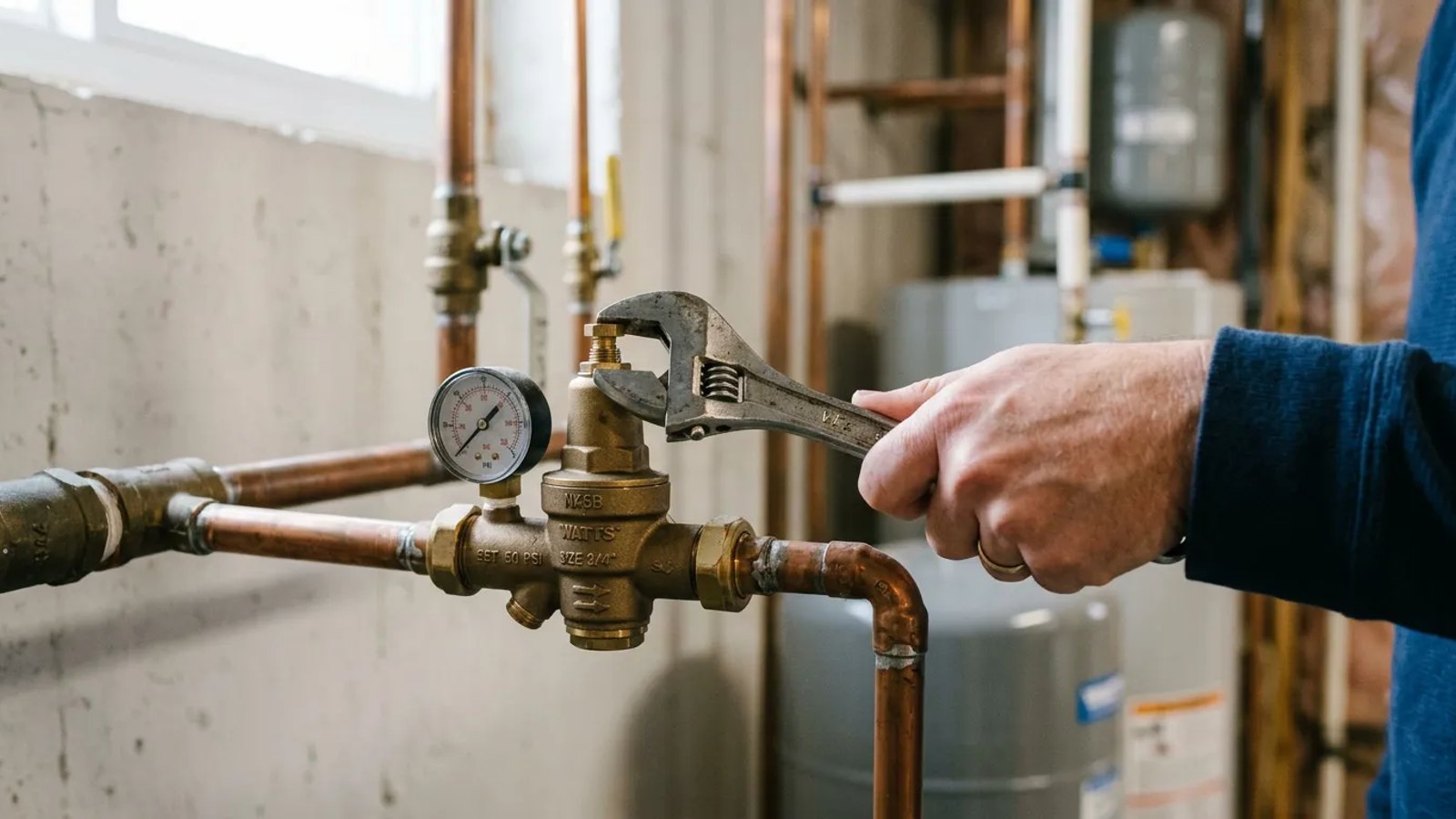
If your main valve is fully open, the next suspect is the Pressure Reducing Valve (PRV). Municipal water often enters a property at very high pressures, sometimes exceeding 100 psi, which can blow out appliance hoses and damage pipe joints. The PRV is a bell-shaped brass fixture installed on the main line just after the shutoff valve. It steps that extreme pressure down to a safe level.
As of 2026, standard plumbing codes and the EPA WaterSense program still mandate that safe home water pressure should sit between 50 and 70 psi. Anything over 80 psi risks damaging your fixtures.
When a PRV ages, the internal rubber diaphragm can tear, or the spring can fail. When I tested my own home's pressure recently after noticing weak showers, I found the PRV had failed completely, dropping my pressure to a dismal 30 psi. We replaced the unit, and the difference was night and day. Before replacing it, however, you should try adjusting it.
A sudden drop in water pressure across your entire home usually points to a single chokepoint, not a massive plumbing failure.
To adjust your PRV, you will need a 10-inch adjustable wrench and a cheap water pressure gauge (typically $15 to $20 at any hardware store in 2026). Screw the gauge onto your outdoor spigot or the drain valve at the bottom of your water heater, and turn the water on to get a baseline reading.
- Locate the adjustment bolt. Look at the top of the bell-shaped PRV. You will see a threaded bolt sticking out, locked in place by a nut.
- Loosen the locknut. Use your wrench to turn the locknut counterclockwise just enough to free the adjustment bolt.
- Increase the pressure. Turn the main adjustment bolt clockwise to increase water pressure. Work in small increments, no more than a quarter-turn at a time.
- Check the gauge. Go back to your pressure gauge and read the new psi. Repeat the adjustment until you hit the sweet spot between 55 and 65 psi.
- Tighten the locknut. Once you have the right pressure, hold the bolt steady and tighten the locknut back down to secure the setting.
If turning the bolt clockwise does absolutely nothing to the reading on your gauge, the internal diaphragm is shot. The PRV needs to be replaced.
Step 3: Check Your Water Meter for Hidden Leaks
If the valves are open and the PRV is functioning, you need to rule out a major leak. A significant break in the main water line running from the street to your house will bleed off the pressure before it ever reaches your taps. Often, these leaks happen underground, meaning you will not see any water pooling in your yard until days later.
Your water meter is the best diagnostic tool for this. Make sure every single faucet, appliance, and toilet in the house is completely turned off. Do not run the washing machine or dishwasher.
Go out to your water meter. Most modern meters have a low-flow leak indicator on the dial face. This is usually a small red or black triangle, or a star-shaped wheel. Watch this indicator for at least three full minutes.
If the triangle is spinning while all your water is shut off, water is escaping somewhere. A fast spin indicates a major line break. A slow spin might mean a running toilet, but a running toilet will not cause whole house low water pressure. If you confirm a fast leak and see no water inside the house, the main service line buried in your yard is likely compromised.
Step 4: Rule Out Water Heaters and Filtration Systems
Sometimes, what feels like a whole-house problem is actually isolated to one side of the system. Go to your kitchen sink and turn on only the cold water. Note the pressure. Then, turn off the cold and turn on only the hot water.
If the cold water is strong but the hot water is weak, your problem is not the main line. The issue is restricted to your water heater. Check the shutoff valve on the cold water inlet pipe feeding the heater to ensure it is fully open. If it is, you may have severe sediment buildup inside the tank blocking the flow, or a failing heat trap nipple.
Alternatively, if you have a whole-house water filtration system or a water softener installed, check the filter cartridges. A heavily clogged sediment filter will choke the water supply to the entire house. Most whole-house filters need to be changed every 3 to 6 months. Try putting the system into "bypass" mode. If the pressure immediately returns to normal, you just need to swap out the dirty filter.
Step 5: Consider a Smart Water Monitor
If you want to avoid future pressure mysteries, installing a smart water monitor is a great upgrade. As of 2026, these Wi-Fi-connected devices attach to your main water line and track flow rates, pressure drops, and hidden leaks in real time. If a pipe bursts or your pressure drops unexpectedly, the monitor sends an instant alert to your phone and can even automatically shut off your main valve to prevent flooding.
When Should You Call the City Water Department?
If you have checked your valves, tested your PRV, and confirmed there are no leaks, the problem might not be inside your property lines at all. Municipal water systems experience pressure drops too.
Call your local water utility company or check their website. They might be flushing fire hydrants in your neighborhood, which temporarily diverts massive amounts of water and lowers pressure for surrounding blocks. There could also be a water main break on your street that the city is currently repairing.
Utility companies are usually happy to send a technician out for free to test the pressure at the street meter. If the pressure is low at the meter, it is their responsibility to fix it. If the pressure is fine at the meter but drops by the time it reaches your house, the issue is on your side of the property line.
Troubleshooting home plumbing issues can feel intimidating, but taking a systematic approach saves time and money. By verifying your valves, checking your regulator, and reading your meter, you can confidently identify the source of the drop. Even if you end up needing a plumber to replace a broken PRV or fix an underground line, you will know exactly what the problem is before they walk through the door.
- A sudden, house-wide pressure drop usually points to a single central component, like the main shutoff or PRV.
- Standard home water pressure should sit between 50 and 70 psi; anything over 80 psi risks damaging your pipes and appliances.
- Always test your water meter for hidden leaks before assuming the municipal supply is to blame.
- A simple $15 pressure gauge from the hardware store is the most accurate way to diagnose your home's water flow.