Why Your AC Is Freezing Up (And How to Thaw It Fast)
Don't panic if your air conditioner turns into a block of ice. Learn why your AC is freezing up, how to thaw it safely, and the exact steps to fix the root cause.
Full guide HVAC & Climate Control How your home heats, cools, and moves air, and the decisions that matter.The late summer heat is bearing down, and you have just switched your thermostat to provide maximum cooling. You expect a refreshing blast of cold air, but instead, the vents are blowing lukewarm air. You walk outside to check the unit, or open your basement utility closet, and find a shocking sight: your air conditioner is covered in a thick block of solid ice.
When you see an AC freezing up, your first instinct might be that the system is working too well. After all, air conditioners are supposed to make things cold, right? Unfortunately, ice is a massive red flag. It means your system is suffocating. If you leave it running, you risk permanently destroying the compressor. As of 2026, a full compressor replacement can easily top $2,500.
The good news is that the most common cause of a frozen air conditioner is something you can fix yourself in about five minutes for less than $25. Here is exactly what is happening inside your system, along with the step-by-step process to thaw it out and get your house cool again.
Why Is My AC Freezing Up? (The Counterintuitive Truth)
To fix the problem, you need to understand why it happens. Your air conditioner does not actually "create" cold air. Instead, it uses chemical refrigerant to absorb heat from inside your house and carry it outside. The indoor component that absorbs this heat is called the evaporator coil.
Under normal conditions, the evaporator coil hovers around 40°F to 45°F. It needs a constant flow of warm, indoor air blowing over it to keep it from getting too cold. If that warm airflow stops, or if the refrigerant pressure drops too low, the temperature of the coil plummets below 32°F.
When the coil drops below freezing, the natural humidity and condensation in your home's air instantly flash-freezes to the metal fins. This creates a thin layer of frost. That frost acts as insulation, blocking even more heat absorption and making the coil even colder. Within a few hours, that frost snowballs into a solid block of ice that chokes the entire system.
Ice on your AC does not mean it is cooling your house well. It actually means the system is suffocating and entirely unable to absorb heat.
There are two primary reasons this happens: severe airflow restriction or a refrigerant leak. We are going to tackle the airflow issues first, as they are completely DIY-friendly.
Step 1: Stop the Cooling and Start the Thaw
Before you can troubleshoot anything, you have to get rid of the ice. You cannot run an air conditioner while it is frozen, and you cannot accurately test it until the coils are completely clear.
- Turn the thermostat to OFF. Go to your thermostat and switch the primary system setting from "Cool" to "Off". This stops the compressor from pumping more refrigerant and making the problem worse.
- Turn the fan to ON. Switch your fan setting from "Auto" to "On". This forces your indoor blower motor to continuously push warm, unconditioned house air over the frozen indoor coil, speeding up the melting process.
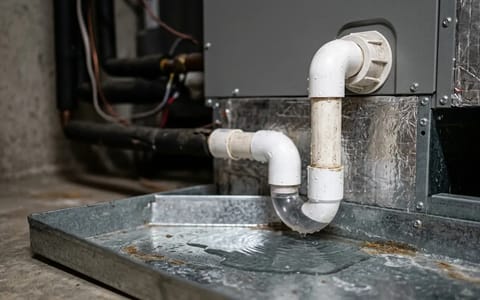
- Prepare for water. As the ice melts, it will drip into your condensate drain pan. If the ice block is massive, it might overwhelm the pan or drip outside of it. Grab a few old towels and place them around the base of your indoor air handler or furnace.
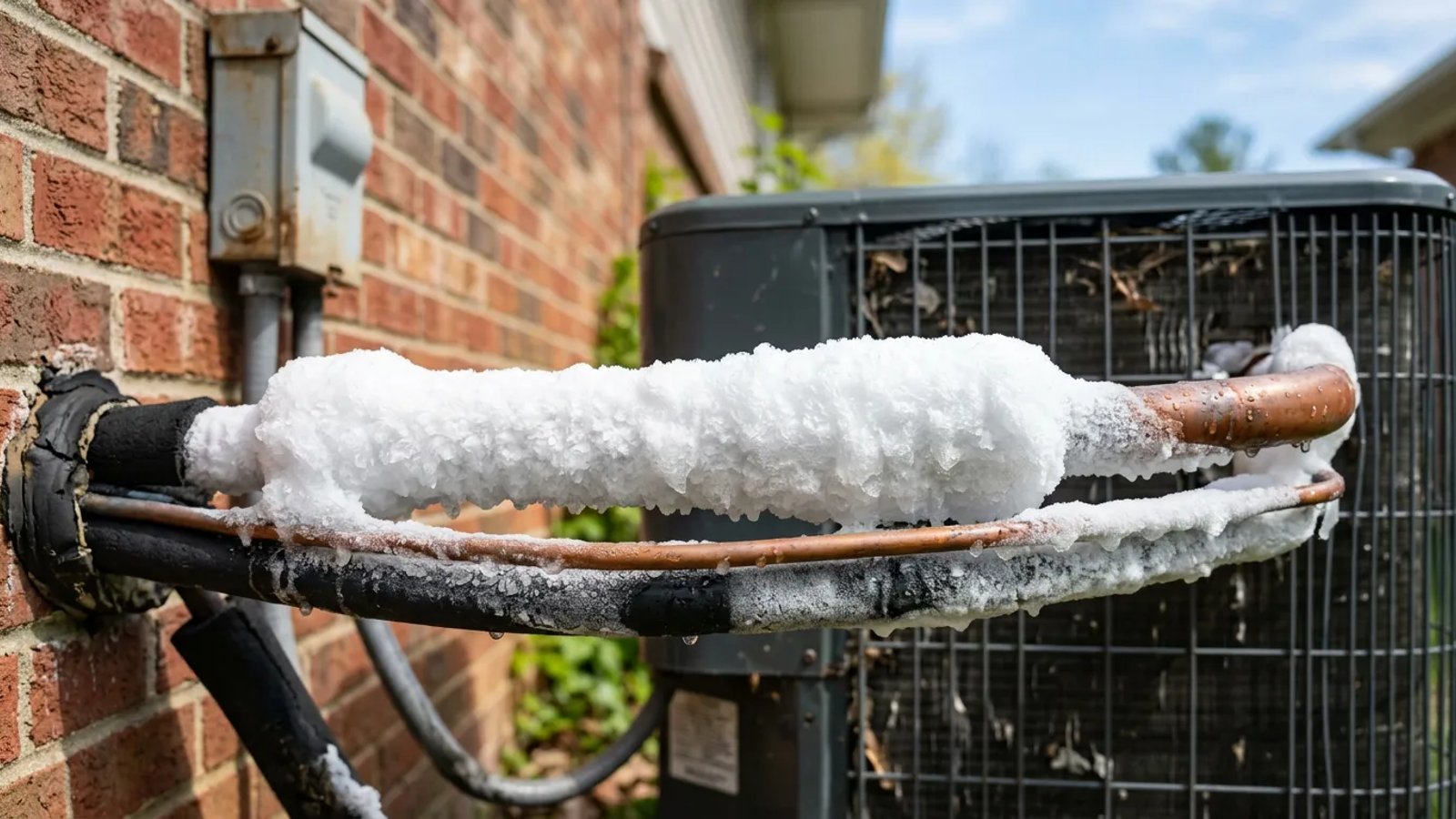
- Wait it out. Depending on the severity of the freeze, thawing can take anywhere from 4 to 24 hours. Do not turn the cooling back on until you are 100% sure the ice is gone from both the indoor coil and the outdoor copper lines.
Step 2: Check Your Air Filter (The Usual Suspect)
While you are waiting for the ice to melt, it is time to check the number one cause of a freezing air conditioner: a filthy air filter. Your HVAC system needs a specific volume of air, measured in cubic feet per minute (CFM), moving across the coil to function.
Over the previous months, your filter traps dust, pet dander, and pollen. If you haven't changed it recently, it becomes a solid wall of debris. The blower motor struggles to pull air through it, the airflow over the coil drops to a trickle, and the system freezes solid.
Pull your filter out and hold it up to a light bulb. If you cannot clearly see light shining through the material, it is fully clogged and must be thrown away. Replace it with a fresh filter. When buying a replacement, aim for a MERV 8 to MERV 11 rating. These fall into the typical 2026 range of $15 to $25 at local hardware stores and strike the perfect balance between catching allergens and allowing your system to breathe. Extremely cheap fiberglass filters do not protect your equipment, while ultra-restrictive MERV 13+ filters can actually cause the exact airflow restriction you are trying to avoid.
Step 3: Open Every Vent in the House
Another incredibly common DIY mistake is closing supply vents in unused rooms to "save money" or force cold air into a specific bedroom. Modern central air systems, especially those with standard single-stage blower motors, are carefully balanced. They are designed to push a specific amount of air through a specific amount of ductwork.
When you close vents, you increase the static pressure inside the duct system. The blower motor has to work harder against this pressure, and as a result, the total volume of air moving across your evaporator coil drops significantly. Just like a dirty filter, this lack of airflow leads directly to an AC freezing up.
Walk through your entire house and ensure that at least 80% of your supply vents (where the air comes out) are fully open. Next, check your return vents (the large grilles that suck air back into the system). Make sure no rugs, couches, or heavy curtains are blocking them. Your system needs to inhale just as much air as it exhales.
Step 4: Inspect for a Dirty Evaporator Coil
If your filter is brand new and all your vents are wide open, the airflow restriction might be happening at the coil itself. If the system was run without a filter in the past, or if a cheap filter let too much dust through, the wet evaporator coil will act like a magnet for dirt.
The dust mixes with the condensation and forms a thick, felt-like blanket over the aluminum fins. This blanket prevents the warm air from actually touching the cold metal, leading to a freeze. If your indoor coil is accessible (usually behind a removable metal panel above your furnace), you can inspect it with a flashlight once the ice has melted.
When Low Refrigerant Is to Blame
Let's say you have completed all the steps above. The filter is pristine, the vents are clear, the coil is clean, and the blower motor is running strong. You turn the AC back on, and within a few hours, the copper lines are turning white with frost again.
At this point, you are almost certainly dealing with a refrigerant leak. This is where the physics of air conditioning gets a bit tricky. It seems backward, but low refrigerant causes the system to run too cold.
When there isn't enough refrigerant in the system, it expands too much when it enters the indoor coil. In fluid dynamics, a drop in pressure equals a drop in temperature. The starved coil drops well below 32°F, and the freezing cycle begins all over again. Air conditioners do not "consume" or burn up refrigerant like a car burns gas. It operates in a closed loop. If you are low on refrigerant, it means there is a physical hole or crack in the copper lines or the coil itself.
The 2026 Refrigerant Phase-Down
If a leak is causing your system to freeze, fixing it promptly is more crucial than ever. Starting in 2025 and accelerating into 2026, the EPA mandated a strict phase-down of older refrigerants like R-410A (Puron) to transition the industry toward climate-friendly alternatives. Because R-410A is now in limited supply, the cost to recharge an older leaking system has skyrocketed. A minor leak that used to be a cheap fix can now be a major expense, making routine maintenance essential.
Dealing with a frozen air conditioner is stressful, especially during the peak summer heat of August. But by staying calm, turning the system off immediately to thaw, and checking the basic airflow components like your filter and vents, you can often solve the problem without spending hundreds of dollars on a service call. Keep those filters fresh, let the system breathe, and you will stay comfortable all season long.