How Often to Clean Gutters (And Signs You Waited Too Long)

Generic 'twice a year' gutter advice doesn't work for every home. Discover exactly how often you need to clean your gutters based on tree coverage, and learn the warning signs that you've waited too long.
Full guide Roofing Learn how long shingles last, how to spot leaks early, and how to decide between a quick repair and a full roof replacement.Ask any contractor, hardware store employee, or well-meaning neighbor how often to clean gutters, and you'll almost always get the same automated response: "Twice a year—spring and fall." It sounds like a solid, reliable rule. But for many homeowners, following that generic advice is a one-way ticket to rotted fascia boards, flooded basements, and expensive foundation repairs.
The truth is that your home is part of a unique micro-environment. A house sitting in the middle of a barren, newly developed subdivision has completely different maintenance needs than a century-old craftsman nestled under a canopy of towering oak and pine trees. Gutters serve a critical function: they capture the massive volume of water shedding off your roof—about 600 gallons for every inch of rain on a 1,000-square-foot roof—and direct it safely away from your home's vulnerable base. When they fail, that water has to go somewhere, and it usually goes straight down.
If you are trying to figure out if you can safely skip a season or if you need to drag the extension ladder out of the garage this weekend, you need a schedule tailored to your specific yard. Let's break down the real factors that dictate your cleaning frequency, the warning signs that your gutters are already failing, and how to build a realistic maintenance routine that actually protects your house.
The Baseline: Why "Twice a Year" is Just a Starting Point
The standard recommendation of cleaning in the spring and fall exists for a good reason. These are the two primary seasons when trees shed debris. In the fall, deciduous trees drop their leaves, which inevitably find their way onto your roof and into your gutters. In the spring, trees reproduce, dropping seed pods, blossoms, oak tassels, and maple "helicopters."
If you have a moderate amount of tree coverage—say, a few mature trees located 20 to 30 feet from your roofline—this twice-a-year schedule is likely perfect for you. You clear the reproductive debris in late spring after the trees have finished shedding, and you clear the dead leaves in late autumn once the branches are bare.
However, this baseline assumes a lot of average conditions. If your yard deviates from the average, your maintenance schedule must adapt. The type of trees hanging over your roof is the single biggest variable in determining your true cleaning frequency.
How Often to Clean Gutters Based on Your Trees
Trees are beautiful, they provide shade, and they lower cooling costs. But they are also relentless debris-generating machines. Here is how specific types of trees alter your gutter maintenance reality.
Heavy Pine Coverage: 3 to 4 Times a Year
If you have pine trees hanging over or very near your roof, throw the "twice a year" rule out the window. Pine trees are notorious for shedding needles year-round, especially during dry spells and heavy winds. Pine needles are a gutter's worst enemy. They are small enough to slip through the gaps in many standard gutter guards, and once inside, they weave together to form a dense, water-blocking mat.
Worse, decomposing pine needles are highly acidic. If left to rot in an aluminum or steel gutter, they can accelerate corrosion and eat through the protective coating of the metal. If you live under pines, you should inspect and likely clear your gutters every three months.
Oak and Maple Trees: 2 to 3 Times a Year
Oak and maple trees are prolific shedders. Maples drop their famous winged seeds (helicopters) in the spring, which are perfectly shaped to slide down downspouts and wedge themselves into the elbow joints. I once spent an hour disassembling a downspout elbow only to find it packed solid with hundreds of sprouted maple seeds that had formed a dense, root-bound plug.
Oaks drop stringy tassels in the spring, small twigs year-round, and heavy, leathery leaves in the fall. Acorns also pose a unique threat; they are heavy, they roll perfectly into downspout openings, and they can strike the metal with enough force to dent older, thinner aluminum. If your home is surrounded by these hardwoods, plan for a thorough late-spring cleaning, a late-fall cleaning, and a mid-summer inspection to catch any early shedding.
No Trees Nearby: Once a Year
What if your house sits on a clear lot with no tall trees in sight? You aren't entirely off the hook. Even without leaves, gutters accumulate debris. Asphalt shingles shed their protective sand-like granules, especially during heavy rainstorms. This heavy grit washes into the gutters and settles at the bottom. Over time, it hardens into a dense sludge that restricts water flow and adds unnecessary weight to the system.
Additionally, strong winds can carry debris from neighboring yards, and birds or wasps often find the sheltered overhang of a gutter perfect for building nests. A single annual inspection—usually in the fall—is sufficient to scoop out the shingle grit and ensure the downspouts are flowing freely.
5 Warning Signs You Waited Too Long
Sometimes life gets in the way, and routine maintenance slips down the priority list. If you aren't sure when your gutters were last cleaned, your house will usually give you a few undeniable hints that a clog has formed. If you spot any of these five signs, it's time to take immediate action.
1. Water Spilling Over the Edges
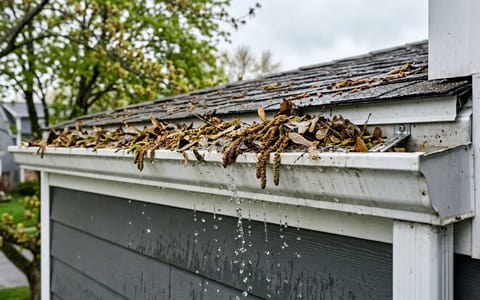
This is the most obvious sign, but you have to be outside during a rainstorm to see it. If water is cascading over the front edge of the gutter like a waterfall, the channel is either completely blocked or the downspout is clogged. Water should flow smoothly toward the downspouts. If it's spilling over, that water is landing directly at the base of your foundation, completely defeating the purpose of having gutters in the first place.
2. Sagging Metal or Pulling Away from the Fascia
Water is surprisingly heavy, weighing about 8.3 pounds per gallon. A standard 5-inch K-style gutter filled with wet, decomposing leaves and standing water can easily hold hundreds of pounds of dead weight. This immense strain will eventually pull the gutter spikes or hidden hangers out of the wooden fascia board. If you look up and notice that the gutter line is no longer straight, or if you can see a gap between the back of the gutter and the wood trim, you have a severe, heavy clog.
A sagging gutter isn't just an eyesore; it's a structural failure waiting to happen under the weight of the next heavy rain.
3. Unexpected Basement Moisture
If you normally have a dry basement but suddenly notice damp concrete walls, a musty smell, or actual puddles forming on the floor after a storm, check your gutters first. When gutters overflow, they dump hundreds of gallons of water directly into the soil surrounding your foundation. This saturates the earth, creating hydrostatic pressure that forces moisture through the microscopic pores and hairline cracks in your basement walls. Fixing the gutter clog is often the cheapest and most effective basement waterproofing method available.
4. The "Gutter Garden"
If you can see green sprouts, grass, or small weeds poking up over the edge of your roofline, you have waited entirely too long. Wind-blown seeds love to land in gutters. When those gutters are filled with a thick layer of decomposed leaves and standing water, it creates a nutrient-rich, hydroponic environment. By the time plants are visibly growing out of your gutters, the root systems have likely formed a dense, impenetrable mat that will require serious manual labor to remove.
5. Staining or Peeling Paint on Siding
When gutters overflow, the dirty water doesn't always just fall straight down. Surface tension often causes the water to curl under the lip of the gutter and run down the face of your siding. Over time, this leaves dark, vertical dirt stains known as "tiger striping." Furthermore, the constant exposure to moisture can cause exterior paint to bubble, crack, and peel, particularly on wood siding or trim boards directly beneath the gutter line.
The Truth About Gutter Guards and Cleaning Frequency
Gutter guards, screens, and helmets are heavily marketed as a "set it and forget it" solution. The promise is incredibly appealing: install these guards and you will never have to climb a ladder to clean your gutters again. Unfortunately, this is a myth.
Gutter guards are fantastic at reducing the frequency of deep, muck-scooping cleanings. A high-quality micro-mesh guard will keep out 95 percent of large leaves, twigs, and acorns. However, they do not make your gutters maintenance-free.
Fine debris, like pine needles, shingle grit, and pollen, can still wash through the mesh over time. More importantly, wet leaves frequently plaster themselves flat against the top of the screen during a storm. If they dry out and stick there, they block the tiny holes, causing the next rainstorm's water to sheet straight off the roof, over the guard, and onto the ground.
If you have gutter guards, you change your maintenance from "scooping out wet muck" to "brushing off the top surface." You still need to inspect them annually. Use a ladder to get up to eye level and use a stiff-bristled brush to sweep off any debris resting on top of the screens. Every few years, you may still need to unscrew a section of the guard to flush out the fine silt that has accumulated in the channel.
DIY vs. Calling a Pro: Making the Call
Cleaning gutters is a highly accessible DIY task for most homeowners, provided you have the right equipment and a healthy respect for gravity. You need a sturdy extension ladder, a ladder standoff (a U-shaped metal bar that rests against the roof so you don't crush the aluminum gutter with your body weight), heavy-duty nitrile or leather gloves, and a plastic gutter scoop. Never use a metal trowel, as it will scratch the rust-resistant coating inside the gutter.
If you decide to tackle it yourself, work in small sections. Don't overreach while on the ladder—keep your belt buckle firmly between the side rails. Scoop the debris into a bucket hanging from the ladder shelf, or simply drop it onto a tarp laid out on the grass below for easy cleanup.
Building Your Realistic Maintenance Schedule
Now that you know the variables, it is time to establish a routine that works for your specific property. Instead of blindly following the "twice a year" rule, build a schedule based on observation.
- Do a rainy-day walkaround. Grab an umbrella during the next heavy downpour and walk the perimeter of your house. Look for overflowing water, leaks at the seams, and water pooling near the foundation.
- Check the downspout output. Ensure water is flowing freely out of the bottom of the downspouts and is being directed at least 4 to 6 feet away from the house via splash blocks or corrugated extensions.
- Inspect the high-risk zones. Pay special attention to roof valleys (where two roof planes meet) and downspout elbows. These are the natural choke points where debris accumulates fastest.
- Flush the system. After scooping out the bulk debris, use a garden hose with a spray nozzle to flush the remaining dirt down the channel. This also allows you to verify that the gutter has the proper slope (about 1/4 inch of drop for every 10 feet of run) and isn't holding standing water.
By paying attention to the specific trees in your yard and watching how your home handles heavy rain, you can stop guessing about maintenance. You might find you only need a quick 30-minute touch-up once a year, or you might realize those beautiful pine trees require a quarterly commitment. Either way, staying ahead of the clogs ensures your gutters do exactly what they were designed to do: protect your home from the top down.