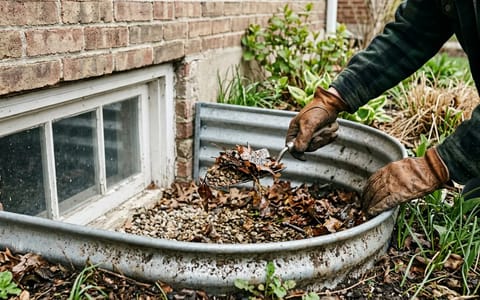
Spring Gutter Cleaning: Protect Your Foundation

Don't let heavy spring showers turn into expensive basement floods. Learn how a thorough gutter cleaning and proper downspout extensions can save your foundation.
Full guide Roofing Learn how long shingles last, how to spot leaks early, and how to decide between a quick repair and a full roof replacement.The shift from freezing winter weather to heavy spring showers puts an immediate stress test on your home's exterior. When your gutters are choked with decaying autumn leaves, twigs, and winter sludge, rainwater has nowhere to go. It spills over the edges, completely bypassing your carefully designed drainage system.
The real danger goes beyond a ruined flowerbed or a muddy walkway. When hundreds of gallons of water dump directly at the base of your exterior walls, it pools against the concrete. This is the primary catalyst for expensive basement leaks, cracked concrete, and structural settling. Taking the time for a thorough spring gutter cleaning is your first and best line of defense against these catastrophic foundation issues.
Why Your Foundation Hates Clogged Gutters
To understand why overflowing gutters are so destructive, look at what happens underground. When water pours over the side of a clogged gutter, it saturates the soil immediately surrounding your house. Soil acts like a sponge, and when it reaches maximum capacity, the trapped water creates hydrostatic pressure.
Hydrostatic pressure pushes heavily against your concrete foundation walls. Over time, this immense weight forces water through microscopic pores and hairline cracks in the concrete, leading to a damp basement or a full-blown flood. Furthermore, in regions that still experience freezing nights in early spring, saturated soil can freeze and expand, physically cracking the foundation block. By keeping your gutters clear, you ensure rainwater is captured and transported away before it ever has a chance to soak the soil near your walls.
Gear Up: Ladder Safety and Essential Tools
Before you climb a single rung, you need the right equipment. Working at heights is inherently risky. As of 2026, emergency rooms still see thousands of homeowners each spring due to ladder mishaps. You will need a sturdy aluminum or fiberglass extension ladder, but more importantly, you need a ladder standoff.
A ladder standoff (or stabilizer) is a U-shaped metal bar that attaches to the top of your ladder. It typically runs $40 to $70 at hardware stores as of 2026, and it rests on the roof rather than the fragile aluminum gutter. Resting a ladder directly on your gutters will crush them, scratch the paint, and potentially cause the ladder to slide sideways.
Along with your ladder and standoff, grab a 5-gallon bucket, an S-hook to hang the bucket from the ladder, and a narrow plastic gutter scoop. Plastic scoops cost about $12 to $15 in 2026 and are vastly superior to metal garden trowels, which scrape the protective anti-rust coating off steel gutters and gouge aluminum.
The Core Process of Spring Gutter Cleaning
Once your gear is staged, it is time to tackle the debris. I remember the first time I cleaned the gutters on my own house: I tried to drop the wet sludge directly into contractor bags on the ground, missing the bag entirely and covering my siding in mud. Use the bucket method to save hours of cleanup.
- Position the ladder securely. Place your ladder on firm, level ground. The base should be one foot away from the wall for every four feet of ladder height. Ensure the standoff arms are resting flat on the roof shingles.
- Scoop the bulk sludge. Starting near the downspout, use your plastic scoop to pull the wet, compacted debris away from the drain hole. Deposit the sludge into your hanging 5-gallon bucket.
- Work in small sections. Clean only what you can comfortably reach without leaning your belt buckle past the side rails of the ladder. When you have to stretch, climb down and move the ladder.
- Clear the downspout cage. If you have wire strainers over your downspout openings, pull them out and scrub them clean. If the downspout itself is clogged, tap the sides firmly with your hand to dislodge the blockage.
Flush the System: Finding Hidden Leaks
Scooping out the visible muck is only half the job. Once the gutters are physically empty, verify that the system actually holds water and moves it in the right direction. Drag a standard garden hose up the ladder and place it at the end of the gutter run, furthest from the downspout.
Turn the water on to a medium flow and watch how it behaves. It should move briskly and steadily toward the downspout. If the water pools in the middle of the run and refuses to drain, your gutter pitch is wrong. Gutters require a subtle slope of about 1/4 inch of drop for every 10 feet of length to drain properly. Sagging gutters will need their hangers adjusted or replaced.
Moving water five feet away from your foundation is the single cheapest insurance policy you can buy against a flooded basement.
While the water is running, walk along the ground and look up at the underside of the gutters. Inspect every seam, end cap, and corner joint for drips. Winter ice often forces these seams apart. If you spot a leak, mark it with a piece of tape. Once the gutter is completely dry, seal the inside of the seam with a specialized waterproof gutter sealant, which runs about $15 a tube as of 2026.
The 5-Foot Rule: Downspout Extensions
This is the most critical step for foundation protection, yet it is the one homeowners skip most often. Having clean, perfectly pitched gutters means nothing if the downspout simply dumps all that collected water right at the corner of your foundation. Those small concrete or plastic splash blocks sitting directly under the spout are almost completely useless, as they only move the water 18 to 24 inches away.
To genuinely protect your basement, every downspout must extend a minimum of 5 to 6 feet away from the house. You can achieve this easily and cheaply using black corrugated drainage pipe. As of 2026, a 10-foot section costs roughly $18 to $25 at big box home improvement stores. It slips directly over the end of your metal downspout and secures with a single zip tie or sheet metal screw. Route the pipe so it discharges the water downhill, away from your landscaping and foundation walls.
Tech Upgrades: Drones and Cleaning Robots
If ladder work makes you nervous, the 2026 market offers highly accessible tech alternatives. Mini camera drones are now frequently used to safely inspect gutters from the ground, letting you pinpoint clogs before deciding on a plan of attack. For the cleaning itself, remote-controlled gutter robots have become far more capable and affordable. They easily sweep out dry leaves and light sludge, drastically reducing the time you spend standing on a ladder.
Knowing When to Call a Professional
While clearing out debris is a classic weekend DIY project, it isn't safe or practical for every home. Knowing your limits is just as important as knowing how to do the work.
Professionals also have high-powered vacuums and heavy-duty augers to clear stubborn downspout clogs that a garden hose simply cannot punch through. If your subterranean drain pipes (the ones routing underground from the downspout) are backing up, a pro with a specialized plumbing snake is required.
Taking a few hours on a dry spring weekend to clear your gutters and extend your downspouts is hard, dirty work, but it pays massive dividends. By controlling where the rainwater flows, you keep your soil stable, your foundation dry, and your basement safe from the costly ravages of water damage.