How to Switch Your Furnace Humidifier to Summer Mode
Don't let your air conditioner work overtime this year. Learn how to switch your whole-house humidifier to summer mode to save energy and prevent frozen AC coils.
Full guide HVAC & Climate Control How your home heats, cools, and moves air, and the decisions that matter.When summer heat sets in and we rely on our cooling systems, most of us focus on cleaning the gutters, testing the air conditioner, and swapping out the main air filter. However, one crucial HVAC task often goes completely unnoticed until high cooling bills arrive: switching your furnace humidifier to summer mode.
If you have a whole-house bypass humidifier attached to your ductwork, it requires a seasonal shutdown. Leaving the humidifier bypass damper open while your air conditioner runs is a costly mistake. It forces newly cooled air to bypass your vents and loop right back into the furnace. This drastically reduces your overall cooling efficiency, drives up energy bills, and can even cause catastrophic damage to your AC system.
Fortunately, putting your humidifier into summer mode takes less than five minutes and requires exactly zero tools. Here is exactly how to find your damper, shut down the system safely, and prep your HVAC unit for peak summer performance.
Why Your Humidifier Needs a Summer Vacation
To understand why this simple switch matters, you have to look at how a bypass humidifier works. The unit typically mounts on either the supply duct (the hot air leaving the furnace) or the return duct (the cold air coming back in). A 6-inch round sheet metal pipe connects the two sides, allowing air to bypass the main system, flow across a water-soaked pad, and pick up moisture before circulating through your house.
In the dead of winter, this bypass loop is exactly what you want. In the summer, that open pipe becomes a massive liability. Cold air naturally takes the path of least resistance. Instead of pushing up into your second-story bedrooms, a large portion of the air produced by your AC simply dumps through the open humidifier bypass and cycles right back into the blower motor.
Leaving your humidifier damper open in July is like running your air conditioner with the front door wide open.
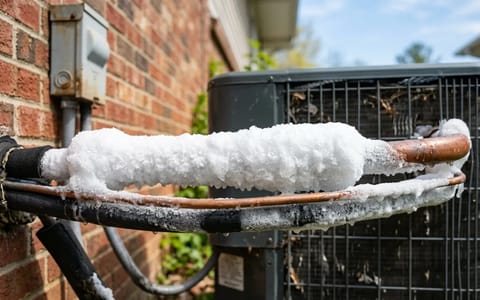
When this happens, your living spaces stay warm, prompting your thermostat to keep the AC running longer. Worse, that looping cold air causes the temperature inside the furnace plenum to drop rapidly. If the air hitting your AC evaporator coil gets too cold, condensation on the coil will freeze into a solid block of ice. A frozen coil completely blocks airflow, shuts down your cooling system, and often results in an emergency service call, which runs between $250 and $600 as of 2026.
How to Switch Your Furnace Humidifier to Summer Mode
Properly shutting down the system involves more than just turning a dial. To fully protect your HVAC system and save money, follow this simple shutdown process.
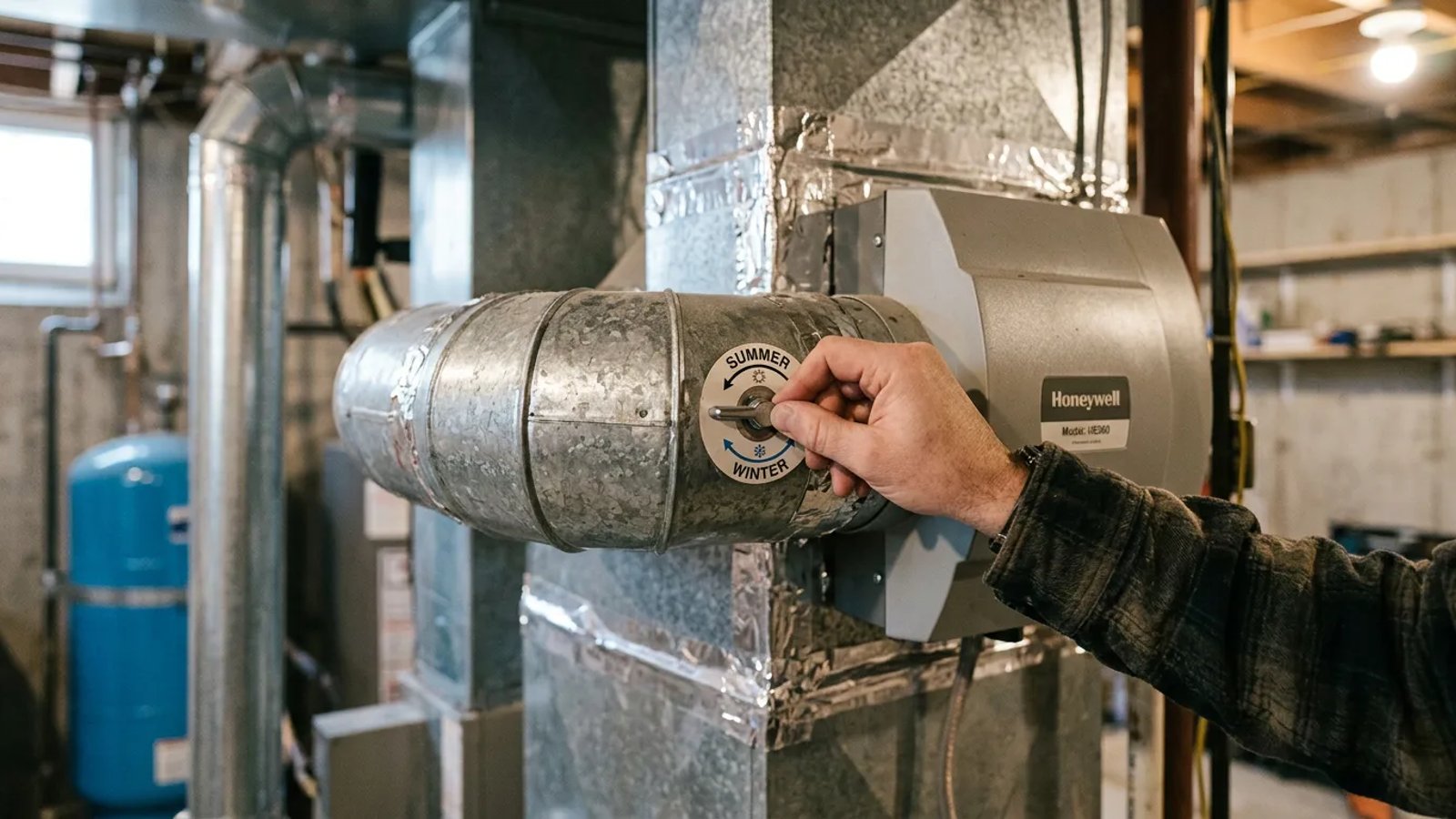
- Flip the bypass damper. Locate the 6-inch round duct connecting the humidifier to your main ductwork. Look for a small lever, knob, or dial on the face of the pipe. Turn the lever from the "Winter" (or "Open") position to the "Summer" (or "Closed") position. When the lever is perpendicular to the pipe, the internal metal flap blocks the airflow.
- Shut off the water supply. Trace the thin 1/4-inch plastic or copper water line from the humidifier back to the main water pipe. You will usually find a small brass saddle valve or a quarter-turn shutoff valve. Turn the small T-handle clockwise until it stops to cut off the water supply.
- Turn off the humidistat. Find the control dial that regulates your indoor humidity. This is usually mounted directly on the return duct above the humidifier, or upstairs next to your main thermostat. Turn the dial all the way down to the "Off" or "0%" position so the solenoid valve does not attempt to open during the summer.
The Problem With Saddle Valves in 2026
If you noticed a saddle valve during your shutdown process, it might be time for a plumbing upgrade. As of 2026, many local plumbing codes have officially banned the installation of new saddle valves because they are highly prone to leaking and clogging. While you do not necessarily have to rip out an existing valve that still works, having a licensed plumber replace your old saddle valve with a reliable quarter-turn ball valve is a smart preventative measure.
Step 3: Swap the Water Panel Now (The Pro Move)
Most homeowners wait until late fall to perform maintenance on their humidifier. However, doing it right at the start of summer is a much smarter move for your indoor air quality.
Throughout the winter, the water panel (also known as the humidifier pad or filter) becomes heavily crusted with white calcium and magnesium scale from your tap water. If you leave that damp, mineral-soaked pad sitting inside a dark, warm HVAC system all summer long, it becomes a prime breeding ground for mold, mildew, and bacteria. When you eventually turn your furnace on in October, that stale, musty air gets blown directly into your living spaces.
Instead of letting it sit, swap the panel out right now. Pop the plastic cover off the humidifier, slide out the scale-covered tray, and throw the old pad in the trash. Wipe down the inside of the plastic tray with a mixture of equal parts white vinegar and water to dissolve any remaining hard water stains. Slide a fresh, dry water panel (which typically falls in the $15 to $30 range in 2026) into the frame and snap the cover back on. Your humidifier is now perfectly clean and fully prepped for the first cold snap of autumn.
The Financial Cost of Ignoring Summer Mode
It is easy to look at a small metal lever on your ductwork and assume it does not matter much. But the math tells a different story. HVAC professionals estimate that leaving a bypass damper open during the cooling season can reduce your air conditioner's efficiency by up to 20 to 30 percent.
If your average 2026 summer electric bill is $175, that open damper could be costing you an extra $35 to $50 every single month in wasted electricity. Add in the potential cost of a service call to thaw out a frozen evaporator coil, and that little forgotten lever becomes a very expensive oversight.
Taking five minutes to walk down to the basement, flip the damper, and shut off the water is one of the highest-return maintenance tasks you can do this season. Your air conditioner will run shorter cycles, your home will cool down faster, and you will keep that expensive chilled air right where it belongs: in the rooms you actually live in.