No Water? How to Reset Your Well Pump Pressure Switch
Did your well water suddenly stop? Before assuming your expensive pump is dead, learn how to manually reset the low-water cut-off pressure switch and restore your water pressure in minutes.
Full guide Plumbing Learn how your home plumbing works and how to stop leaks before they ruin your house.Few things strike fear into the heart of a homeowner quite like turning on the kitchen faucet and getting nothing but a hollow hiss of air. When you rely on well water, a sudden and total loss of water pressure immediately sends your mind racing toward worst-case scenarios. You picture a massive drilling rig tearing up your front lawn, or a plumber handing you a bill for a $2,500 submersible pump replacement.
But before you panic, take a deep breath. In many cases, your pump is perfectly fine. The culprit is often a small, inexpensive component doing exactly what it was designed to do: protecting your system. If your home is equipped with a low-water cut-off mechanism, learning how to reset your well pump pressure switch is a fundamental DIY skill that can restore your water in minutes.
I remember the first time this happened to me. I was mid-shower, shampoo in my hair, when the water simply stopped. Utter silence from the pipes. I trudged down to the basement, convinced I was looking at a massive repair bill. It turned out my lawn sprinklers had simply outpaced the well's recovery rate, and the safety switch had tripped. A quick flip of a lever, and I was back in business.
Suddenly No Water From Your Well? Where to Start
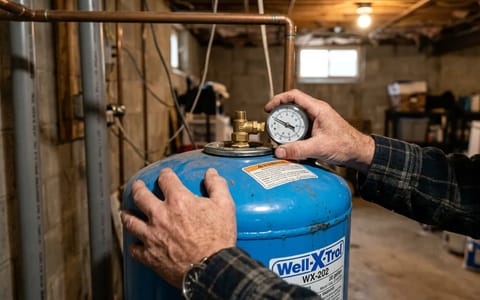
If you experience a situation where there is suddenly no water from your well, the first step is to check the pressure gauge on your indoor water tank. This gauge acts as the diagnostic hub for your entire system. If the gauge reads zero, the problem is on the supply side: your pump, the well itself, or the pressure switch. If the gauge shows normal pressure (typically between 40 and 60 PSI) but you have no water in the house with your well system, the problem is on the delivery side, such as a closed valve or a clogged filter.
Understanding the Low-Pressure Cut-Off
To understand why your water stopped, you need to understand the anatomy of your well's pressure system. Your well pump doesn't run every time you open a tap. Instead, it pushes water into a large indoor pressure tank (usually blue or grey, sitting in your basement or utility room). Inside this tank is a heavy-duty rubber bladder surrounded by compressed air. As water fills the bladder, the air compresses, creating the pressure that pushes water through your home's pipes.
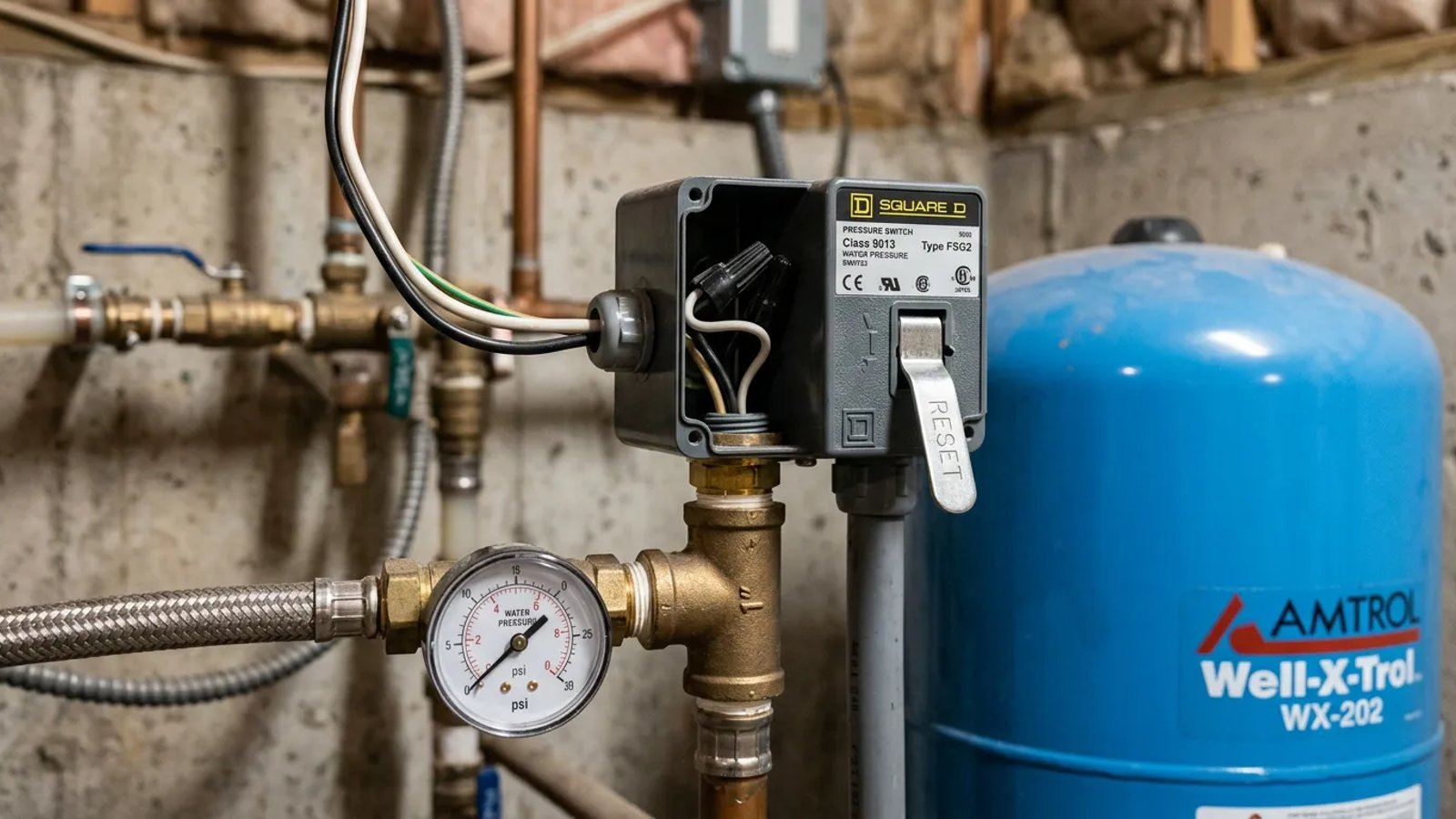
The brain of this operation is the pressure switch. It's a small box (usually grey or black, often made by Square D or Pumptrol) mounted on a brass pipe fitting right next to the pressure tank. Inside this box are electrical contacts and tension springs.
Standard systems operate on a 30/50 PSI or 40/60 PSI cycle. Let's use a 40/60 system as an example. When you use water and the tank pressure drops to 40 PSI, the switch snaps shut, sending electricity to the pump. The pump runs until the pressure reaches 60 PSI, at which point the switch opens, cutting the power.
However, if you have a low-water cut-off switch, it has an added safety feature. If the pressure drops roughly 10 PSI below the normal cut-in point (down to 30 PSI in a 40/60 system), the switch assumes something is wrong. It assumes the well has run dry, a pipe has burst, or the power flickered. To prevent the pump motor from running dry and melting down, the switch completely trips open, locking the pump off. It will not turn back on until a human physically intervenes.
Why Did the Switch Trip?
Before you reset the switch, it's helpful to know why it tripped. If you reset it without understanding the cause, it might just trip again.
- Heavy Water Usage: This is the most common culprit. If you are running the washing machine, the dishwasher, taking a shower, and running the irrigation system all at once, you might be drawing water faster than the pump can push it up from the well. The pressure plummets, and the switch trips to save the pump.
- Power Fluctuations: A brief power outage or brownout can interrupt the pump mid-cycle. If you are using water during this flicker, the pressure will drop below the safety threshold before the pump can catch up.
- Temporary Well Drawdown: During dry summer months, your well's water table might drop. The pump might temporarily suck air, causing a rapid pressure drop.
- Failing Check Valve: If water is draining back down into the well after the pump shuts off, the pressure will slowly drop until it hits the safety cut-off point.
Before you panic and assume your expensive well pump is dead, check the little grey box next to your pressure tank.
Step-by-Step: How to Reset Your Well Pump Pressure Switch
Resetting the switch is a straightforward process, but it requires a bit of finesse. The lever on the side of the switch has three positions. The resting position (usually pointing down or horizontally) is the "Auto" mode. The middle position (roughly a 45-degree angle) is the "Start" or "Reset" mode. Pushing it all the way up or over is the "Off" position.
Here is the exact process to get your water flowing again.
- Turn off any open fixtures. Go through the house and make sure all faucets, showers, and water-using appliances are turned off. If you try to rebuild pressure while a tap is wide open, the pump will struggle to catch up.
- Locate the switch and gauge. Find the pressure tank, the small grey pressure switch, and the circular water pressure gauge. Tap the glass on the gauge lightly with your finger; it should be resting at zero.
- Gently lift the reset lever to the 45-degree angle. Move the silver metal lever on the side of the switch into the middle "Start" position. You will feel a slight spring resistance. Do not force it all the way to the end of its travel path.
- Listen for the pump and watch the gauge. As soon as you hold the lever at the 45-degree angle, the electrical contacts inside the box will close. You should immediately hear the hum of the pump (if it's an above-ground jet pump) or the sound of water rushing into the tank (if it's a submersible pump). Keep your eyes glued to the pressure gauge.
- Hold the lever until pressure builds. The needle on the gauge should slowly start to climb. 10 PSI, 20 PSI, 30 PSI. You must hold the lever manually for about 15 to 30 seconds.
- Release the lever once pressure stabilizes. Once the gauge reaches your system's normal cut-in pressure (usually 30 or 40 PSI), the internal mechanism will engage. Gently let go of the lever. It should stay in the "Auto" position on its own, and the pump should continue running until it hits the cut-out pressure (50 or 60 PSI) and shuts itself off.
How to Reset Your Water Pump After a Power Outage
When the electrical grid goes down, your pump immediately stops running. If anyone in the house flushes a toilet or opens a tap during the outage, the tank pressure will drop below the safety threshold. When the power finally returns, the switch will already be in the tripped position.
To reset a well pump pressure switch after a power outage, first ensure your home's power is fully stabilized. Turn the well pump breaker off for 60 seconds to clear any electrical faults, turn it back on, and then follow the manual lever reset steps outlined above. Hold the manual reset pressure switch lever in the middle "Start" position until the gauge reaches 30 or 40 PSI.
How to Reset a Pressure Switch on a Well Pump Without a Lever
Many homeowners search for a reset lever only to find a plain grey box. If you are wondering how to reset a pressure switch on a well pump without a lever, the short answer is that you do not manually reset the switch itself. Standard pressure switches (those without the silver arm) are designed to reset automatically as soon as the tank pressure drops to the cut-in point.
If your pressure is at zero and you have no lever, the switch has not tripped; instead, the pump has lost power or failed. Here is how to troubleshoot and reset the system:
- Check the main breaker: Go to your electrical panel. Power surges often trip the dedicated 240V double-pole breaker for the well pump. Flip it completely off, then firmly back on.
- Reset the control box: If you have a submersible pump, you likely have a control box mounted on the wall near the pressure tank. Look for a red or black thermal overload reset button on the bottom or face of the box. Press it firmly until you hear a click. As of 2026, standard replacement control boxes cost between $75 and $150, making them a relatively affordable fix if the box itself has failed completely.
- Clean the contacts: Turn off the breaker. Remove the grey cover from the pressure switch. Look at the four round metal contacts. Spiders, earwigs, or carbon buildup can block the electrical connection. Gently pull a piece of fine sandpaper or a clean piece of heavy paper between the contacts to clear debris.
Well Water Pump Runs But No Water Pressure
One of the most concerning scenarios is when your well water pump runs but you have no water pressure. If you can hear the pump humming (or hear the control box clicking) but the pressure gauge remains at zero, the motor is receiving electricity but failing to move water into the tank. Shut off the pump breaker immediately to prevent the motor from burning out, then investigate these three common causes:
- Dry Well: During severe summer droughts, the water table can drop below your pump's intake. The pump runs, but it is only sucking air.
- Broken Drop Pipe: The pipe connecting a submersible pump to your house can crack or break. The pump pushes water, but it simply sprays back out into the well casing instead of reaching your home.
- Stripped Impellers: The plastic or brass impellers inside the pump can wear down from pumping abrasive sand and sediment. The motor spins, but the impellers can no longer generate lift.
Pressure Tank Has Pressure But No Water
What if you check your tank and the gauge reads a healthy 50 PSI, but your faucets are completely dry? If your pressure tank has pressure but no water is flowing, the well and pump are working perfectly. The blockage is happening somewhere between the tank and your taps. Check to ensure the main water shut-off valve was not accidentally closed. In the winter, this often points to a frozen pipe in an unheated crawlspace. Year-round, the most common culprit is a completely blocked whole-house sediment filter that has stopped water flow entirely.
How to Adjust Your Well Pump Pressure Switch
If your water pressure feels weak overall, you might want to perform a water well pressure switch adjustment to reach a higher setting. Most modern homes operate comfortably on a 40/60 PSI cycle.
To adjust the pressure switch on your well, always start by turning off the power at the breaker panel. Never adjust a live switch. Remove the plastic cover, and you will see two spring-loaded nuts: a tall one and a short one.
Turn the tall nut clockwise with a 3/8-inch wrench or nut driver to increase the overall pressure. The tall nut controls both the cut-in and cut-out pressure simultaneously. Three full turns typically equal a 10 PSI increase. Leave the short nut alone unless you specifically need to widen the gap between the cut-in and cut-out pressures. Replace the cover, turn the power on, and run water to test the new cycle on your gauge. Note that if you raise your pressure switch settings, you must also add air to your pressure tank so the bladder pressure remains exactly 2 PSI below your new cut-in pressure.
How to Fix Low Water Pressure From Your Well
If your switch is working perfectly but you are still experiencing low water pressure from your well, the issue lies elsewhere in your low water pressure well system. Start with the easiest fix: check your whole-house sediment filter. These filters should be replaced every 3 to 6 months. As of 2026, standard 10-inch replacement cartridges cost roughly $15 to $30 for a multi-pack. A severely clogged filter will choke off the water supply to your house, even if the pressure tank is sitting at a healthy 60 PSI.
If the filter is clean, check your faucet aerators and showerheads for hard water scale buildup. If the low pressure is system-wide and your tank is struggling to reach the cut-out pressure, your well pump's impellers may be wearing out, or you may have a leak in the drop pipe down inside the well casing. Upgrading to a constant pressure valve system is also a popular 2026 solution for homes suffering from fluctuating flow rates.
Troubleshooting a Stubborn Switch
Sometimes, the reset process doesn't go smoothly. If you let go of the lever at 40 PSI and it immediately snaps back down, shutting off the pump with a loud clack, you might have a clogged sensor pipe. The switch is connected to the plumbing manifold by a narrow, 1/4-inch threaded nipple. Over time, iron bacteria, sediment, and hard water scale can completely clog this tiny pipe. When this happens, the switch cannot accurately "feel" the water pressure in the tank.
If you suspect a clog, you will need to turn off the power to the pump at your main breaker panel, drain the tank completely, and unscrew the switch to clean or replace the nipple. In 2026, a replacement Square D pressure switch typically costs about $35 to $60 at home improvement stores, and it's often easier to simply replace the whole unit if it's heavily corroded.
How to Test a Pressure Switch on a Well Pump
If you hold the manual lever and nothing happens, or if you have a standard switch that refuses to engage, you can test it with a multimeter. With the power on and the contacts closed, test the two outside terminals (Line) to ensure 240 volts are coming from the breaker. Then, test the two inside terminals (Load). If power is coming into the switch but not going out to the pump, the switch has failed and must be replaced.
When a Tripped Switch Means Bigger Problems
A low-water cut-off switch that trips once or twice a year during heavy summer watering is usually nothing to worry about. It is doing its job. However, if you find yourself marching down to the basement to reset the well pump pressure switch three times a week, you have a systemic problem that needs investigating.
First, check your pressure tank. If you have absolutely no pressure in your water tank and the air Schrader valve on top spits water instead of air when you press it, the rubber bladder inside has ruptured. The tank becomes "waterlogged." Without that cushion of compressed air, the pump will short-cycle, turning on and off rapidly every time you flush a toilet. This aggressive cycling can cause pressure spikes and drops that confuse the switch and cause it to trip.
Second, consider your well's health. If you are holding the lever at the 45-degree angle, the pump is running, but the pressure gauge refuses to move past zero, you have a severe issue. The pump might be spinning but the impellers are stripped, the drop pipe connecting the pump to your house might have a massive hole in it, or the well has actually run dry. Continuing to hold the lever in this scenario will burn out the pump motor.
Dealing with a sudden loss of well water is incredibly frustrating, but understanding the safety mechanisms built into your system gives you the power to troubleshoot confidently. By knowing how to locate, engage, and reset your well pump pressure switch, you can save yourself an expensive emergency service call and get your household back to normal in a matter of minutes. Just remember to treat the lever gently, keep an eye on that gauge, and be mindful of your water usage during dry spells.