Why You Keep Running Out of Hot Water (And How to Fix It)
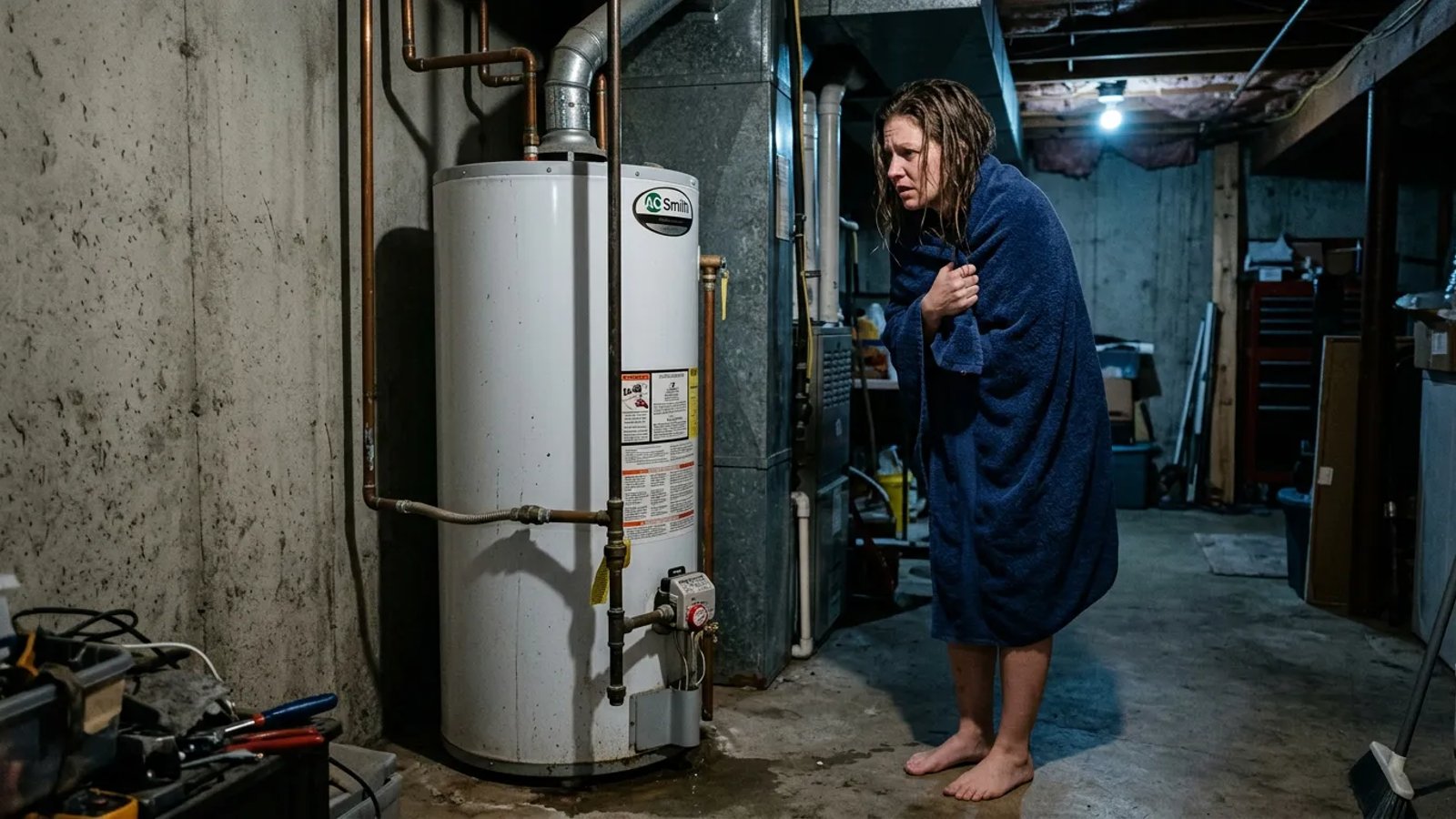
Stepping into a suddenly freezing shower is a terrible way to start the day. Discover the three most common reasons your tank is running out of hot water—and exactly how to fix them.
Full guide Plumbing Learn how your home plumbing works and how to stop leaks before they ruin your house.There is nothing quite as jarring as stepping into a perfectly warm, relaxing shower, only for the water to turn freezing cold five minutes later. When you find yourself consistently running out of hot water, the immediate, sinking fear is usually that your water heater has reached the end of its life and you are about to be hit with a massive replacement bill. However, before you start budgeting for a brand-new appliance, take a deep breath.
A sudden or gradual loss of hot water capacity rarely means the entire tank is doomed. In fact, the vast majority of capacity issues stem from localized, inexpensive component failures or simple maintenance neglect. A water heater is not a complex machine; it is essentially a large insulated thermos with a heat source. When it stops holding enough hot water, it is usually due to a snapped dip tube, a burnt-out heating element, or severe sediment buildup.
A few years ago, I spent three days taking four-minute military showers before realizing a $20 plastic tube was the only thing standing between me and comfort. Let's walk through how to diagnose your tank, identify the culprit, and get your long, hot showers back on track.
The "Cold Shower" Diagnosis: Assessing Your Symptoms
Before grabbing your toolbox, you need to play detective. The way your water heater behaves tells you exactly which component has failed. First, identify whether you have a gas or electric water heater. Gas heaters have a burner at the bottom and a vent pipe at the top. Electric heaters have no vent pipe and typically feature two rectangular access panels on the side of the tank.
Next, note the timeline of your cold showers. Did the capacity drop happen overnight? If you had 40 minutes of hot water on Tuesday and only 10 minutes on Wednesday, you are likely looking at a broken dip tube or a failed heating element. Did the capacity slowly dwindle over the last three years? That points directly to sediment buildup.
Once you have narrowed down the timeline and the type of tank you own, you can start investigating the main suspects.
Culprit #1: The Broken Dip Tube (The Cold Water Invader)
This is the most common reason for a sudden, drastic drop in hot water capacity, affecting both gas and electric models. To understand why, you must understand how water flows through the tank.
Cold water enters your water heater through a pipe at the top. Attached to this inlet is a long plastic pipe called the "dip tube." This tube extends almost all the way to the bottom of the tank. Its job is to deliver incoming cold water directly to the bottom, right next to the heat source, so it does not mix with the freshly heated water floating at the top of the tank (where the exit pipe draws from).
Over time, especially in older models or tanks operating at very high temperatures, this plastic dip tube becomes brittle and snaps off. When the dip tube breaks near the top, incoming cold water no longer travels to the bottom. Instead, it dumps directly into the top of the tank, immediately mixing with the hot water heading to your shower. You end up with lukewarm water almost instantly.
Replacing a dip tube is a straightforward DIY project that usually costs under $30 as of 2026. Here is how you tackle it:
- Turn off the power and water. Shut off the gas valve or flip the breaker for your electric tank. Turn off the cold water inlet valve at the top of the tank.
- Relieve the pressure. Open a hot water faucet somewhere in the house, then briefly open the pressure relief valve on the tank to let out excess pressure.
- Disconnect the cold water line. Use a pipe wrench to disconnect the cold water supply line from the top of the heater.
- Extract the old tube. Look down into the inlet hole. You should see the top of the dip tube (often a flared plastic ring). Pry it up with a flathead screwdriver and pull it out. If it is broken, it will be much shorter than the tank.
- Insert the new tube. Wrap the threads of the new dip tube nipple with Teflon tape, drop the new tube into the tank, and reconnect your water line.
Culprit #2: Burnt-Out Lower Heating Elements (Electric Tanks Only)
If you have a gas water heater, you can skip this section. But if you have an electric water heater and you are suddenly running out of hot water halfway through your routine, a burnt-out lower heating element is almost certainly to blame.
Standard electric water heaters rely on an upper element and a lower element. They do not run at the same time. The upper element kicks on first to quickly heat the top quarter of the tank, ensuring you have hot water fast. Once the top is hot, power shifts to the lower element, which does the heavy lifting of heating the remaining 75 percent of the tank.
If your electric water heater suddenly only gives you half the hot water it used to, a burnt-out lower heating element is almost always the thief.
If the lower element burns out due to age or sediment encasement, the upper element will continue to heat the top of the tank perfectly fine. You will still get hot water, but because the bottom of the tank remains ice cold, you will run out in a fraction of the normal time.
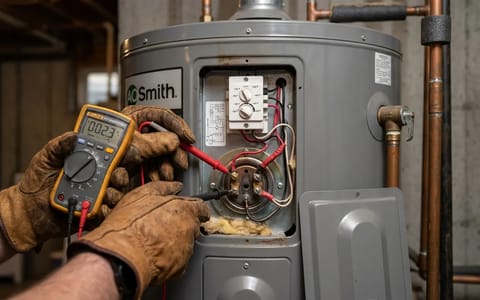
To diagnose this, you need a basic multimeter. Here is the process:
- Kill the power. This is critical. Flip the breaker to the water heater. Use a non-contact voltage tester to verify the power is entirely off before touching anything.
- Remove the access panels. Take off the lower access panel and peel back the insulation to reveal the heating element and thermostat.
- Test for continuity. Disconnect the two wires attached to the face of the heating element. Set your multimeter to the lowest Ohms setting (or continuity mode). Touch one probe to each screw terminal on the element.
- Read the results. A healthy element will register between 10 and 16 Ohms. If the multimeter reads "OL" (Open Loop) or infinity, the element is burnt out and must be replaced.
Replacing the element requires draining the tank below the level of the lower element, unscrewing the old element with a 1-1/16 inch socket wrench, and screwing in a replacement part. A new element falls in the typical 2026 range of $25 to $40, making it a highly satisfying and cost-effective fix.
Culprit #3: Severe Sediment Buildup (The Volume Thief)
If your loss of hot water has been a slow, creeping annoyance over the last few years rather than a sudden overnight failure, sediment is your primary suspect. All municipal and well water contains dissolved minerals, primarily calcium and magnesium. When water is heated, these minerals precipitate out and fall to the bottom of the tank.
If you do not flush your water heater annually, this loose sediment hardens into a solid, rock-like layer. This causes two massive problems for your hot water capacity. First, it physically displaces the water. If you own a 50-gallon tank but there are 15 gallons of solid calcium rock sitting at the bottom, your tank now only holds 35 gallons of water. You are literally running out of physical space.
Second, in gas heaters, the burner is located at the absolute bottom of the tank. The sediment layer acts as a thick stone insulator between the gas burner and the water. The burner has to heat up the rock before the rock can heat the water. This leads to incredibly slow recovery times, meaning once you run out of hot water, it takes hours to get it back.
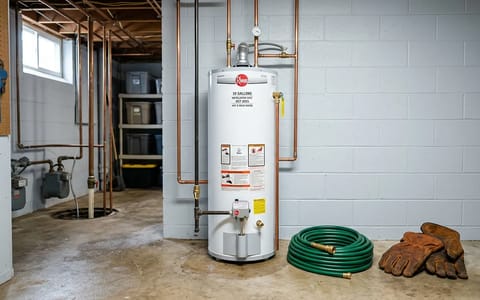
To fix this, you need to perform a deep flush. Attach a garden hose to the drain valve at the bottom of the tank, run the other end to a floor drain or driveway, and open the valve. If the tank has been neglected for years, the valve might clog with large chunks of scale. In severe cases, you may need to remove the drain valve entirely to extract the rocks or use a specialized descaling solution (like commercial white vinegar) to dissolve the buildup.
Culprit #4: Clogged Air Filters (Heat Pump Models)
As of 2026, heat pump (hybrid) water heaters have become incredibly common in North American homes due to updated energy codes and federal rebates. Unlike traditional electric tanks, these models pull heat from the surrounding air to warm the water. To do this efficiently, they rely on a fan and an air filter located near the top of the unit.
If that air filter gets clogged with dust or pet hair, the heat pump cannot breathe. When it starves for air, the unit will automatically switch over to standard electric resistance heating, which is much slower and less efficient. Some models will simply struggle to recover entirely, leaving you with lukewarm water. If you own a hybrid model, pull the filter out and wash it in the sink. A clean filter often restores full hot water capacity in just a few hours.
DIY vs. Pro: What You Can Fix Safely
Troubleshooting a water heater can feel intimidating, but the issues outlined above are generally well within the capabilities of a handy homeowner. However, knowing when to call a professional is just as important as knowing how to use a wrench.
Running out of hot water does not have to mean the end of your water heater's life. By paying attention to the timeline of the failure, testing your electrical elements, inspecting the dip tube, and keeping up with annual flushing, you can easily restore your tank's capacity. Grab your tools, diagnose the symptoms, and get ready to enjoy long, uninterrupted showers once again.