Circuit Breaker Keeps Tripping? How to Find the Real Cause
Is your power constantly cutting out in one room? Learn how to safely troubleshoot a tripping circuit breaker, identify overloads, and know when to call a pro.
Full guide Electrical Learn how your home electrical system works and what parts are safe for you to handle.You hear a sudden click, followed immediately by a dark room and a silenced television. If your circuit breaker keeps tripping, your first instinct is probably to march right down to the basement or garage and simply flip the switch back on. It is a frustrating interruption, especially when you are in the middle of vacuuming or drying your hair.
But when that exact same breaker trips for the second, third, or fourth time, your home's electrical system is sending you an urgent message. A tripping breaker is not a nuisance; it is a critical safety mechanism doing exactly what it was designed to do. Inside your walls, wires are carrying electrical current. If too much current flows through a wire, it generates intense heat. Without a breaker to monitor that flow and cut the power, that heat would eventually melt the wire's insulation and start an electrical fire.
A tripping breaker isn't a nuisance—it's a critical safety device doing exactly what it was designed to do: prevent an electrical fire.
Instead of treating the panel like a frustrating reset button, we need to find out why the system is overloaded. This guide will walk you through a safe, logical process to isolate the problem, fix simple overloads, and recognize when it is time to step back and call a professional.
The Big Three: Why Your Circuit Breaker Keeps Tripping
Before we start unplugging things, it helps to understand what the breaker is actually looking for. Modern residential electrical panels are designed to trip under three specific conditions: an overloaded circuit, a short circuit, or a ground fault.
An overloaded circuit is by far the most common culprit. This happens when the devices plugged into a circuit demand more electrical current than the circuit was built to safely provide. A short circuit is more dangerous; it occurs when a "hot" (live) wire accidentally touches a "neutral" wire, causing a massive, instantaneous surge of electricity. Finally, a ground fault happens when a hot wire touches a ground wire or the metal side of an electrical box, which is a severe shock hazard.
Step 1: Diagnose an Overloaded Circuit
Most homes have standard 15-amp and 20-amp circuits. A 15-amp circuit running on standard 120-volt household power can handle a maximum of 1,800 watts. However, for continuous safety, you should only load a circuit to 80% of its capacity, which equals about 1,440 watts.
If you plug a 1,500-watt space heater into the same room where a 300-watt television and a few 60-watt lamps are running, you have instantly exceeded the safe limit. The wires begin to heat up, the breaker senses the thermal change, and it snaps shut.
To confirm an overload is your issue, follow this diagnostic process:
- Turn off all switches. Go to the room or area that lost power and turn off all wall switches for overhead lights and ceiling fans.
- Unplug everything. Walk around the room and physically unplug every single device from the wall outlets. Do not just turn them off; pull the plugs out.
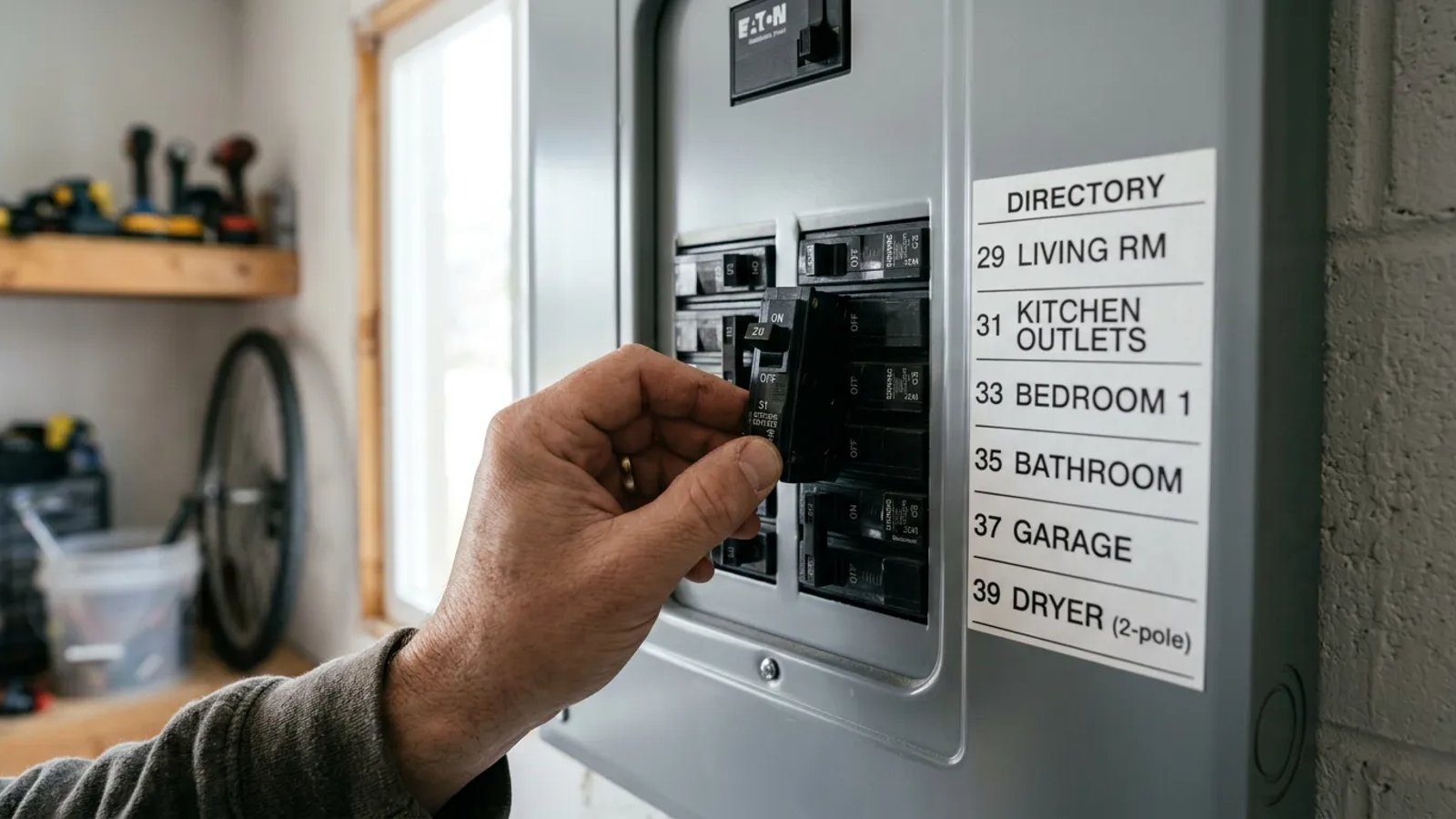
- Reset the breaker properly. Go to your electrical panel. A tripped breaker usually sits in a middle position. You must push it firmly all the way to the "OFF" position until it clicks, and then push it firmly to the "ON" position.
- Test the load. Go back to the room. Turn on the overhead lights. Wait a few minutes. If the power stays on, plug in your devices one by one. If plugging in your heavy-duty vacuum or window AC causes the breaker to instantly pop again, you have found your overload.
If you confirm an overload, the solution is simple: you need to redistribute your heavy-draw appliances to different circuits in the house. You cannot run a space heater and a hair dryer on the same 15-amp bathroom circuit.
Step 2: Hunt Down a Short Circuit
If you unplugged everything in the room, reset the breaker, and it immediately tripped again with a loud pop, you are likely dealing with a short circuit. This is a much more serious issue. When a hot wire touches a neutral wire, the resistance drops to almost zero, causing a massive spike in current that trips the breaker almost instantly.
Short circuits often happen inside the appliances themselves or within the wall receptacles. Grab a flashlight and carefully inspect the area that lost power. You are looking for three specific warning signs:
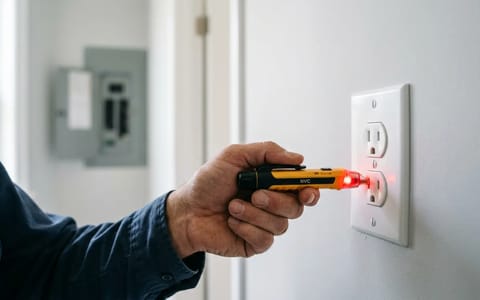
- Visual damage: Look closely at your wall outlets. Do you see black soot, scorch marks, or melted plastic around the receptacle slots? Check the power cords of the devices you unplugged for melted insulation or exposed copper wiring.
- Smell: A short circuit often produces a distinct, acrid smell of burning plastic or ozone. If an outlet smells like burning fish or melting plastic, leave it entirely alone.
- Sound: Sometimes a failing receptacle will produce a faint buzzing or crackling sound right before the breaker trips.
If you find a damaged cord, throw the appliance away or have it professionally repaired. If you find a scorched wall outlet, leave the breaker off. The receptacle must be replaced, and the wiring behind it must be inspected for heat damage.
Step 3: Check for Ground Faults and Moisture
A ground fault is a specific type of short circuit where the hot wire touches a ground wire, a grounded metal junction box, or even a person. Because water is an excellent conductor of electricity, ground faults frequently occur in kitchens, bathrooms, basements, and outdoor outlets.
Modern homes use GFCI (Ground Fault Circuit Interrupter) outlets in these wet areas. These are the outlets with the little "Test" and "Reset" buttons on the faceplate. A GFCI outlet is incredibly sensitive and will cut power at the outlet level before the main circuit breaker in the panel even notices a problem.
However, if water gets inside an outdoor outlet during a heavy rainstorm, or if an older home doesn't have GFCI protection, a ground fault will trip the main panel breaker. If your breaker trips after a heavy rain, check your exterior outlets. A cracked weatherproof cover might be letting moisture bridge the electrical contacts inside.
Step 4: Inspect for Worn-Out Hardware
Circuit breakers are tough, but they do not last forever. The internal springs and bimetallic strips that make a breaker work can wear out after 30 to 40 years of use, or after being tripped and reset dozens of times.
When a breaker goes bad, it often becomes overly sensitive, tripping well below its rated amperage. You might also notice physical signs of failure at the panel. A healthy breaker switch feels firm and snaps cleanly between the on and off positions. If the switch feels loose, "spongy," or refuses to catch when you push it to the "ON" position, the internal mechanism is likely broken.
Dealing with electrical issues can be intimidating, but a methodical approach keeps you safe. By understanding the limits of your circuits and knowing how to isolate high-draw appliances, you can resolve the vast majority of tripped breakers without spending a dime. Just remember to respect the system: if the breaker refuses to stay on, it is doing you a favor. Leave the power off, step away from the panel, and let a professional track down the hidden hazard.