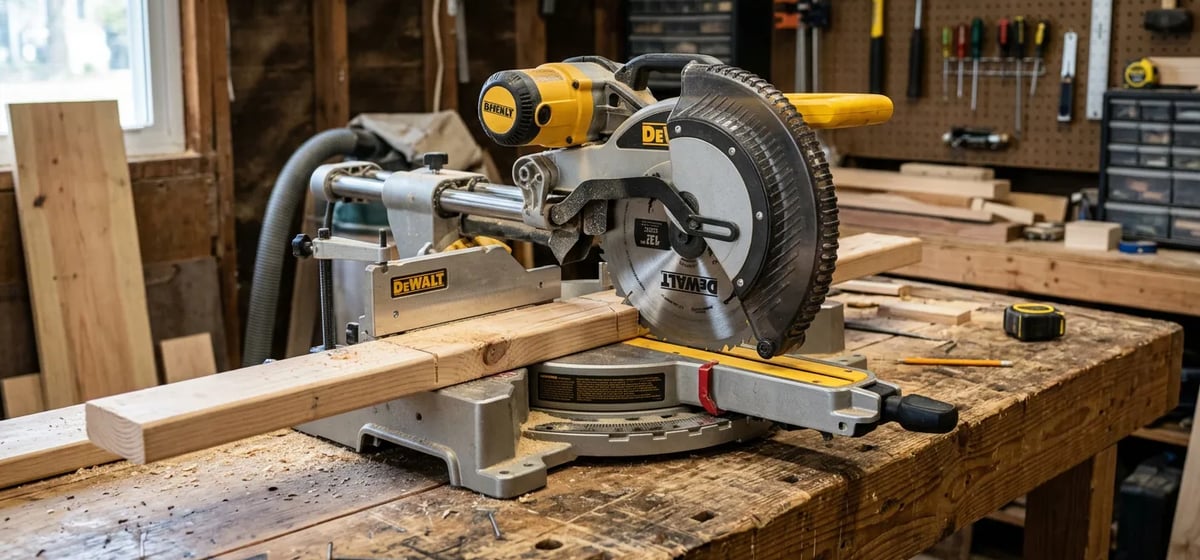
What is a Miter Saw?
A miter saw is a power tool used to make precise, angled cuts in wood. It features a circular blade mounted on a hinged arm. You pull this arm down onto a piece of wood resting on a flat base. The word miter comes from the Latin word mitra, which was a type of headband or turban. In carpentry, the word evolved to describe a joint made by cutting two pieces of wood at an angle to form a perfect corner.
This tool is famous for making quick and accurate cuts. The base of the saw has a metal guide called a fence. You push your wood against the fence to keep it steady. Then, you can pivot the saw blade to different angles. Most saws lock into common angles like 45 degrees or 90 degrees. This makes it very easy to cut perfect corners every single time.
Why It Matters to You
If you plan to do any home updates involving trim, you will quickly find out how valuable a miter saw is. You need one if you want to install baseboards, crown molding, or new door frames. Trying to cut perfect 45 degree angles with a hand saw is slow and often looks sloppy. A miter saw gives you a clean, tight fit.
Many homeowners buy their first miter saw when they decide to tackle their Interior: Paint, Drywall & Trim projects. It is also great for building shelves, making picture frames, or cutting deck boards. If you are weighing DIY vs. Hiring a Pro for a flooring or trim job, owning this tool makes the DIY route much more realistic. It saves you hours of frustration and wasted material.
Types of Miter Saws
When you shop for a miter saw, you will see a few different types. They all look similar but have different features.
- Standard miter saw: This basic saw pivots left and right to make angled cuts. The blade drops straight down.
- Compound miter saw: This saw pivots left and right, but the blade also tilts to the side. This lets you cut a miter angle and a bevel angle at the exact same time. You need this for crown molding.
- Dual bevel compound miter saw: This saw tilts to both the left and the right. It saves you from having to flip your wood over when making complex cuts.
- Sliding compound miter saw: The arm on this saw slides forward and backward on rails. This allows you to cut much wider pieces of wood, like wide shelving boards.
What It Costs
Miter saws come in a wide range of prices depending on their features and size. Most homeowners do perfectly fine with a 10 inch or 12 inch blade. Keep in mind that actual price ranges vary based on the brand and where you shop.
- Basic standard miter saw: Expect to pay 100 to 150 dollars. This is fine for small, simple projects like picture frames.
- Single bevel compound miter saw: These generally cost 150 to 250 dollars. This is the sweet spot for most casual DIY trim projects.
- Sliding compound miter saw: These run from 250 to 600 dollars. You pay more for the sliding rails, but it is worth it if you cut wide planks or flooring.
- Professional grade saws: High end models with laser guides and heavy duty stands can easily cost 600 to 800 dollars or more.
What to Watch For
Miter saws are powerful and can be dangerous if you do not pay attention. The blade spins incredibly fast and can pull loose items right in. You must always respect the tool and follow basic safety rules.
Another important tip is to let the saw do the work. Do not force the blade down into the wood too fast. Pull the trigger, let the blade reach full speed, and then lower it smoothly. Once the cut is done, release the trigger. Keep the saw arm held down until the blade comes to a complete stop. If you lift the spinning blade too soon, it can catch the cut piece of wood and throw it across the room.