What SHGC means for your home
If you are shopping for new windows, you will see a rating called SHGC. This stands for Solar Heat Gain Coefficient. It measures how much heat from the sun passes through your glass and enters your home. The National Fenestration Rating Council created this metric in the late 1980s to help consumers compare energy efficiency. The term uses the word coefficient from physics to express a measurable ratio of transmitted solar energy.
The rating falls on a scale from 0 to 1. A lower number means the window blocks more heat. This keeps your house cooler in the summer and lowers your air conditioning bills. A higher number means more solar heat gets inside. Most modern windows score somewhere from 0.20 to 0.80 on this scale.
Why climate matters for your rating
The best SHGC for your home depends entirely on where you live. If you live in a hot climate like Florida or Arizona, you want a very low SHGC. A rating of 0.25 or lower is ideal for hot areas. This blocks the intense summer sun and keeps your home comfortable. It also takes a huge load off your cooling system. You can learn more about managing your home temperatures in our HVAC & Climate Control guide.
If you live in a cold climate like Maine or Minnesota, you actually want some free heat from the sun. In these northern areas, a higher SHGC from 0.35 to 0.60 is often better. The winter sun shines through the glass and helps warm your rooms. This lowers your winter heating bills. If you live in a mixed climate, a middle rating around 0.30 gives you a good balance for both summer and winter.
How window direction changes things
You do not have to use the exact same rating for every single window in your house. The direction your windows face changes how much sun they get. Mixing and matching ratings can help you build a highly efficient home.
- South facing windows: These get direct sunlight for most of the day. You want a low SHGC here to block intense heat.
- West facing windows: These get blasted by the hot afternoon sun. A low SHGC is very important on this side of the house.
- North facing windows: These barely get any direct sunlight. You can safely use a higher SHGC rating here.
- East facing windows: These only get mild morning sun. A higher SHGC rating works perfectly fine for these rooms.
Look for the low E coating. Manufacturers achieve a low SHGC by adding a microscopic metallic layer to the glass. This is called a low E coating. It reflects solar heat away from your house without blocking the natural light.
Where to find this number
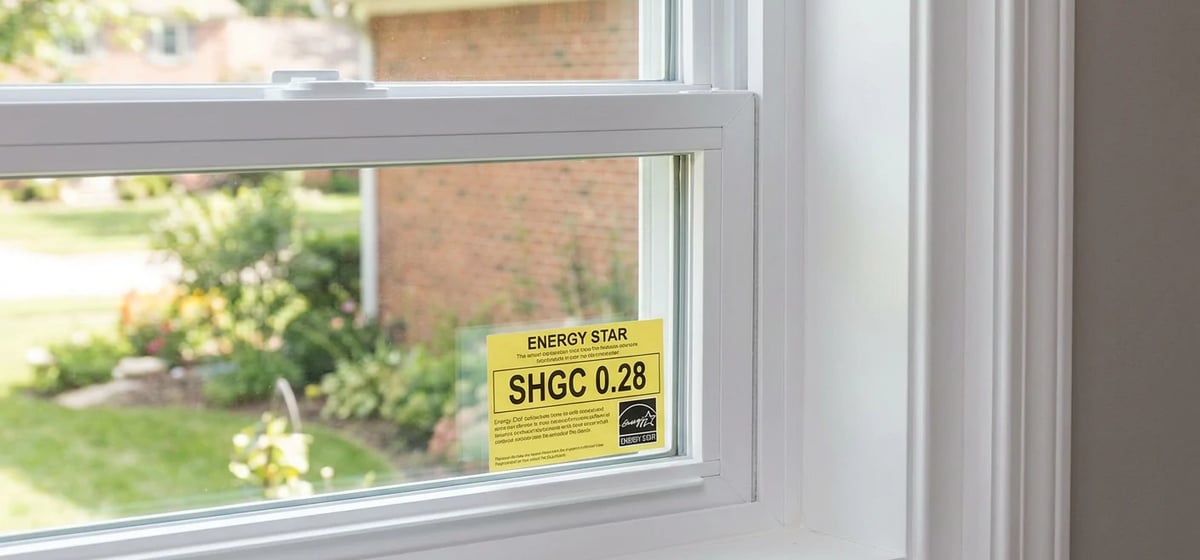
You will find the SHGC rating on a sticker attached to the glass of any brand new window. This is called the NFRC label. It is a white sticker with black text that lists several energy ratings. The SHGC is usually located right next to the U factor. You should always look for this sticker before you buy. If a window does not have an NFRC label, you cannot trust its energy claims. When you are ready to upgrade, read our Windows & Doors guide to understand the other ratings on that label.
What energy efficient windows cost
Upgrading to windows with a better SHGC rating requires buying completely new windows. Replacing your old windows with new energy efficient ones is a big investment. A standard double hung vinyl window with a good SHGC rating usually costs 400 to 800 dollars per window. This includes the cost of the window and basic labor. Custom sizes, wood frames, or triple pane glass will push that price higher. You can expect to pay 800 to 1500 dollars for high end options. Keep in mind that prices range widely based on your location and the contractor you hire. For a deeper breakdown of these expenses, check out our Window Replacement Cost guide.