What is a BTU?
BTU stands for British Thermal Unit. It's a measurement that tells you how much heat an appliance can produce or remove from the air. You'll see this number on air conditioners, furnaces, and gas grills. A higher number means the unit can heat or cool a larger space.
The term was defined in the late 1800s. It's the exact amount of heat required to raise the temperature of one pound of water by one degree Fahrenheit. When you look at a heater, the BTU rating tells you how much heat it adds to your home. When you look at an air conditioner, the rating tells you how much heat it pulls out of the air.
Why BTUs matter for your home
You might think bigger is always better. That's simply not true when it comes to heating and cooling. You need the right amount of BTUs for your specific space. If you buy a unit with too few BTUs, it'll run all day and never reach your target temperature. This wastes energy, wears down the motor, and drives up your monthly power bill.
If you buy a unit with too many BTUs, it'll heat or cool the room too fast. It'll turn on and off constantly. This is called short cycling. Short cycling wears out the parts much faster. When an oversized air conditioner short cycles, it blasts your house with cold air and then shuts off five minutes later. The air stops moving, and the room feels stuffy. You'll be left with a cold, clammy house because the unit never ran long enough to wring the moisture out of the air. Getting the size right is a big part of proper HVAC & Climate Control.
Where you'll see this number
You'll run into this term anytime you buy something that changes the temperature. Here are the most common places you'll see it.
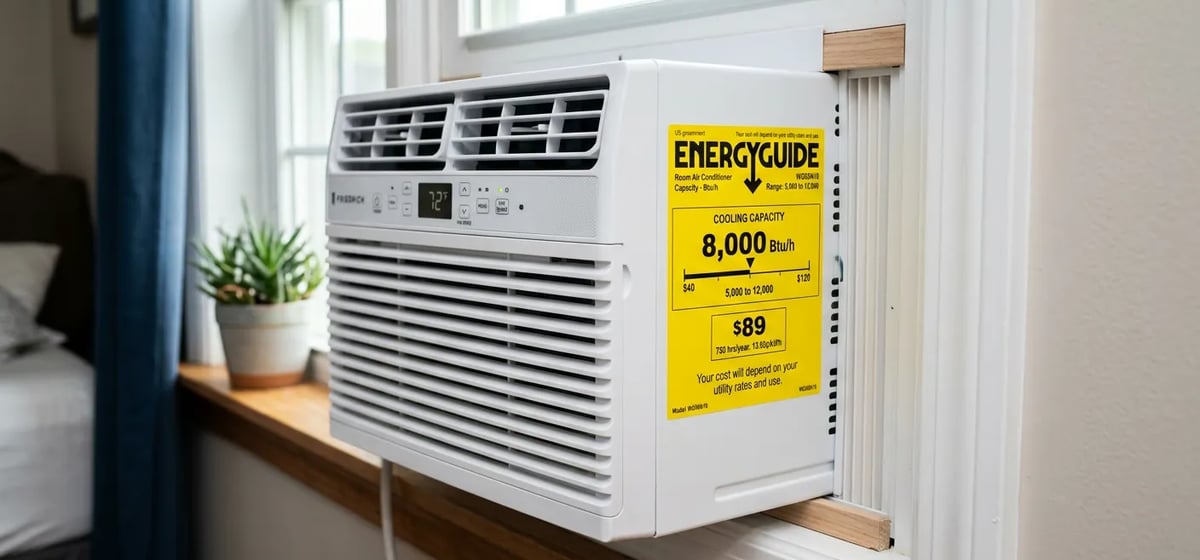
- Air conditioners: Window units usually range from 5,000 to 15,000 BTUs. Central air systems use much larger numbers, often measured in tons. One ton of cooling equals exactly 12,000 BTUs.
- Furnaces and heaters: A standard home furnace might put out 40,000 to 100,000 BTUs. Small space heaters usually produce around 5,000 BTUs.
- Gas grills and stoves: When you shop for Appliances like a gas range or an outdoor grill, the burners are rated in BTUs. A standard stove burner puts out about 7,000 BTUs. A high heat power burner might push 15,000 BTUs or more to boil water faster.
You might also see heating and cooling power listed in watts instead of BTUs. One watt equals about 3.4 BTUs per hour. If you buy an electric space heater rated at 1,500 watts, it puts out roughly 5,100 BTUs. This is helpful to know if you are comparing a gas heater directly to an electric heater.
How many BTUs do you need?
A simple rule of thumb for cooling a room is to use 20 BTUs for every square foot of space. You just multiply the length of the room by the width to get the square footage. Then multiply that number by 20. A room that is 10 feet wide and 15 feet long is 150 square feet. That means you need an air conditioner with about 3,000 BTUs. Most small window units start at 5,000 BTUs, which works perfectly for a standard bedroom.
Keep in mind that high ceilings, poor insulation, and direct sunlight will change this math. Kitchens also need more cooling power because cooking generates extra heat. Here is a rough guide for sizing a window air conditioner.
| Room Size (Square Feet) | Estimated BTUs Needed |
|---|---|
| 100 to 150 | 5,000 |
| 150 to 250 | 6,000 |
| 250 to 300 | 7,000 |
| 300 to 350 | 8,000 |
| 350 to 400 | 9,000 |
Costs will scale with the power of the unit. A basic 5,000 BTU window air conditioner usually costs $150 to $250. A larger 12,000 BTU model might run $300 to $500. For whole house heating, a new 80,000 BTU gas furnace can cost $3,000 to $6,000 to install. Remember that these ranges vary based on your location, the brand you choose, and the complexity of the installation. If you are replacing a central furnace or air conditioner, do not guess the size. Hire a professional to do a manual heat load calculation so they can tell you exactly what your house needs.