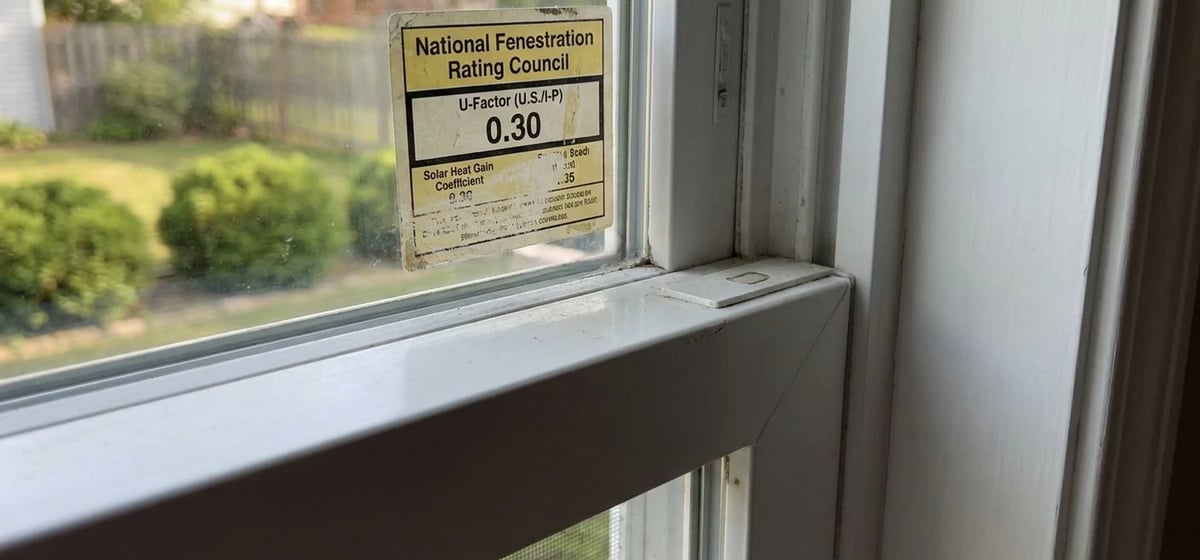
What is a U-Factor?
A U-Factor measures how well a window or door keeps heat inside your home. It tells you the exact rate at which heat escapes through the glass and the surrounding frame. If you live in a cold climate, paying attention to this number is very important. A lower number means the window provides much better insulation. This keeps your rooms warmer in the winter and saves you a lot of money on your monthly heating bills.
Engineers in the mid 1900s chose the letter U to represent the overall heat transfer coefficient in thermodynamics. If you know a little bit about wall insulation, you might already know about R-values. The U-Factor is just the mathematical opposite of an R-value. While a high R-value means good insulation for your walls and attic, a low U-Factor means good insulation for your windows and doors.
Why it matters for your home
Your windows are basically giant holes in your walls. Even the absolute best windows lose more heat than a standard insulated wall. When you have drafty windows with a high U-Factor, your furnace has to work overtime to keep the house warm. This drives up your energy bills and puts extra wear and tear on your HVAC & Climate Control system.
Upgrading to windows with a lower rating makes your home much more comfortable. You will not feel a cold chill when you sit near the glass in January. It also helps prevent annoying condensation from building up on the inside of the glass during freezing weather. Less condensation means less risk of mold growing on your wooden window sills.
What to look for on the label
When you shop for new materials in the Windows & Doors category, you will see a white sticker on the glass. The National Fenestration Rating Council puts this sticker on all certified windows. The U-Factor is usually the very first number listed on that label in the top left corner.
Ratings generally range from 0.20 to 1.20. Here is how to read them:
- 0.20 to 0.26: Excellent insulation. These are usually triple-pane windows made for very cold northern climates. They have special gas fills between the glass layers.
- 0.27 to 0.30: Great insulation. Most high quality double-pane windows fall in this range. They are perfect for mixed climates that see both cold winters and hot summers.
- 0.31 to 0.40 and up: Poor insulation. You often see these numbers on older windows, cheap aluminum frames, or single-pane glass.
If you plan to replace your windows soon, check out the Window Replacement Cost guide to prepare your budget. You can expect to pay $600 to $1,200 per window for units with a great U-Factor, though prices and ranges vary based on the size and frame material.
How materials change the rating
The glass is not the only thing that changes a window rating. The frame material plays a massive role in how much heat escapes your house. Aluminum frames conduct heat very easily, so they usually have much higher and worse U-Factors. Vinyl and fiberglass frames do not conduct heat well at all, which gives them much lower and better scores.
Window makers also pump heavy invisible gases like argon or krypton between the panes of glass. These gases slow down the heat transfer even more. A double-pane window filled with argon gas will always have a better score than a regular double-pane window filled with plain air.
U-Factor vs. SHGC
You will see another measurement right next to the U-Factor on the window sticker. This is the Solar Heat Gain Coefficient. It is important to know the difference between the two numbers so you buy the right product for your climate.
The U-Factor tells you how well the window stops your indoor heat from escaping into the cold night. The Solar Heat Gain Coefficient tells you how well the window blocks heat from the sun coming inside during the day. If you live in a cold place like Maine, you want a low U-Factor to keep your heat inside. If you live in a hot place like Florida, you care much more about a low Solar Heat Gain Coefficient to keep the blazing sun out of your living room.