How the calculator works
1. Your climate zone sets the target. The calculator uses ENERGY STAR's recommended attic levels, which follow the 2021 International Energy Conservation Code. They are the total to aim for; if you already have 3 to 4 inches, ENERGY STAR's "add" figure is the second column.
| Climate zone | Aim for (total) | Add over 3–4 inches |
|---|---|---|
| Zone 1 | R-30 | R-25 |
| Zones 2 and 3 | R-49 | R-38 |
| Zones 4 to 8 | R-60 | R-49 |
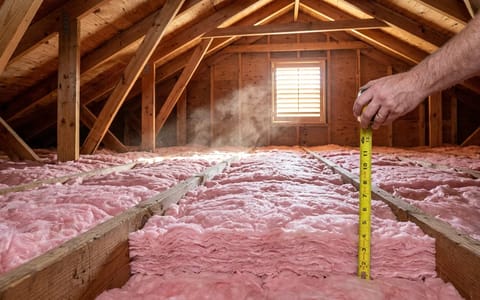
2. What's up there now. R-value is roughly depth times the material's R-value per inch. The calculator uses the middle of the Department of Energy's ranges:
| What it looks like | Material | R per inch (DOE range) |
|---|---|---|
| Pink, yellow or white rolls between the joists | Fiberglass batts | 2.9 to 3.8 |
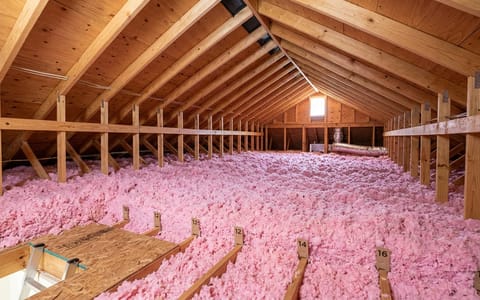
| Fluffy pink, yellow or white loose fill | Loose fiberglass | 2.2 to 2.7 |
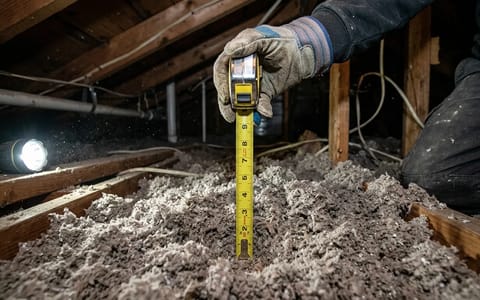
| Gray, shredded-paper loose fill | Cellulose | 3.2 to 3.8 |
| Gray-brown or white woolly loose fill | Rock wool | 3.0 to 3.3 |
Insulation that has settled, got wet or been flattened by stored boxes is worth less than its depth suggests, so measure in a few places away from the hatch and use a typical depth.
3. Inches and bags come from the coverage charts printed on the bags, which is what the FTC's R-value rule requires manufacturers to publish. Coverage per bag shrinks as the R-value grows:
| R-value | Cellulose: sq ft per bag, settled depth | Fiberglass: sq ft per bag, settled depth |
|---|---|---|
| R-30 | 25.9 sq ft, 8.3″ | 68.5 sq ft, 10.75″ |
| R-38 | 19 sq ft, 10.4″ | 52.6 sq ft, 13.5″ |
| R-49 | 14.1 sq ft, 13.3″ | 39.9 sq ft, 17″ |
| R-60 | 11.6 sq ft, 16.1″ | 31.8 sq ft, 20.5″ |
Cellulose figures are from Greenfiber's Sanctuary bag (25 lb), fiberglass from Owens Corning AttiCat (27.5 lb). Other brands differ, so check the chart on the bag you buy. 4. The cost is the bag count times your store's price, and the pro range is a national installed price per square foot; get two or three local quotes before you decide.
Climate zones by state
Zones are set county by county. Here are the zones each state has and the one most of its homes are in, from the Pacific Northwest National Laboratory's county list weighted by population.
| State | Zones | Most homes |
|---|---|---|
| Alabama | 2 and 3 | Zone 3 (80%) |
| Alaska | 5, 6, 7 and 8 | Zone 7 (69%) |
| Arizona | 2, 3, 4 and 5 | Zone 2 (86%) |
| Arkansas | 3 and 4 | Zone 3 (74%) |
| California | 2, 3, 4, 5 and 6 | Zone 3 (97%) |
| Colorado | 4, 5, 6 and 7 | Zone 5 (94%) |
| Connecticut | 5 | Zone 5 |
| Delaware | 4 | Zone 4 |
| District of Columbia | 4 | Zone 4 |
| Florida | 1 and 2 | Zone 2 (72%) |
| Georgia | 2 and 3 | Zone 3 (87%) |
| Hawaii | 1 | Zone 1 |
| Idaho | 5 and 6 | Zone 5 (72%) |
| Illinois | 4 and 5 | Zone 5 (89%) |
| Indiana | 4 and 5 | Zone 5 (55%) |
| Iowa | 5 and 6 | Zone 5 (89%) |
| Kansas | 4 and 5 | Zone 4 (98%) |
| Kentucky | 4 | Zone 4 |
| Louisiana | 2 and 3 | Zone 2 (79%) |
| Maine | 6 and 7 | Zone 6 (95%) |
| Maryland | 4 and 5 | Zone 4 (98%) |
| Massachusetts | 5 | Zone 5 |
| Michigan | 5, 6 and 7 | Zone 5 (89%) |
| Minnesota | 5, 6 and 7 | Zone 6 (87%) |
| Mississippi | 2 and 3 | Zone 3 (83%) |
| Missouri | 3, 4 and 5 | Zone 4 (95%) |
| Montana | 6 | Zone 6 |
| Nebraska | 5 | Zone 5 |
| Nevada | 3, 4 and 5 | Zone 3 (73%) |
| New Hampshire | 5 and 6 | Zone 5 (80%) |
| New Jersey | 4 and 5 | Zone 4 (71%) |
| New Mexico | 3, 4 and 5 | Zone 4 (44%) |
| New York | 4, 5 and 6 | Zone 4 (62%) |
| North Carolina | 3, 4 and 5 | Zone 3 (90%) |
| North Dakota | 6 and 7 | Zone 6 (73%) |
| Ohio | 4 and 5 | Zone 5 (66%) |
| Oklahoma | 3 and 4 | Zone 3 (91%) |
| Oregon | 4 and 5 | Zone 4 (86%) |
| Pennsylvania | 4 and 5 | Zone 4 (52%) |
| Rhode Island | 5 | Zone 5 |
| South Carolina | 2 and 3 | Zone 3 (96%) |
| South Dakota | 5 and 6 | Zone 6 (86%) |
| Tennessee | 3 and 4 | Zone 3 (51%) |
| Texas | 1, 2, 3 and 4 | Zone 2 (70%) |
| Utah | 3, 5 and 6 | Zone 5 (90%) |
| Vermont | 6 | Zone 6 |
| Virginia | 3, 4 and 5 | Zone 4 (80%) |
| Washington | 4, 5 and 6 | Zone 4 (72%) |
| West Virginia | 4 and 5 | Zone 4 (69%) |
| Wisconsin | 5 and 6 | Zone 5 (68%) |
| Wyoming | 5, 6 and 7 | Zone 6 (70%) |
Before you add insulation
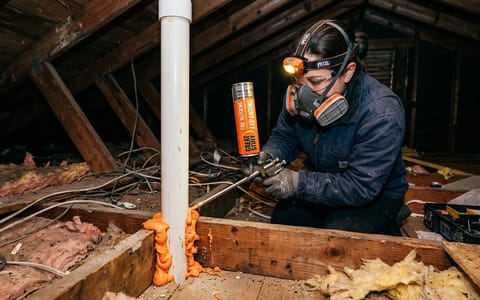
- Seal the air leaks first. Gaps around plumbing, wiring, the chimney and the attic hatch let warm air straight past any amount of insulation, and they're much harder to reach once it's deep. Here's how to air seal an attic.
- Keep the soffit vents open. Never cover them with insulation. Fit rafter vents (baffles) at the eaves so air can still flow.
- Mind the recessed lights. Keep insulation at least 3 inches from "can" lights unless they're rated IC (for insulation contact).
- Leave space around flues. Codes usually require 1 inch of clearance from metal flues and 2 inches from masonry chimneys to anything combustible, insulation included.
Sources
- ENERGY STAR, Recommended Home Insulation R-Values (based on the 2021 IECC)
- Pacific Northwest National Laboratory, Guide to Determining Climate Zones by County (PNNL-33270)
- U.S. Department of Energy, Types of Insulation: R-value per inch (archived copy)
- Owens Corning, AttiCat fact sheet with the coverage chart
- Greenfiber, Sanctuary cellulose attic coverage card
- Fixr, Blown-in insulation cost (updated August 2025)
- ENERGY STAR, Methodology for estimated savings from sealing and insulating
- ENERGY STAR, About attic ventilation (soffit vents, recessed lights)
- ENERGY STAR, Sealing air leaks around furnace flues
- U.S. EPA, Protect your family from asbestos-contaminated vermiculite insulation