What Delta T Means for Your Home
Delta T is just a fancy way to say temperature difference. In the home maintenance world, it measures the change in air temperature as it moves through your heating and cooling system. When an HVAC technician visits your house, they measure the air going into your return vent. Then, they measure the air blowing out of your supply vents. The difference between those two numbers is your Delta T.
The word delta comes from the Greek alphabet and means change. The letter T stands for temperature. You don't need a math degree to understand it. You just need to know that this number tells you if your air conditioner or furnace is actually doing its job.
Why This Measurement Matters
Your heating and cooling equipment uses a lot of energy. You want to make sure it runs at peak efficiency. If your house feels hot on a summer day, a quick Delta T check helps you find the problem. Let's say your thermostat says the room is 75 degrees. The air blowing out of your vent should be around 55 degrees. That gives you a difference of 20 degrees.
If the air coming out is 65 degrees, your difference is only 10 degrees. Your air conditioner is running, but it isn't cooling the air enough. The system will run all day long trying to cool your house. This puts heavy wear and tear on your equipment. It also drives up your monthly utility bills. You can learn more about how these systems work in our guide to HVAC & Climate Control.
What Is a Normal Delta T?
The ideal temperature difference changes depending on the season and your specific equipment. Here's a quick look at what you want to see.
- Air Conditioning: A healthy cooling system usually shows a difference of 15 to 20 degrees Fahrenheit.
- Gas Furnaces: A standard gas furnace often produces a difference of 30 to 70 degrees Fahrenheit. The exact number depends on the model.
- Heat Pumps: Heat pumps produce cooler heat than gas furnaces. You will normally see a difference of 20 to 30 degrees Fahrenheit in heating mode.
How to Check It Yourself
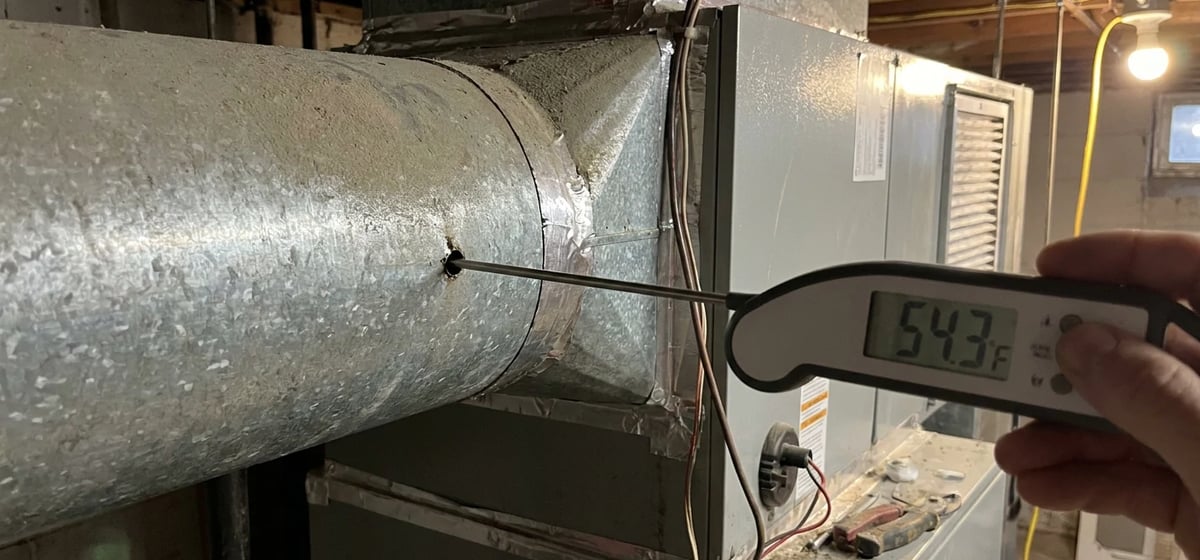
You can check this measurement on your own before calling a professional. You just need a digital probe thermometer. Turn on your air conditioner and let it run for 15 minutes. This gives the system time to stabilize.
First, stick the thermometer into the return vent. This is the large grate on your wall or ceiling where the filter lives. Wait for the temperature to stop changing and write the number down. Next, stick the thermometer into a supply vent. Pick a vent that is close to the main unit. Write that number down. Subtract the smaller number from the larger number. If your result falls between 15 and 20 degrees, your system is cooling normally.
When to Call a Professional
If your calculation is way off, you need to troubleshoot. Always check your air filter first. A dirty filter restricts airflow and ruins your efficiency. If you put in a fresh filter and the temperature difference is still low, you likely have a bigger issue. A low number often points to a refrigerant leak, a failing compressor, or dirty coils.
At this point, you should hire an HVAC technician. A standard diagnostic service call costs between 75 and 200 dollars. If the technician finds a refrigerant leak, the repair costs normally run from 200 to 1500 dollars. Keep in mind that these ranges vary based on your location and the exact problem. You can get a better idea of typical contractor pricing in our guide to What Home Repairs Cost.