What is refrigerant?
Refrigerant is the chemical fluid that makes modern air conditioning and refrigeration possible. The word comes from the Latin word refrigerare, which means to make cool. Early cooling systems used dangerous and toxic chemicals. Modern systems use safer synthetic chemical blends. This fluid flows continuously through the copper pipes of your air conditioner or heat pump. It absorbs heat from the air inside your house and carries it outside to cool your home.
You also have a smaller amount of this exact same fluid inside your kitchen refrigerator. You can read more about how household machines operate in our guide to Appliances.
How the cooling cycle works
This fluid is special because it easily changes from a liquid to a gas at very low temperatures. Your system pumps it in a continuous closed loop to move heat from one place to another.
- It starts as a cold liquid in the indoor part of your system.
- Warm air from your house blows over the indoor coils.
- The fluid absorbs the heat from the air and boils into a gas.
- The gas travels through copper pipes to the big unit outside your house.
- A compressor squeezes the gas, making it very hot and highly pressurized.
- A fan blows outdoor air over the outdoor coils to pull the heat out of the gas.
- The gas turns back into a cold liquid and heads back inside to repeat the process.
Why a low level means trouble
A big myth among homeowners is that your air conditioner naturally uses up this fluid over time. This is completely false. Your system does not burn it like a car burns gas. The loop is totally sealed. If a technician tells you that your system is low on fluid, it means you have a physical hole or crack somewhere in the copper lines.
When a leak happens, your air conditioner loses its ability to move heat. It will run for hours without shutting off while trying desperately to cool your house. This drives up your monthly power bill and puts extreme wear and tear on the expensive parts of your system. You can learn more about protecting your equipment in our HVAC & Climate Control section.
Types of cooling fluids
Over the years, the types of chemicals used have changed to protect the environment. Contractors refer to them by specific numbers, usually starting with the letter R.
- R-22: This is an older type often called Freon. The government banned it for new systems because it damages the ozone layer. If you have an older system that uses R-22, buying replacement fluid is very expensive.
- R-410A: This is the standard fluid used in most systems built between 2010 and 2023. It is commonly known by the brand name Puron. It is safer for the ozone layer than older chemicals.
- R-32 and R-454B: These are the newest types. New rules require manufacturers to use these even greener options for brand new systems built today.
Signs of a leak and repair costs
You might have a leak if you hear a faint hissing or bubbling sound near your indoor unit. Another extremely common sign is ice building up on the copper pipes outside or on the indoor coils. You might also notice that your vents are blowing room temperature air instead of cold air, or that your house feels unusually humid.
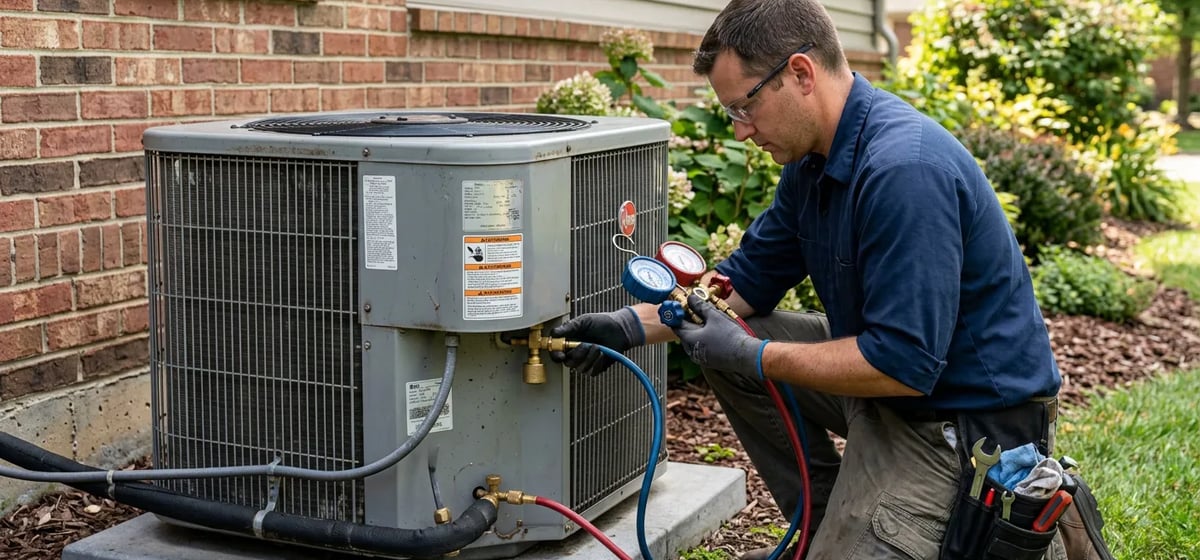
Fixing a leak and adding new fluid is strictly a job for a licensed professional. They must follow strict federal laws and use special gauges to handle these chemicals safely. Expect to pay between 150 to 300 dollars just for a technician to locate the exact source of the leak. The total cost to fix the hole and recharge the system ranges from 400 to 1500 dollars. Prices vary widely based on your location, the specific type of fluid your system needs, and how hard the leak is to reach. Sometimes a leak is so severe, or the system is so old, that replacing the entire unit makes more financial sense. You can compare repair versus replacement costs in our guide to Hiring Contractors & What Things Cost.