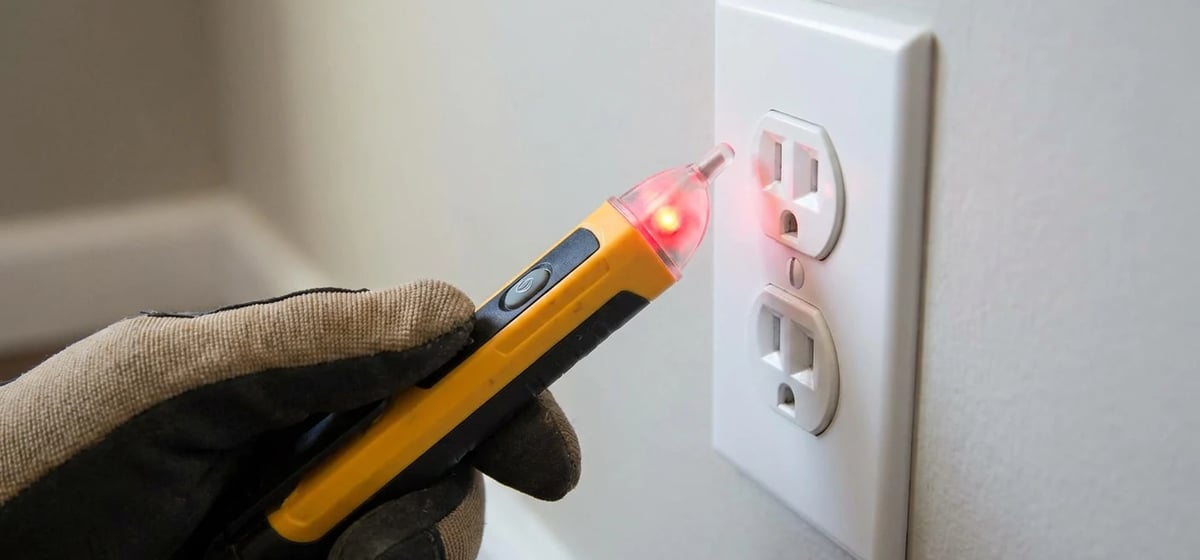
What is a non contact voltage tester?
When you own a home, you'll eventually need to deal with electricity. A non contact voltage tester is a small, pen shaped device that keeps you safe. It checks for live electrical current without requiring you to touch any bare metal wires. You simply bring the tip of the tester close to a wire, a light switch, or an outlet. The tool uses special sensors to feel the electrical field right through the plastic wire insulation. If it detects live electricity, the tool will beep loudly and flash a bright red light.
Why this tool matters to you
This tool is incredibly important for your safety. Electricity is invisible, and a shock can cause serious injury or worse. Anytime you plan to do basic Electrical maintenance, you need to be absolutely certain the power is off. You might go to your breaker box and flip the switch labeled for the living room. However, breaker boxes are often labeled incorrectly by previous owners or builders. You might think the power is off when it's actually still flowing. A non contact voltage tester gives you immediate proof. It tells you if that specific wire in your hand is truly dead and safe to touch.
How to use it safely
Using this tool correctly is very simple, but you must follow a strict routine every single time. Here are the steps you should always take:
- First, turn the tester on and touch it to a known live source, like a working lamp or outlet.
- Second, take the tester to the wire or switch you want to work on and move the tip around the plastic casing.
- Finally, take the tool back to your known live source and test it one last time to prove the batteries didn't die while you were walking across the room.
Common mistakes to avoid
Even though this tool is easy to use, homeowners often make a few common mistakes. One big mistake is testing a thick bundle of wires all at once. If you hold the tester against a thick power cord, the outer rubber jacket might block the sensor. You should always try to test individual wires when possible. Another mistake is assuming the tool works on everything. A standard non contact voltage tester won't pick up direct current from car batteries or small solar setups. It is designed specifically for the alternating current that flows through your home walls. Finally, don't drop your tester or leave it out in the rain. The internal sensors are delicate. If you drop it on a hard concrete garage floor, you should replace it just to be completely safe. A broken tool could easily give you a false sense of security.
Buying one and what it costs
You can find these testers at any local hardware store or online. A standard model typically costs $15 to $30. Prices vary slightly depending on the brand and extra features. Some models include a handy little flashlight on the tip. Other models offer dual range sensitivity. This means they can detect low voltage items like doorbells as well as standard household wiring.
If you're weighing DIY vs. Hiring a Pro for a simple job like swapping a light fixture, buying this tool is a smart investment. It costs far less than a service call. Just remember that this tool only tells you if voltage is present. It won't tell you how much voltage is there or help you diagnose a complicated wiring problem. If your tester keeps beeping and you can't figure out which breaker turns the power off, stop working. That's the moment you should call a licensed electrician. You can read more about typical service call fees in our guide to Hiring Contractors & What Things Cost.