GFCI Outlet Won't Reset? How to Find the Problem Fast
Frustrated by a GFCI outlet that refuses to reset? Learn how to safely troubleshoot the circuit, find hidden ground faults, and know when the receptacle needs replacing.
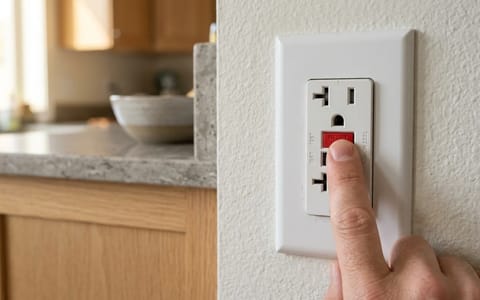
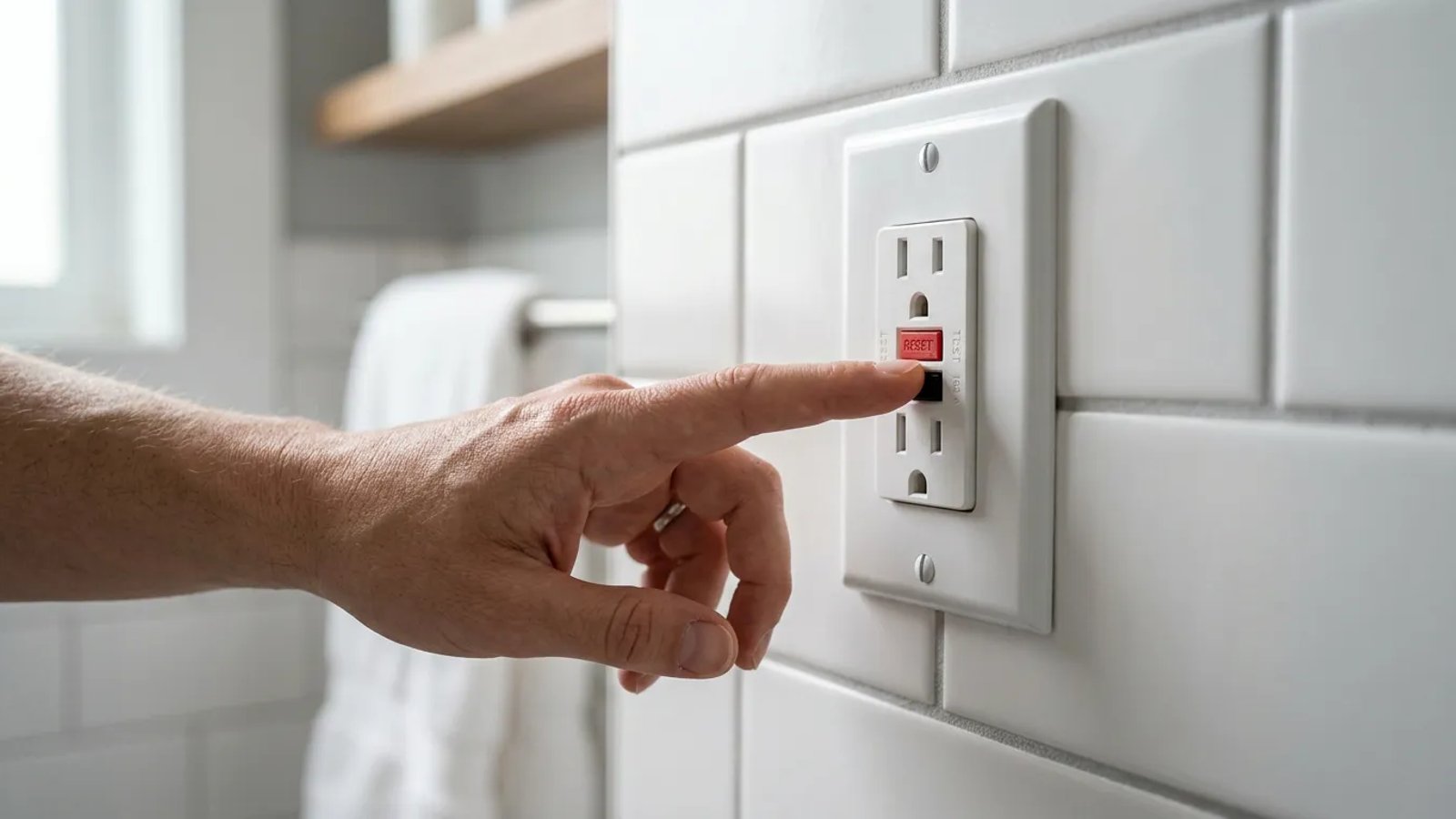
Full guide Electrical Learn how your home electrical system works and what parts are safe for you to handle.You are standing in the bathroom, drying your hair or shaving, when the power suddenly cuts out. You look down at the outlet, press the little reset button, and it immediately pops right back out with a stubborn click. When a gfci outlet won't reset, it is incredibly frustrating. It is easy to assume the receptacle itself is broken, but in most cases, that little button is doing exactly what it was designed to do.
Ground Fault Circuit Interrupters (GFCIs) are safety devices built to save your life. They constantly monitor the electrical current flowing into a device and the current flowing back out. If the outlet detects an imbalance as tiny as 4 or 5 milliamps, it assumes the electricity is escaping somewhere it shouldn't, like through water or, worse, through you. In just 1/40th of a second, it cuts the power.
Troubleshooting a stubborn GFCI doesn't require an engineering degree. By following a logical process of elimination, you can figure out if a specific appliance is causing the issue, if water has breached the circuit, or if the outlet has simply reached the end of its lifespan.
Why Won't My GFCI Outlet Reset?
Before you start pulling off faceplates, it helps to understand the rules of GFCI behavior. Modern electrical codes require these outlets in areas prone to moisture: bathrooms, kitchens, garages, basements, and exterior walls. According to the Electrical Safety Foundation, the widespread installation of GFCIs has cut home electrocutions by half over the past few decades.
When the button refuses to stay pushed in, the outlet is either actively sensing a ground fault, it has no incoming power from the main breaker, or its internal sensor has permanently failed. Modern GFCIs built after 2015 include an auto-monitoring feature. Under current standards as of 2026, if the internal circuitry stops working, the outlet purposefully locks you out. It will not allow you to reset it, ensuring you are never left with an unprotected, powered receptacle.
A GFCI that refuses to reset is usually doing exactly what it was built to do: protecting you from a dangerous electrical shock.
Step 1: Unplug Devices When Your GFCI Outlet Won't Reset
The most common reason an outlet trips is a faulty appliance. A frayed wire inside a toaster, a failing motor in a hairdryer, or a power tool with a damaged cord will instantly trigger the safety mechanism. To isolate the problem, you need to clear the entire circuit. This can involve unplugging all devices currently drawing power.
- Unplug the active device. Remove whatever you were using when the power cut out.
- Test the reset button. Press the button firmly. If it clicks and stays in, your appliance is the problem, not the outlet.
- Clear the downstream outlets. If it still won't reset, unplug everything else in the room.
- Check adjoining rooms. GFCIs often protect standard outlets wired "downstream" from them. Unplug devices in nearby bathrooms or outside walls.
It is very common for a single GFCI in a garage to protect all the outdoor receptacles, or for one bathroom GFCI to protect the outlets in a second bathroom down the hall. You must ensure absolutely zero electrical load is drawing from the circuit before you can accurately test the main receptacle.
Step 2: Hunt Down Hidden Moisture
Water and electricity are a notorious combination. If clearing the appliances didn't work, moisture is your next prime suspect. GFCIs are incredibly sensitive to humidity and condensation.
We once spent an entire Saturday trying to diagnose a tripping garage outlet, only to realize a heavy rainstorm the night before had soaked an outdoor extension cord tied to the same circuit. The outdoor receptacle was wet, but the indoor GFCI was taking the hit.
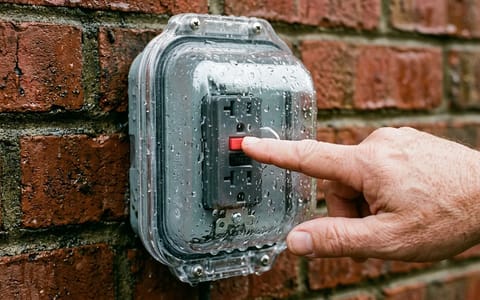
Check all exterior outlets for signs of water intrusion. Ensure the weatherproof covers are snapped shut and no sprinklers have been spraying directly at the wall. In bathrooms, heavy steam from a long shower can sometimes condense inside the outlet box. If you suspect moisture, do not attempt to dry it with a hairdryer or heat gun. Simply wait 24 hours for the box to air dry naturally, then attempt to reset the button again.
Step 3: Check the Main Breaker Panel
A GFCI requires incoming power to operate. If there is no power reaching the box, the reset button will feel "dead" and won't click into place. This often happens if the main circuit breaker in your garage or basement has tripped.
Walk to your electrical panel and look for any switches that have moved to the middle position. A tripped breaker won't always be completely in the "Off" position. It usually rests halfway between "On" and "Off". Firmly push the breaker all the way to "Off" until it clicks, and then push it back to "On". Return to the outlet and try the reset button again.
How Do I Know if the GFCI Receptacle is Dead?
Like any mechanical device, GFCIs wear out. The average lifespan is 10 to 15 years. Every time they trip, the internal contacts endure a tiny electrical arc, which eventually degrades the metal. Dust, high humidity, and frequent power surges also shorten their life.
To definitively test if the outlet is receiving power but refusing to function, you can use a basic plug-in receptacle tester. In 2026, these testers typically cost about $15 to $20 at most hardware stores and feature three LED lights. Plug it in. If no lights illuminate, and you have confirmed the main breaker is on, the outlet is likely dead.
If you are comfortable using a digital multimeter, you can carefully remove the faceplate and test the "Line" terminals (the screws where power enters the device) for 120 volts. If your multimeter reads 120 volts at the Line screws, but the outlet refuses to reset and provide power to the front plugs, the internal sensor has failed. The unit must be replaced.
The Rise of Smart GFCIs in 2026
If you need to replace a dead unit, consider upgrading to a smart GFCI. As of 2026, many homeowners are installing Wi-Fi-enabled receptacles that send instant smartphone alerts when they trip. This is especially useful for outlets powering garage freezers or basement sump pumps, where a silent power loss could cause expensive damage. These modern units also run continuous self-diagnostics and will alert you the moment their internal protection fails.
When It's Time to Call an Electrician
Replacing a GFCI is a straightforward project for a confident homeowner. You turn off the main breaker, verify the power is off with a non-contact voltage tester, and carefully swap the wires, ensuring you match the Line (incoming) and Load (outgoing) wires perfectly. Modern outlets clearly label these on the back.
You should also hire a licensed electrician if you open the electrical box and find crumbling wire insulation, signs of scorching, or old two-wire systems without a dedicated ground wire. While it is code-compliant to install a GFCI on an ungrounded circuit to add protection, the wiring must be handled correctly, and the outlet must be labeled "No Equipment Ground."
Electrical safety is never the place to cut corners. If your GFCI outlet won't reset, respect the warning it is giving you. Take the time to clear the circuit, check for water, and test the power. More often than not, a stubborn reset button isn't a nuisance. It is a sign the system is working exactly as it should to keep your home safe.
- Never force a GFCI reset button to stay in; if it pops out, the safety mechanism is working.
- A single GFCI often protects multiple standard outlets 'downstream' on the same circuit.
- Check outdoor outlets after heavy rain, as water intrusion frequently trips connected indoor GFCIs.
- Use a simple $10 plug-in receptacle tester to quickly verify if power is reaching the outlet.
- If the outlet refuses to reset with nothing plugged in and no moisture present, the unit is likely dead and needs replacement.