How to Prevent Siding Mildew From Returning Every Summer
Tired of scrubbing green grime off your house every summer? Learn how fixing poor airflow, overgrown landscaping, and overflowing gutters can stop siding mildew for good.
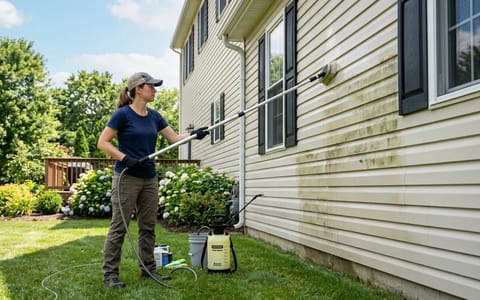
Full guide Exterior: Siding, Garage & Decks Learn how to maintain your siding, garage doors, and decks to protect your home from the weather.You spend a Saturday in June dragging a heavy pressure washer around the yard, mixing chemical cleaners, and scrubbing until your arms ache. The house looks fantastic by sunset. Then, a few weeks later, after a stretch of humid mid-summer rain, you walk outside and see it: the familiar, creeping green and black haze returning to the exact same spot. It is a frustrating cycle that leaves many homeowners feeling like they are fighting a losing battle against nature.
The hard truth is that cleaning the siding only treats the symptom. If you want to prevent siding mildew from returning permanently, you have to change the environment that allows it to thrive in the first place. Mildew and algae are simple organisms. They require three things to survive: a food source (like dust or tree sap on the siding), shade, and a constant supply of moisture. Take away the moisture, and the mildew simply cannot grow.
Instead of reaching for the bleach again, we are going to look at the structural and environmental factors around your home's perimeter. By improving wind circulation, managing ground moisture, and fixing drainage issues, you can break the wash-and-return cycle for good.
Why Does Mildew Always Return to the Same Spot?
If you take a walk around your property, you will likely notice that the mildew problem is not distributed evenly. It heavily favors the north side of the building, or areas tucked behind large, dense landscaping. This is not a coincidence. The north-facing walls receive the least amount of direct, drying sunlight throughout the day. Morning dew, rain, and humidity cling to these shaded panels for up to 4-6 hours longer than they do on the south or west sides.
Last July, I noticed the north side of my own house turning green just three weeks after a heavy soft-washing session. We measured the distance from the siding to the nearest row of mature hydrangeas—they were barely six inches away, and in some spots, the wet leaves were plastered directly against the vinyl. The dense foliage was acting like a sponge, holding morning dew against the house and completely blocking the wind.
According to the EPA guidelines on moisture control, the key to stopping biological growth on building materials is keeping them dry. When you have a shaded wall, you cannot rely on the sun to do the drying. You have to rely on wind. If you block the wind with overgrown shrubs, you are essentially building a custom greenhouse for mildew.
How Do I Prevent Siding Mildew with the Two-Foot Rule?
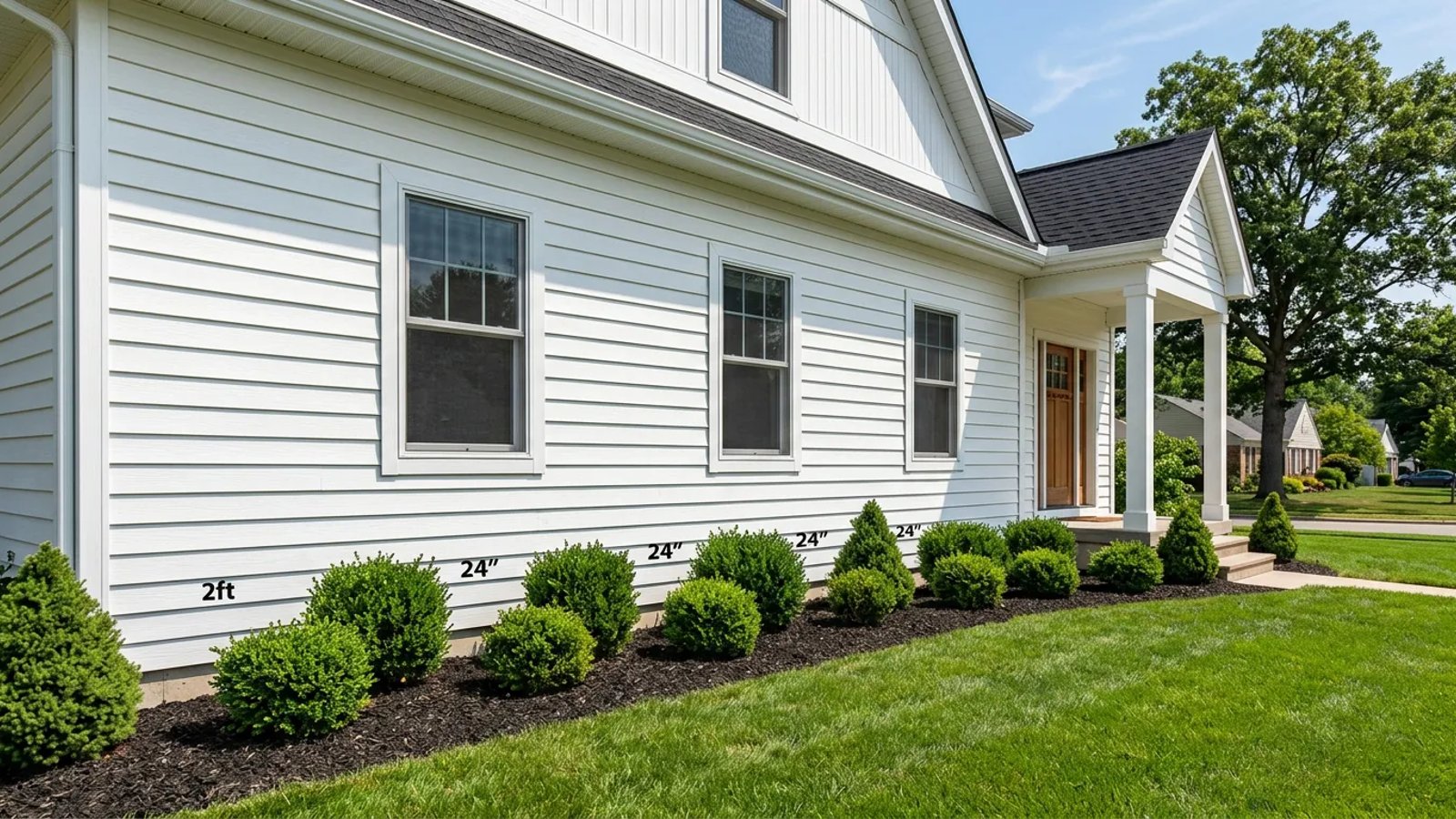
The single most effective landscaping change you can make to protect your home's exterior is implementing the "two-foot rule." This rule dictates that there should be a minimum of 24 inches of clear, empty air space between your home's siding and any plant life. This gap acts as an air channel, allowing breezes to sweep through and dry the siding rapidly after a rainstorm.
Airflow is the cheapest, most effective fungicide you will ever use.
Creating this air gap requires some aggressive pruning, especially if your foundation plants have been left to their own devices for a few seasons. Here is how to tackle the perimeter of your home to maximize wind circulation:
- Assess your foundation plantings. Walk around the house and identify any shrubs, bushes, or ornamental grasses that are touching or coming within two feet of the wall.
- Prune back the sides. Use a pair of sharp 10-inch bypass loppers ($25-$40 at a hardware store) to cut back branches. Cut them back slightly more than two feet to account for the rest of the summer's growth.
- Thin out the interior of the bushes. Do not just give the shrub a haircut on the side facing the house; remove some interior branches to allow wind to pass completely through the plant, rather than just around it.
- Trim overhanging tree branches. Look up. If low-hanging tree branches are casting deep shade on the roofline or siding, use a pole saw to remove them and let more dappled sunlight hit the wall.
- Clear out dead leaves and debris. Rake out the dead organic matter trapped between the base of the shrubs and the foundation, as this material holds excessive ground moisture.
The Hidden Culprit: Clogged Gutters and Splash-Back
Sometimes, the moisture feeding your siding mildew is not coming from the air; it is coming from your roof. Gutters are designed to catch thousands of gallons of water during a summer storm and route it safely away from the foundation. But when they are clogged with leaves, pine needles, or asphalt shingle grit, they fail completely.
When a gutter overflows, the water cascades over the front edge and plummets straight down. As it hits the ground, it creates a massive splash-back effect. This constant splashing throws dirt, organic matter, and water directly onto the lowest three or four panels of your siding. If you notice a heavy band of dark green or black grime specifically concentrated on the bottom two feet of your house, overflowing gutters are almost certainly the cause.
Keeping your gutters clear is a critical part of exterior moisture control. Check them at least twice a year, or more frequently if you have heavy tree coverage. Ensure that the downspouts are securely attached and that they route the water at least four to six feet away from the base of the house. You can buy simple corrugated plastic downspout extensions for about $10 to $15 each to easily direct water out into the yard.
Ground-Level Moisture: Mulch vs. Stone
The type of material you use in your foundation garden beds plays a massive role in how much moisture stays trapped near your siding. Wood mulch is incredibly popular because it looks great, suppresses weeds, and breaks down to feed the soil. However, it is designed to hold water. That is its primary job in gardening.
When you pile wet wood mulch directly against your foundation, you are creating a humid micro-climate right at the base of your siding. As the sun beats down on the yard, the moisture in the mulch evaporates upward, constantly bathing the lower panels of your house in humidity. Additionally, decomposing wood mulch is a natural home for fungal spores, which can easily catch a breeze and attach to your exterior walls.
To fix this, pull all organic wood mulch back from the house. Create a border of inorganic material directly against the foundation. A 12-inch to 18-inch strip of 5/8-inch crushed river rock or decorative gravel works perfectly. Stone drains instantly, does not retain moisture, and will not harbor fungal spores. This simple hardscaping trick dramatically reduces the ambient humidity around the base of your walls.
Mid-Summer Siding Inspection Checklist
To keep your exterior clean and dry for the rest of the season, run through this quick inspection. Catching these issues early saves you hours of scrubbing later.
That last point about sprinklers is often overlooked. Irrigation heads that are slightly misaligned can spray the side of your house every single morning. This daily soaking, especially in shaded areas, guarantees a rapid return of algae and mildew. Turn your sprinkler system on manually and watch the spray patterns to ensure the water is only hitting the grass.
Keeping Your Exterior Dry and Clean
You do not have to accept a dirty, green-tinged house as an inevitable part of summer. By understanding how moisture and shade interact to create a breeding ground for fungi, you can take control of your home's exterior environment. Grab your clippers, enforce the two-foot rule around your foundation, clear out those gutters, and pull the wet mulch back from the walls.
When you fix the airflow and drainage, you starve the mildew of the water it desperately needs. Your siding will stay cleaner, your house will look better, and next summer, you can leave the heavy pressure washer sitting in the garage where it belongs.
- Stop relying solely on pressure washing; fix the airflow around your house to starve mildew of the moisture it needs to survive.
- Enforce a strict 'two-foot rule' for all foundation plantings, ensuring nothing touches the exterior walls.
- Clean your gutters mid-summer to prevent rain from cascading over the sides and soaking your lower siding panels.
- Swap out moisture-retaining wood mulch for a 12-inch to 18-inch border of crushed stone right against the foundation.