Why Your GFCI Breaker Keeps Tripping (And How to Fix It)
A GFCI breaker that constantly trips is frustrating, but it is usually preventing a serious electrical hazard. Learn how to isolate the problem, test your appliances, and safely fix a faulty outlet.
Full guide Electrical Learn how your home electrical system works and what parts are safe for you to handle.Losing power in the middle of drying your hair or running a power saw is incredibly frustrating, especially when the reset button refuses to cooperate. However, when your gfci breaker keeps tripping, it is almost always doing exactly what it was designed to do: protecting you from a potentially fatal electrical shock.
A Ground Fault Circuit Interrupter (GFCI) is far more sensitive than a standard circuit breaker. While your main panel breaker trips to prevent wires from overheating and starting a fire, a GFCI monitors the actual flow of current. If it detects even a tiny imbalance—as small as 4 to 5 milliamps—it shuts off the power in a fraction of a second. Let's walk through how to safely isolate the problem, test your devices, and determine if it is time to replace the receptacle entirely.
Understanding GFCI Protection: Types, Locations, and Why it Trips
While the GFCI outlet you see in your bathroom or kitchen is the most common form of protection, it's important to understand that GFCI technology comes in a few different types, each designed to safeguard specific parts of your home's electrical system. Knowing the difference can help you pinpoint where protection is needed and why your particular GFCI might be tripping.
The most familiar is the GFCI receptacle, which replaces a standard wall outlet. These are installed directly into the electrical box and provide ground-fault protection for any appliances plugged into them. Crucially, a single GFCI receptacle can also protect all standard outlets wired "downstream" from it on the same circuit. This means one GFCI in your garage might be protecting several other non-GFCI outlets throughout the space, and even outdoor outlets.
Another key player is the GFCI circuit breaker, which is installed in your home's main electrical service panel. Instead of protecting just one outlet or a small series of outlets, a GFCI breaker protects an entire branch circuit. If a ground fault occurs anywhere on that circuit, the breaker trips, cutting power to all connected devices and outlets. These are often used for dedicated circuits like hot tubs, swimming pool equipment, or to provide protection to multiple circuits in older homes where adding many GFCI receptacles might be impractical.
There are also portable GFCIs, which are temporary devices you can plug into a standard outlet, and then plug your tool or appliance into the GFCI. These are excellent for outdoor work with power tools, ensuring you have protection even if the outlet you're using isn't GFCI-protected. Regardless of the type, their core function remains the same: to rapidly detect dangerous ground faults and interrupt the power flow.
Electrical codes mandate GFCI protection in at least eight key areas where water and electricity might mix, significantly reducing the risk of shock. This includes all bathrooms, kitchens (especially near sinks), garages, basements, crawl spaces, unfinished areas, laundry rooms, and of course, all outdoor receptacles. These requirements are in place because even a small amount of moisture can turn a seemingly safe area into a hazardous one if a ground fault occurs.
What Causes a Ground Fault?
A ground fault occurs when electricity escapes its intended path (the wiring) and finds a shortcut to the ground. If you happen to be touching the faulty appliance or wire, that shortcut could be your body. According to the Consumer Product Safety Commission (CPSC), the widespread installation of GFCI outlets has cut home electrocutions by half over the last few decades.
Common culprits for ground faults include frayed cords, water splashing onto an outlet, or old appliances with deteriorating internal insulation. Because the GFCI is so sensitive, even high humidity or a speck of conductive dust bridging the gap between the hot and neutral terminals can trigger a trip.
A GFCI doesn't trip to annoy you; it trips to save your life by detecting electrical leaks as small as four milliamps.
Why Does My GFCI Breaker Keep Tripping?
When you are dealing with a GFCI that trips repeatedly, the root cause usually falls into one of three categories: a faulty appliance, environmental interference (like water), or a worn-out receptacle. To figure out which one you are dealing with, you need to systematically isolate the circuit.
Many homeowners do not realize that a single GFCI outlet often protects several standard outlets wired "downstream" from it. I tested a client's outdoor circuit last summer that kept tripping the main garage GFCI. After an hour of checking the garage walls, it turned out to be a single frayed landscape light hidden in the wet bushes outside. The fault was outside, but the trip happened inside.
Step 1: Unplug Everything on the Circuit
The fastest way to diagnose a tripping GFCI is to remove all potential loads from the equation. This proves whether the issue is inside the wall or attached to the wall.
- Unplug all devices. Go to every outlet on the affected circuit and physically remove the plugs. Do not just turn the devices off.
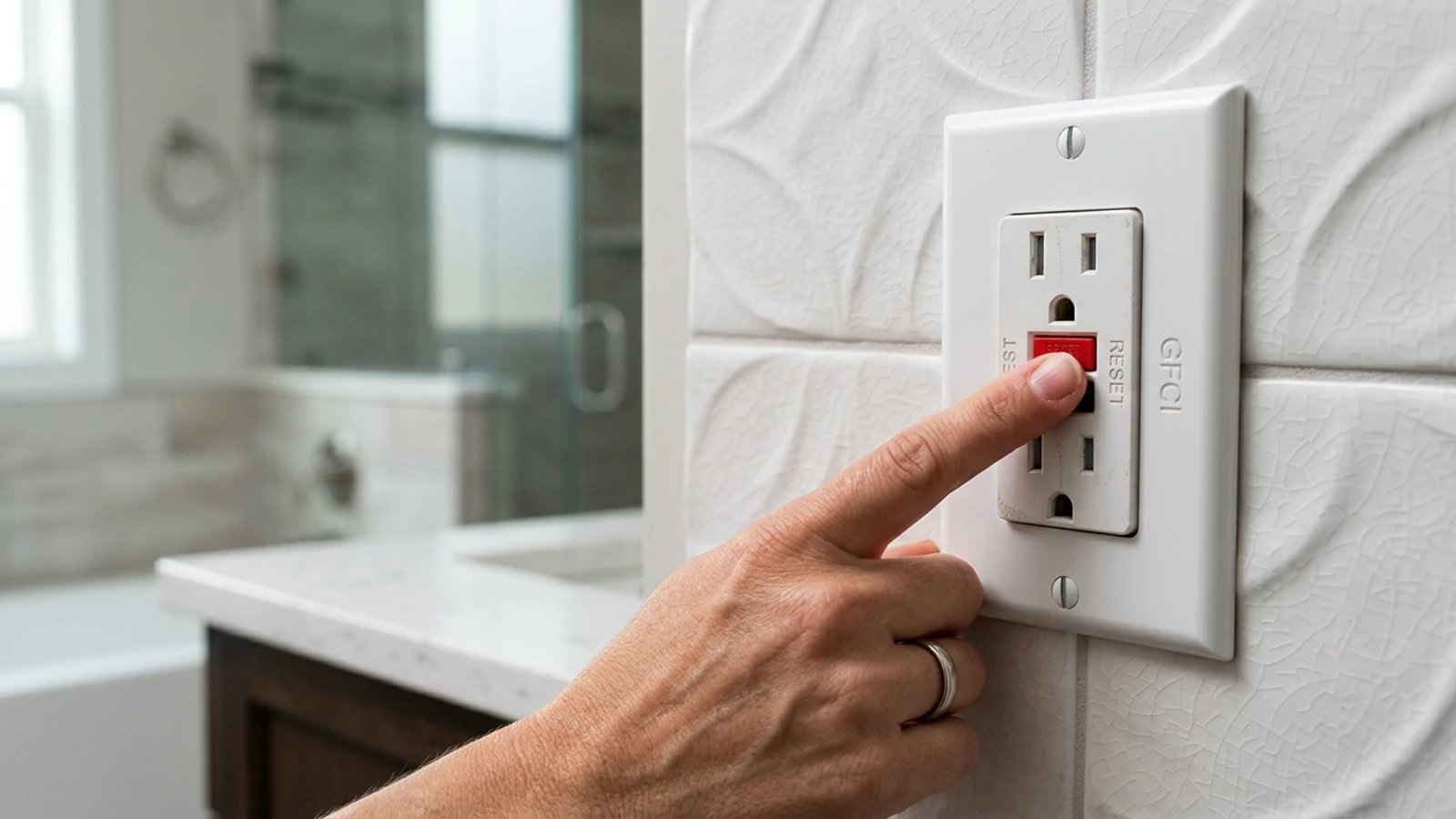
- Reset the GFCI. Press the reset button firmly. If it clicks and stays in, the wiring and the outlet are likely fine.
- Test the appliances. Plug your devices back in one at a time, turning each one on as you go.
- Identify the culprit. If the GFCI trips immediately when you plug in your coffee maker, you have found the ground fault. The appliance needs repair or replacement.
Step 2: Inspect for Moisture and Damage
Because electrical codes require GFCIs in wet locations—bathrooms, kitchens, garages, basements, and exteriors—moisture is the leading cause of nuisance tripping. A heavy rainstorm, high humidity from a hot shower, or a splash from the kitchen sink can easily introduce water into the electrical box.
Inspect the outlet visually. If you see condensation inside the slots or signs of rust on the mounting screws, water is bridging the connection. Turn off the breaker at the main panel and let the outlet dry completely. You can speed this up slightly with a hair dryer on a low, warm setting, but never use high heat on plastic electrical components.
Step 3: The Reset Test and Device Lifespan
If you have unplugged everything, the outlet is bone dry, and the GFCI still will not reset, you are likely dealing with a dead unit. GFCIs do not last forever. The internal circuitry that monitors the current degrades over time. A typical GFCI receptacle has a lifespan of about 10 to 15 years.
Modern GFCIs are built with a self-testing feature. If the internal sensor fails, the unit permanently trips and refuses to reset, cutting power completely. This is a safety mechanism to prevent you from using an unprotected outlet. If your outlet is older than a decade, replacing it is usually the most cost-effective next step.
How to Replace a Faulty GFCI Receptacle
If you are comfortable with basic DIY electrical work, swapping out a bad GFCI takes about 30 minutes. You will need a non-contact voltage tester, a Philips screwdriver, and a pair of wire strippers.
- Turn off the main breaker. Never work on live wires. Flip the breaker at your main electrical panel.
- Verify the power is off. Use a non-contact voltage tester on the outlet slots and the wires once you pull the receptacle out of the wall.
- Note the wiring layout. GFCIs have specific "Line" (incoming power) and "Load" (outgoing power to other outlets) terminals. Take a photo of the old wiring before disconnecting it.
- Connect the new outlet. Attach the incoming hot and neutral wires to the Line terminals, and the downstream wires to the Load terminals. Connect the bare copper wire to the green ground screw.
- Restore power and test. Turn the breaker back on and press the reset button. Use a lamp or tester to confirm power is flowing.
Dealing with electrical issues requires patience and a strict adherence to safety. By isolating your appliances and understanding how a GFCI operates, you can quickly determine if you just need to throw away an old toaster or replace an aging receptacle. To keep your home safe, make it a habit to press the "Test" button on all your GFCI outlets once a month to ensure the mechanical components are still snapping into action when you need them most.
- A tripping GFCI is a safety mechanism doing its job to prevent electrical shocks.
- Isolating the circuit by unplugging everything is the fastest way to find the culprit.
- Replacing a worn-out GFCI is a $15 to $25 DIY project that takes under an hour.
- Outlets wired downstream can lose power when a single GFCI trips, confusing many homeowners.