Flickering Lights in One Room? How to Find the Cause Fast
Sitting in a room with flickering lights is annoying and slightly unnerving. Learn how to isolate the problem, from simple LED mismatches to serious wiring faults.
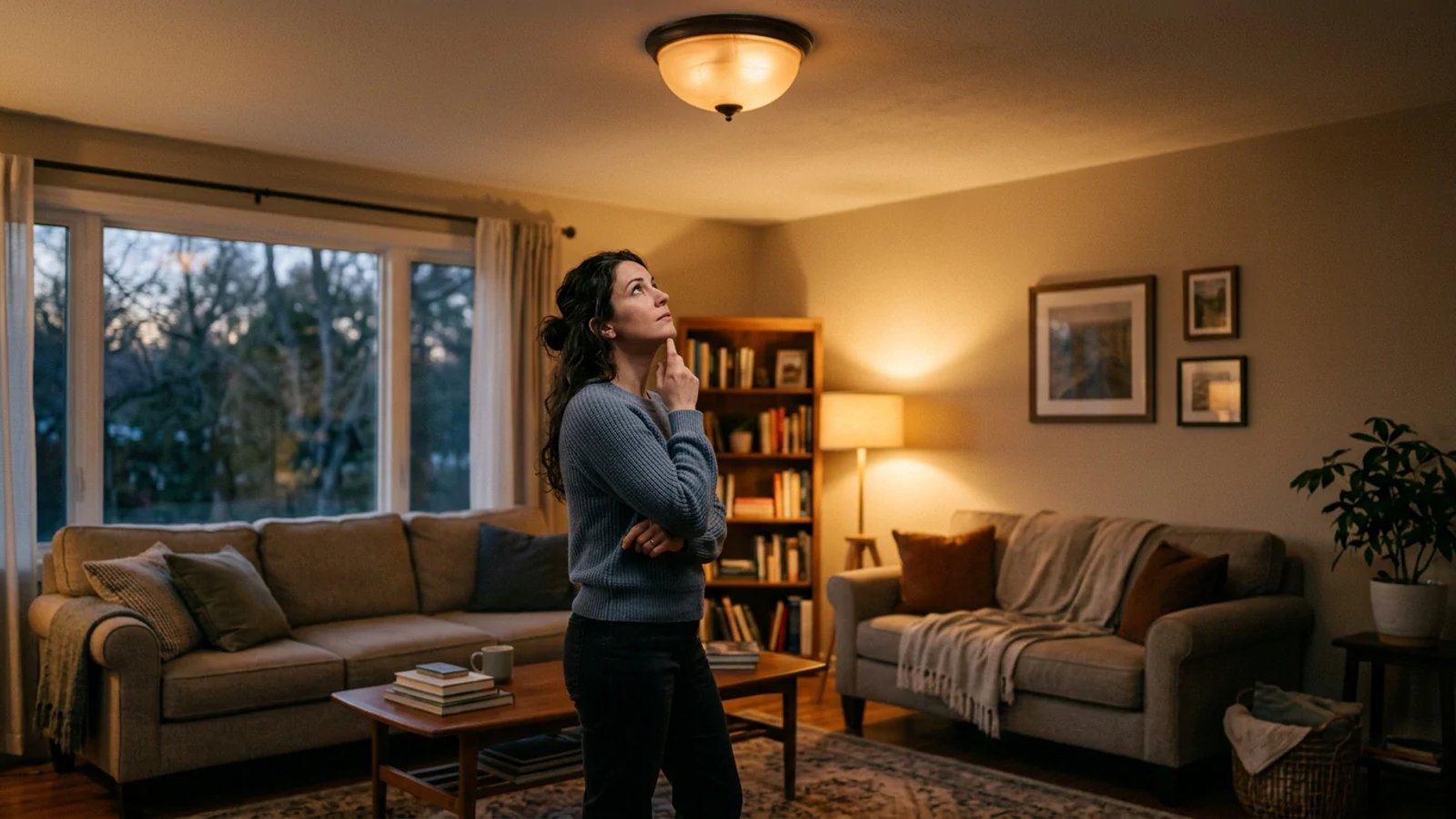
Full guide Electrical Learn how your home electrical system works and what parts are safe for you to handle.You are sitting on the couch reading a book, or perhaps lying in bed winding down for the night, when the lamp beside you starts to pulse. You look up, and the overhead fixture is doing it too. Having flickering lights in one room is incredibly distracting, but more than that, it tends to trigger a quiet sense of anxiety. Is this a harmless nuisance, or is a hidden electrical fire waiting to happen inside the drywall?
Electrical issues demand respect, but they do not always demand panic. In my experience, by paying attention to exactly when and where the pulsing occurs, you can narrow down the root cause with surprising accuracy. The fact that you have isolated the problem to a single area of the house is actually a massive advantage in troubleshooting.
We are going to walk through a logical, process-of-elimination approach to this problem. We will start with the simplest, cheapest, and safest fixes that any homeowner can handle in a few minutes, before moving on to the symptoms that indicate a serious wiring fault. By the end of this guide, you will know exactly what you are dealing with.
Why Are the Flickering Lights in One Room Actually Good News?
When you notice electrical oddities, the first step is always to determine the scale of the issue. If the lights in your kitchen, living room, and upstairs bedrooms are all dimming at random intervals, you are likely dealing with a systemic problem. Whole-house flickering usually points to an issue with the main utility drop coming from the street, a failing main breaker, or a major issue with the neutral wire at your electrical meter.
But if the problem is strictly isolated to a single bedroom or living space, you can breathe a slight sigh of relief. You have just ruled out the municipal power grid and the main service entrance. The issue is localized to a single branch circuit, a single wall switch, or even just a specific set of fixtures, often narrowing the investigation to one of just a few 15-amp or 20-amp circuits.
Most residential rooms are powered by one or two 15-amp or 20-amp branch circuits. Because the wiring is confined, the list of potential suspects is much shorter. Your job now is to figure out if the circuit is overloaded, if the hardware is incompatible, or if a physical connection is failing.
The LED and Dimmer Mismatch (The Most Common Culprit)
If you have recently updated your lighting, this is the very first thing you should check. The vast majority of flickering issues in modern homes come down to a technological mismatch between new bulbs and old switches.
A few years ago, I swapped out all six recessed halogen bulbs in my living room for energy-efficient, dimmable LEDs. The moment I slid the wall dimmer below 50 percent, the room turned into a low-budget strobe light. It turned out the 1990s-era switch on the wall was completely incompatible with the new technology.
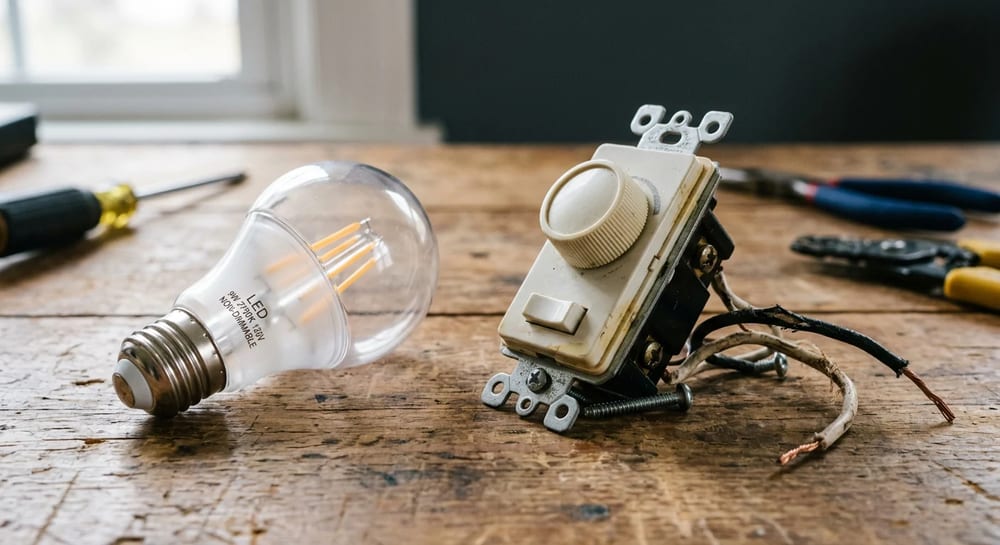
Older dimmer switches—often called leading-edge dimmers—were designed for incandescent and halogen bulbs. They work by rapidly cutting off the alternating current (AC) electricity dozens of times per second to reduce the total energy reaching the glowing filament. Because a hot tungsten filament cools down slowly, the human eye never sees the rapid power cuts; we just perceive a softer, dimmer light.
LEDs, however, do not have glowing filaments. They are digital devices with internal drivers that require a steady, specific voltage. When you feed an LED the choppy, cut-up power from an old incandescent dimmer, the LED's internal driver panics. It rapidly turns on and off, which you see as a distinct, annoying flicker or pulse.
How to Test for a Switch Mismatch
You can diagnose this issue in about two minutes without touching a single wire:
- Turn off the light switch. Wait for the current bulbs to cool down if they have been on for a while.
- Remove one LED bulb. Leave the others in place.
- Install a traditional incandescent bulb. Screw a standard 60-watt incandescent bulb into that empty socket.
- Turn the switch back on and test the dimmer. Slowly slide the dimmer up and down.
If the flickering stops entirely across all the bulbs in that fixture, you have found your culprit. The incandescent bulb acts as a buffer, absorbing the choppy current and stabilizing the circuit for the remaining LEDs. To fix this permanently, you will need to replace the old wall switch with an LED-compatible dimmer (usually a $20 to $30 part at the hardware store).
Is an Overloaded Circuit Causing the Drop?
If your lights are not on a dimmer, or if they only flicker at specific times of the day, you need to look at what else is pulling power in that room.
Standard residential lighting circuits are usually rated for 15 amps, which provides roughly 1,800 watts of total power before the breaker trips. In older homes, it is very common for the overhead lights and the wall outlets in a single room to share the exact same circuit.
When a high-draw appliance turns on, its motor requires a massive, temporary surge of electricity—often called inrush current. If that appliance is sharing a circuit with your lights, it will literally pull voltage away from the bulbs for a split second.
Common culprits that cause voltage drops in a single room include:
- Space heaters (which routinely pull 1,500 watts of continuous power).
- Window air conditioning units.
- Vacuum cleaners.
- Laser printers (the fuser roller draws a massive spike of power when warming up).
- Hair dryers or curling irons.
If your bedroom lights dim exactly when the space heater kicks on, the circuit is simply working at its maximum capacity. This is not necessarily a fire hazard, but it is a sign that you should avoid plugging any other high-draw devices into that room. If the dimming is severe, or if the breaker frequently trips, you will need an electrician to run a new, dedicated circuit for the heavy appliances.
Checking for Loose Connections at the Fixture
If you have ruled out dimmers and heavy appliances, the next step is to check the physical connections. Electricity requires a tight, secure path to flow smoothly. The slightest gap in a connection will cause the current to jump—or arc—across the empty space.
A loose connection doesn't just interrupt power; it creates electrical arcing, which generates intense heat and degrades the metal components.
Start with the simplest connection point: the bulb itself. Turn off the switch, wait for the bulb to cool, and check if it is screwed in tightly. Sometimes, normal house vibrations (like heavy footsteps on the floor above) can cause a bulb to back out of its socket just a fraction of an inch.
If the bulb is tight, look inside the socket. At the very bottom of the threaded socket is a small, brass contact tab. Over time, especially if bulbs have been screwed in too tightly, this tab can get flattened against the base, resulting in a poor connection.
Once the breaker is off and you have verified the power is dead with a non-contact voltage tester, you can use a small flathead screwdriver to gently pry the brass tab up about an eighth of an inch. This ensures it makes firm contact with the base of the next bulb you screw in.
When to Call a Pro: Red Flags of Dangerous Wiring
If you have gone through the steps above and the lights in your room are still flickering, dimming, or pulsing, you have reached the limit of basic DIY troubleshooting. At this point, you are likely dealing with a degraded wiring connection behind the walls, which requires professional intervention.
According to the Electrical Safety Foundation International (ESFI), home electrical fires account for thousands of injuries and billions in property damage every year. Many of these fires start with a loose connection that was ignored for too long.
You should immediately turn off the breaker for that room and call a licensed electrician if you notice any of the following red flags:
- Audible buzzing or crackling: If you hear a faint buzzing sound coming from the wall switch, the outlet, or the breaker panel when the lights flicker, this is the sound of electricity arcing. Arcing generates extreme heat and can easily ignite the surrounding drywall paper or wood framing.
- Switches that are hot to the touch: A dimmer switch might feel slightly warm under a heavy load, but a standard toggle switch should never feel hot. If the plastic faceplate is warm, melting, or discolored, shut the power off immediately.
- Flickering when walking nearby: If the lights flicker when you walk heavily across the floor, or when you shut a nearby door, you have a loose physical wire connection. This could be a loose wire nut inside the ceiling junction box, or a failing "backstabbed" connection on a wall switch.
- The smell of ozone or burning plastic: Electrical fires have a distinct, acrid smell before they produce visible smoke. Never ignore this odor.
Don't Ignore the Warning Signs
Flickering lights in one room are your home's way of asking for attention. While it is incredibly common for the issue to be nothing more than a cheap LED bulb fighting with an old dimmer switch, you should never simply accept the flickering as a quirk of the house. Take the time to swap the bulbs, map out your heavy appliances, and listen closely to your switches. Isolating the problem early keeps your home safe and saves you from much more expensive repairs down the road.
- Test a flickering fixture by swapping the LED for a standard incandescent bulb to rule out dimmer incompatibility.
- Map your room's circuit to see if a space heater or vacuum is causing the voltage drop.
- Never ignore a buzzing switch or a light that flickers when you walk across the floor above it.
- Tighten bulbs and check the metal tabs inside the socket before assuming the wiring is bad.