What is a declarations page?
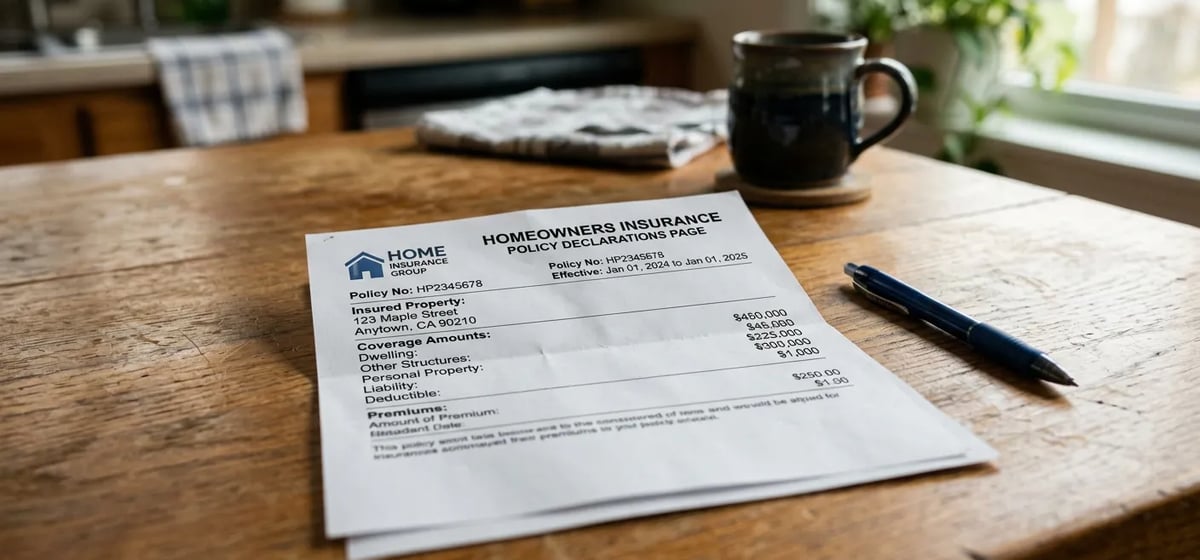
The word declaration comes from the Latin word declarare, which means to make clear. Insurance companies created this summary page to give you a quick, clear overview of your legal contract. The declarations page is usually the very first page of your home insurance policy. Most people just call it the "dec page" for short.
Instead of reading through 50 pages of dense legal text, you can look at this single document to see exactly what you bought. It lists who is insured, what property is covered, and how much the insurance company will pay if disaster strikes. You'll receive a new one every year when your policy renews.
What your dec page includes
Your declarations page packs a lot of important numbers into a small space. Here's what you'll find on it:
- Policy period: The exact dates your coverage starts and ends.
- Premium: The amount you pay each year for the policy. Average yearly premiums run from 1,200 to 3,000 dollars, though ranges vary widely based on your location and home size.
- Deductible: The amount you pay out of pocket before the insurance kicks in. This is usually a flat fee like 1,000 or 2,500 dollars. In some states, it might be a percentage of your total home coverage.
- Dwelling coverage: The maximum amount the insurance company will pay to rebuild the physical structure of your house.
- Personal property coverage: The limit for replacing your stuff, like furniture, clothes, and electronics.
- Liability coverage: The amount that pays for legal fees or medical bills if someone gets hurt on your property.
Why it matters to you
You need this document to keep your mortgage lender happy. When you borrow money to buy a house, the bank wants to make sure their investment is safe. They require you to carry home insurance at all times. Your declarations page is the official proof that you have enough coverage.
If you have an escrow account, your mortgage servicer uses the premium amount listed on this page to calculate your monthly payment. They collect a portion of your insurance cost every month and pay the annual bill for you. If your premium goes up, your monthly mortgage payment will go up too. You can learn more about how this works in our guide to mortgages.
When you'll need it
You'll run into your declarations page in a few specific situations. The first time is when you are buying a home. You can't close on the house until you send a copy of this page to your lender.
You'll also need it if you ever have to file a claim. If a tree falls on your roof or a pipe bursts, you'll want to check your deductible and your dwelling coverage limits before you call the insurance company. Finally, you'll need it if you decide to shop around for a better insurance rate. You can hand your current dec page to a new insurance agent so they can match your exact coverage levels and give you an accurate quote.
What to watch for
Always read your declarations page carefully as soon as it arrives in the mail or your email inbox. Look for simple typos in your name or your home address. A wrong address can cause massive headaches if you need to file a claim later.
Next, check your dwelling coverage limit. Construction costs go up over time. Make sure the amount listed is actually enough to rebuild your home today. If you added a new bathroom or finished your basement this year, you probably need to increase this limit.