What is a thermostatic expansion valve?
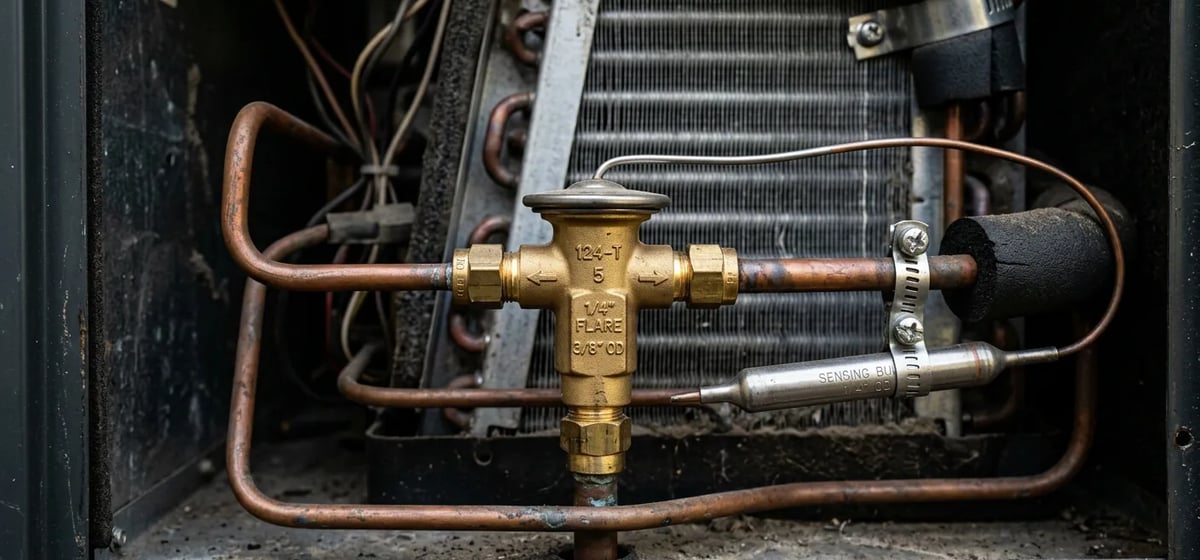
A thermostatic expansion valve is a small brass part inside your air conditioning system. You'll usually find it sitting right next to the indoor cooling coil. HVAC pros often call it a TXV for short. The word thermostatic comes from two Greek words. Therme means heat, and statos means standing. Engineers invented this valve back in the 1920s to make commercial refrigeration more reliable. Today, you'll find one in almost every modern home air conditioner.
Think of the TXV as the brain of your indoor cooling coil. It has a tiny sensing bulb attached to the refrigerant line. This bulb measures the temperature of the pipe. Based on that temperature, the valve opens and closes to control exactly how much cold liquid refrigerant sprays into the coil.
Why it matters to your home
This valve plays a huge role in keeping your house comfortable. If your air conditioner sprays too much refrigerant into the coil, the liquid can travel back to the compressor and destroy it. If it sprays too little, your system won't cool your house down. Your air conditioner will run all day and waste a lot of electricity.
By measuring the pipe temperature, the valve gives the coil the exact amount of refrigerant it needs at any given moment. This keeps your system running efficiently. It also stops the indoor coil from turning into a block of ice. If you want to learn more about how all these parts work together, check out our guide to HVAC & Climate Control.
Signs of a failing valve
A TXV can get stuck open or stuck closed. It can also lose the special gas inside its sensing bulb. When the valve fails, your air conditioner will quickly let you know. Watch out for these common warning signs.
- Your vents blow warm or room temperature air.
- You see thick ice or frost building up on the copper pipes outside.
- Your air conditioner runs constantly but never reaches the temperature set on your thermostat.
- Your monthly electricity bill suddenly spikes for no clear reason.
Replacement costs and repairs
Replacing a bad TXV isn't a project you can do yourself. It requires special licenses to handle the refrigerant gas. A professional must remove the old refrigerant, cut out the broken brass valve, weld a new one in place, and recharge the system.
If your air conditioner is still under the manufacturer warranty, the part itself is usually free. You'll only pay for the labor and the new refrigerant. This typically costs 400 to 800 dollars. If your system is out of warranty, you have to pay for the part too. In that case, the total bill usually runs from 800 to 1500 dollars. Keep in mind that local labor rates and part availability mean these ranges vary. If you aren't sure how to find a good repair company, read our tips on Hiring Contractors & What Things Cost.
How to protect your valve
You can't lubricate or clean the valve itself, but you can protect it by keeping your whole system clean. The most common reason a TXV fails is dirt and debris getting inside the refrigerant lines. This usually happens if a technician does a poor job installing the system. However, poor airflow can also put stress on the valve.
You should change your indoor air filter every 30 to 90 days. A dirty filter blocks airflow and forces the valve to work harder to balance the temperatures. You should also schedule a professional tune up every spring. A technician will check the refrigerant levels and make sure the sensing bulb is still strapped tightly to the copper pipe. If the bulb comes loose, the valve can't read the temperature correctly.