Change Your Smoke Detector Battery & Stop the Chirp

Stop that 3 AM chirp. Learn how to safely change your smoke detector battery, disconnect hardwired units, and reset alarms that won't stay quiet.
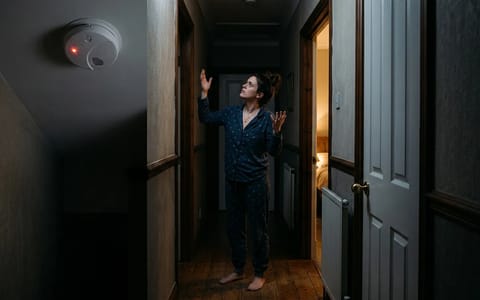
It is a universal rule of homeownership that a smoke alarm will only start chirping between the hours of 2:00 AM and 4:00 AM. That single, piercing beep echoes down the hallway, perfectly spaced about 60 seconds apart—just long enough for you to fall back asleep before it jolts you awake again. If you just grabbed your phone and typed "smoke detector batery" in a bleary-eyed panic while standing on a dining chair, you are in the right place.
Dealing with a low battery warning is frustrating, but it is also a critical maintenance task. A working fire alarm is the single most important safety device in your house. However, simply swapping the 9-volt or AA battery does not always fix the problem. Sometimes the chirp continues, or worse, the alarm triggers a full-volume false alarm for seemingly no reason.
Last winter, I spent 45 minutes standing on a step stool in my hallway, swapping three different brand-new batteries into a hardwired unit, only to have it continue chirping at me. It turns out, I was missing a crucial reset step. Let's walk through exactly how to safely remove your detector, swap the power source, and silence that noise for good.
Silencing the 3 AM Smoke Detector Chirp: A 5-Minute Fix
When you are dealing with a low-battery chirp, the immediate goal is to get the unit off the ceiling and stop the noise so you can think clearly. Most modern smoke detectors are mounted on a plastic base plate attached to the drywall. You do not need a screwdriver to remove the detector from this plate.
To remove the unit, firmly grasp the outer edges of the plastic housing and twist it counterclockwise. It usually only takes about a quarter-turn before the locking tabs release and the unit drops into your hand. If it feels stuck, do not yank it downward. Look closely at the rim; some commercial or older residential units have a tiny tamper-resist locking pin inserted into the side. If you see a small plastic pin, you will need to pull it out with needle-nose pliers before the unit will twist.
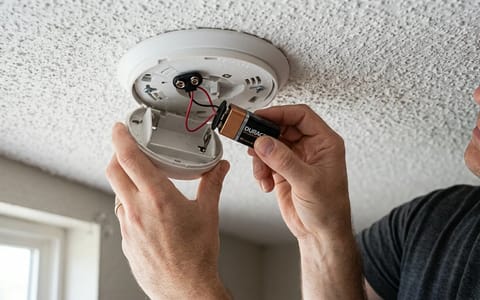
Once the unit is in your hand, locate the battery door. On many models, the door is on the back. On others, it is a slide-out drawer on the side. Remove the old battery immediately. If the unit is strictly battery-operated, removing the battery will instantly kill the power and stop the chirp. However, if you pull the unit down and find it tethered to the ceiling by a bundle of wires, you have a hardwired system.
How Do I Change a Hardwired Smoke Detector Battery?
Hardwired smoke detectors draw their primary power from your home's electrical grid, usually on a 120-volt circuit. The battery inside is just a backup in case of a power outage. Because it is connected to your home's wiring, many homeowners feel nervous about handling them. Fortunately, you do not need to touch any bare wires or use wire nuts to change the backup battery.
The detector connects to the ceiling wiring via a plastic quick-disconnect plug. This harness makes it entirely safe to detach the unit from the ceiling to work on it at a table.
- Turn off the breaker. While the quick-disconnect plug is safe to handle, flipping the breaker for the smoke alarm circuit adds an extra layer of safety.
- Twist the unit off the bracket. Rotate the detector counterclockwise until it drops from the ceiling plate.
- Support the detector. Do not let the unit dangle by its wires, which can damage the ceiling drywall or the harness connection.
- Squeeze the harness tabs. Look at the plastic plug inserted into the back of the alarm. Pinch the two small plastic tabs on the sides of the plug and pull it straight out.
- Open the battery compartment. With the unit completely detached, open the door on the back and swap the battery. Pay attention to the positive and negative terminal markings.
- Reconnect the harness. Push the plastic plug back into the detector until it clicks. It only fits one way, so you cannot plug it in backward.
- Remount the unit. Line up the tabs on the back of the detector with the slots on the ceiling bracket and twist clockwise until it locks into place.
Why Does My Smoke Detector Keep Going Off After a Battery Swap?
You put in a fresh battery, plugged the unit back in, and went back to bed. Ten minutes later, the chirp returns. Or worse, the full alarm sounds. This is the point where many people are tempted to smash the detector with a broom handle. Before you resort to violence, understand that the detector is likely dealing with one of three common issues: residual charge, environmental contamination, or expiration.
The Residual Charge Problem
Smoke detectors have internal capacitors that store a tiny amount of electricity. When the old battery dies, the detector enters an error state. Sometimes, even after you insert a fresh battery, the internal memory is still stuck in that error state because the capacitor never fully drained. The detector thinks the battery is still dead. You have to manually drain this residual charge to reset the logic board.
Dust, Spiders, and Humidity
Smoke alarms work by passing a small beam of light or a tiny electrical current through a sensor chamber. If smoke enters the chamber, it disrupts the beam or current, triggering the alarm. The problem is that the sensor cannot tell the difference between smoke particles, a thick layer of household dust, a spider web, or dense water vapor.
If your alarm keeps triggering full false alarms (three loud beeps, pause, three loud beeps), the chamber is likely dirty. Take the unit down and use a vacuum cleaner with a soft brush attachment to thoroughly clean the vents around the outside. Alternatively, use a can of compressed air to blow out the inside of the sensor chamber. If the alarm is located right outside a bathroom, steam from a hot shower can also trigger it. Wait for the humidity to clear, and the alarm should settle down.
The 10-Year Expiration Limit
If the unit is clean, the battery is new, and it is still chirping, check the back of the detector. Every smoke alarm has a printed date of manufacture. According to the National Fire Protection Association (NFPA), all smoke alarms must be replaced 10 years from the date of manufacture. The sensors degrade over time, losing their sensitivity. Many modern alarms have a built-in end-of-life timer. When they hit the 10-year mark, they will chirp continuously, and no amount of new batteries will stop it. If your unit is a decade old, you must buy a replacement.
How to Reset a First Alert or Hardwired Smoke Alarm
To fix the residual charge issue mentioned earlier, you need to perform a hard reset. This process forces the detector to forget its previous error state and recognize the new battery. This works for almost all major brands, including First Alert and Kidde.
First, remove the unit from the ceiling and disconnect the hardwired wiring harness if it has one. Next, take the battery completely out of the detector. Now, press and hold the "Test/Silence" button on the front of the unit for 15 to 20 seconds. You might hear a brief, faint chirp as the last bit of stored power is drained from the capacitor. Once you have held the button, release it, insert the fresh battery, and reconnect the wiring harness. The unit should now be fully reset and quiet.
Clearing the residual charge is the most skipped, yet most important, step when a new battery fails to stop the chirping.
How to Find the Initiating Alarm in an Interconnected System
Modern building codes require hardwired smoke detectors to be interconnected. This means that if the detector in the basement senses smoke, the detector in your second-floor bedroom will also sound the alarm. This is a brilliant safety feature, but it makes troubleshooting false alarms a nightmare.
When the whole house starts blaring at 3 AM, how do you know which detector is actually sensing the "smoke" (or dust) and which ones are just following orders? You need to look at the LED lights on the units.
While all the alarms will be making noise, only the initiating alarm will have a rapidly flashing red LED light. The other alarms will sound, but their red lights will remain off or flash very slowly. Walk through the house and check the lights. Once you find the one with the rapid red flash, that is your culprit. You can press the silence button on that specific unit to quiet the whole house, then take it down for cleaning or battery replacement.
What About Carbon Monoxide Alarms?
Combination smoke and carbon monoxide (CO) detectors follow the same battery replacement and reset rules, but they communicate differently. A standard smoke alarm beeps in sets of three. A carbon monoxide alarm beeps in sets of four (four rapid beeps, pause, four rapid beeps). If you hear four beeps, do not assume it is a false alarm or a battery issue—evacuate the house and call the fire department.
If a CO detector is chirping once every minute, it is a low battery. If it chirps five times a minute, that is almost always the end-of-life warning. CO sensors degrade faster than smoke sensors, and many standalone CO detectors expire after just 5 to 7 years, rather than 10. Check the back of the unit for the specific replacement timeframe.
Testing the System
Once you have swapped the battery, cleaned the vents, and reset the unit, remount it to the ceiling. Your final step is to test the system. Press and hold the test button on the front of the detector. It should sound a loud, piercing alarm. If you have a hardwired, interconnected system, holding the button on one unit should cause every other detector in the house to sound off within a few seconds.
Keeping your smoke detectors powered and clean takes a few minutes of effort, but it ensures your home is ready to alert you at the first sign of trouble. Keep a spare pack of 9-volt and AA batteries in a kitchen drawer, and the next time the 3 AM chirp starts, you will know exactly how to handle it quickly and safely.
- A single chirp every 30-60 seconds means low battery; three continuous beeps means smoke detected; five beeps usually means end-of-life.
- Never use rechargeable batteries in smoke detectors, as their voltage drops too rapidly at the end of their cycle.
- In an interconnected system, look for the unit with the rapidly flashing red light to find the one triggering the false alarm.
- Clearing the residual charge is the most skipped, yet most important, step when a new battery fails to stop the chirping.