What Is a Chalk Line?
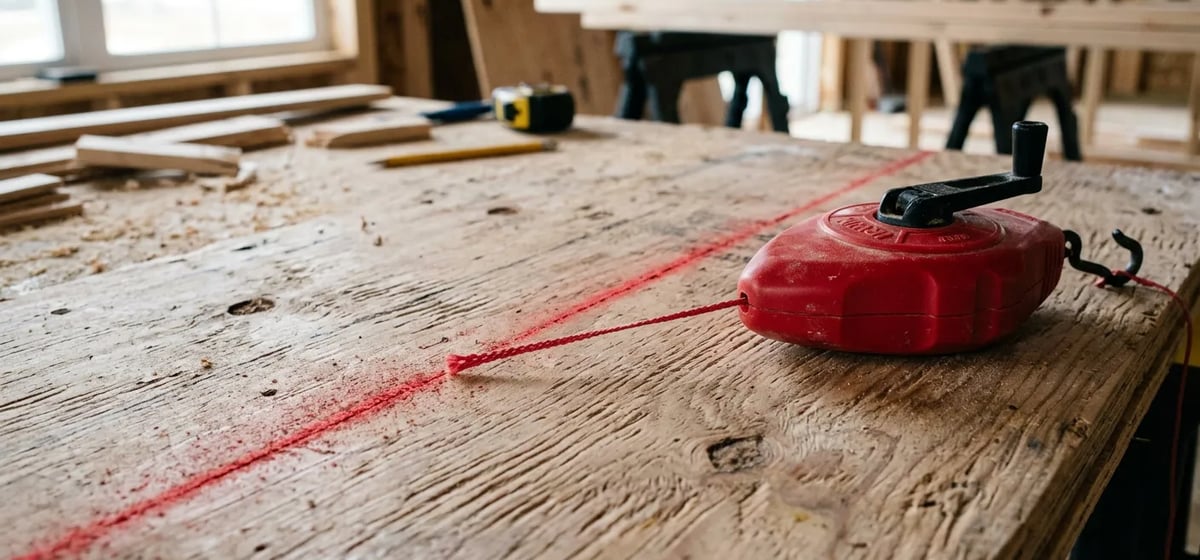
A chalk line is a simple hand tool that marks a perfectly straight line across a long flat surface. It looks like a small metal or plastic teardrop case. Inside the case is a spool of string and a pile of colored chalk dust. When you pull the string out, it gets covered in the dust. You pull the string tight across a floor or wall, lift it slightly, and let it snap back. The string leaves a straight line of colored dust on the surface. Because of this snapping action, many builders simply call the tool a chalk box or refer to the process as snapping a line.
Builders in ancient Egypt used string dipped in wet paint or chalk to mark straight lines on stone. The modern enclosed reel was patented in the US in the late 1800s. Today, it remains one of the cheapest and fastest ways to guide straight work over large areas. The design has barely changed in over a century because it works so well.
Why It Matters to You
If you plan to do any home updates, you need things to be straight. A tape measure and a pencil only work for short distances. A standard level is usually only two to four feet long. If you need a straight line that is ten or twenty feet long, a chalk line is the best tool for the job. A laser level can also give you a long straight line, but lasers are hard to see in bright sunlight and cost a lot of money.
You can buy a basic chalk line kit at any hardware store for $10 to $20. Costs vary based on the brand and the material of the case. A metal case costs a bit more than a plastic one but can survive being dropped off a roof. The chalk refills are also very cheap, usually costing $3 to $5 a bottle. Because it is so cheap and reliable, it belongs in every homeowner toolkit.
Where You Will See It
Contractors use this tool on almost every major project. You will see lines snapped on the ground before a contractor builds a new wall. Roofers snap lines on tar paper to keep shingles straight. You will also see it when workers install new Flooring. They snap lines on the bare subfloor to make sure the first row of tile or wood planks goes down perfectly straight.
If you are hanging wallpaper or adding a chair rail, you might use one for Interior: Paint, Drywall & Trim projects. It is also common outside. Builders use it to align fence posts, cut long sheets of plywood, or hang Exterior: Siding, Garage & Decks materials.
How to Use It
Using a chalk line is very easy. It works best with two people, but you can do it alone if you tap a small nail into the surface to hold one end of the string.
- Mark your starting point and your ending point with a pencil.
- Hook the metal tab at the end of the string to your starting point.
- Walk to the ending point while letting the string unspool from the box.
- Pull the string very tight so it hovers just above the surface.
- Pinch the string near the middle, lift it straight up an inch or two, and let it go.
- The string will snap against the surface and leave a crisp line of chalk.
- Reel the string back into the box when you are done.
What to Watch For
Always use blue chalk if you are marking a finished wall or a surface that will be painted later. Red chalk is strictly for outdoor use or for surfaces that will be completely covered by something else, like a subfloor hiding under carpet. Other colors like green or fluorescent orange are also available for specific jobs, but blue and red are the most common.
You also need to keep the tool dry. If the chalk powder inside the case gets wet, it turns into a hard clump. The string will not coat properly, and you will have to throw the tool away or spend a lot of time cleaning it out. Always store your chalk box in a dry toolbox or a sealed bag.