What is plumber's putty?
Plumber's putty is a soft clay used to stop water from leaking. You'll see it mostly in Plumbing projects. It creates a watertight seal around sink drains and the base of faucets. The word putty comes from the French word potee. That was a polishing paste made of tin dust. Plumbers took that idea and mixed clay with linseed oil to make a waterproof sealant.
Unlike glue or caulk, it never hardens completely. It repels water but remains flexible. It stays soft for years. This makes it very easy to remove a drain or faucet later if you need to replace it. You won't have to chip away hard cement if you ever want to change your sink hardware.
Where you use it
You use this putty anywhere metal meets a sink or tub. It fills the tiny gaps between the hard surfaces so water can't sneak through. Common spots include sink basket strainers, pop-up drains in bathrooms, and the base plates of new faucets. You'll also find it under the metal drain flange in your bathtub.
The putty acts as a custom gasket. It's much more reliable than rubber gaskets alone because it molds perfectly to the exact shape of your specific sink or tub. When you tighten the metal pieces together, the putty squishes flat. The extra putty squeezes out the sides. You just wipe that extra away with your finger.
When to avoid it
You can't use plumber's putty on everything. The linseed oil in the putty will stain certain materials.
You also shouldn't use it on plastic pipes or plastic sink basins. It can make some plastics brittle over time. If you have a stone counter or a plastic sink, you need to use silicone sealant or a special oil-free putty instead.
Putty is also not for pressurized pipes. Never use it to fix a leaking water supply line inside your wall. Putty only stops water that is draining away by gravity. It has no strength to hold back water pressure. If you have a leak on a threaded pipe joint, you need Teflon tape or pipe dope instead of putty.
How much it costs
This is one of the cheapest things you'll ever buy for your house. A small tub of plumber's putty costs between $3 and $5 at any hardware store. One tub will last you for many small projects. A tub can sit on your garage shelf for a few years. Just make sure you snap the lid on tight so it doesn't dry out. If it feels rock hard when you open it, just throw it away and spend another $4 on a fresh tub.
If you decide to call a professional instead, you'll pay much more for the labor. Hiring a plumber to replace a basic sink strainer usually costs $150 to $300. Prices vary based on where you live. If you want to save money, this is a great project to tackle yourself. You can read more about deciding when to do the work in our guide to DIY vs. Hiring a Pro.
How to apply it
Using this putty is very simple. It feels just like playing with modeling clay. If the putty feels a little stiff when you first take it out of the tub, just knead it in your hands for a minute. The heat from your hands will soften it up.
- Scoop out a small lump of putty with your fingers.
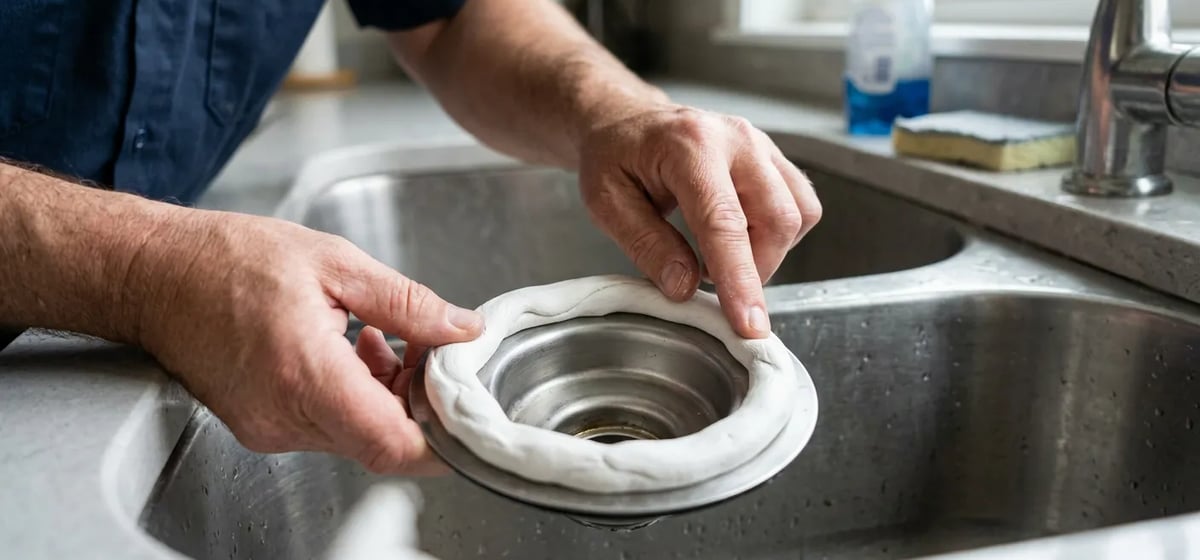
- Roll it back and forth between your hands until it forms a snake shape.
- Make the snake about as thick as a pencil.
- Wrap the putty snake in a circle under the rim of your drain piece.
- Push the drain piece into the sink hole and tighten the nut underneath.
- Wipe away the extra putty that squeezes out the top.
The putty doesn't need time to dry or cure. You can run water down the drain right away to test for leaks. If you see a leak, you might need to tighten the nut a little more.