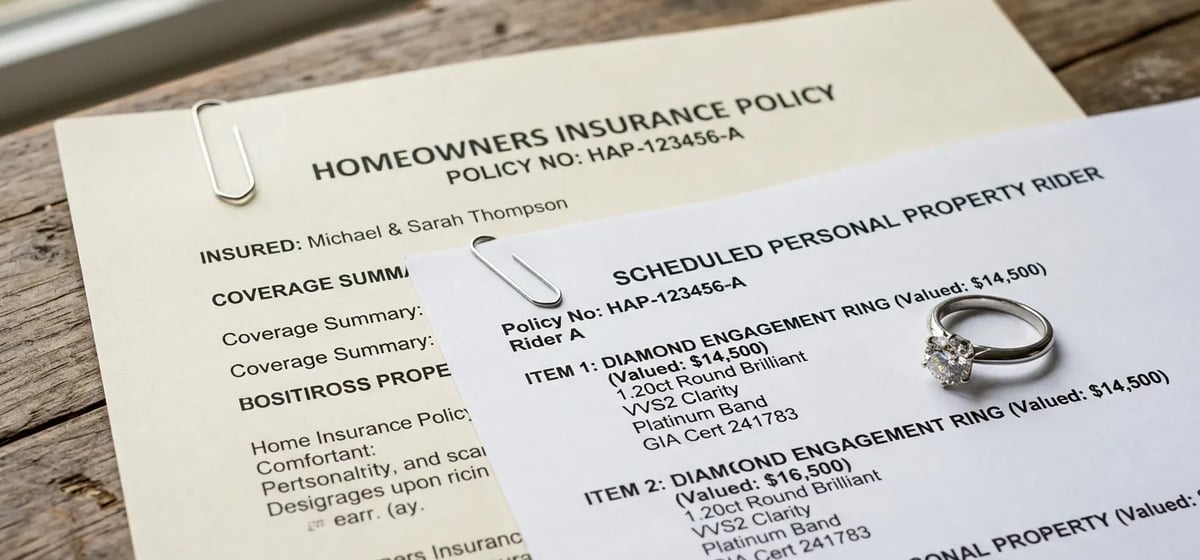
What Is A Rider?
A rider is an extra document you add to your standard Home Insurance policy. It covers specific valuable items that your base policy doesn't fully protect. The word started in the legal world to describe an extra clause that rides along with the main document. Insurance companies started using the term in the 1900s for extra coverages.
Your standard policy puts strict limits on certain categories of belongings. If your house burns down or gets robbed, the insurance company will only pay up to that limit for those categories. A rider boosts your coverage for a specific item so you get its full value back if disaster strikes.
Why It Matters To You
Many homeowners assume their main policy covers everything inside their house. That's a risky mistake. Most standard policies cap payouts for jewelry at 1,000 to 1,500 dollars. If a thief steals your 5,000 dollar engagement ring, your base policy leaves you thousands of dollars short. You'd only get the 1,500 dollar limit, minus your deductible.
When you buy a rider, you list the exact item and its exact value. The insurance company guarantees they will pay that full amount if something happens to it. Another massive benefit is that riders usually have no deductible. If you lose a covered item, you get a check for the full amount without paying anything out of pocket.
Riders also cover more types of accidents. A standard policy might only cover theft or fire. A rider often covers accidental loss. If your ring falls down the drain or you leave your expensive camera at a coffee shop, the rider pays to replace it.
Common Items That Need A Rider
You don't need a rider for your everyday furniture, televisions, or clothes. Your base policy covers those items just fine. You only need a rider for high value items that exceed your standard policy limits. Here are the most common things homeowners protect with a rider:
- Engagement rings, wedding bands, and expensive watches.
- Fine art, sculptures, and rare antiques.
- High end electronics and professional camera gear.
- Expensive musical instruments like a grand piano or vintage guitar.
- Coin collections, rare stamps, or expensive trading cards.
- High end sporting equipment like custom golf clubs or expensive bicycles.
What It Costs
Adding a rider is usually very affordable. The cost depends on what you're insuring and where you live, so ranges vary. As a general rule, expect to pay 1 to 2 percent of the item value per year.
If you have a 5,000 dollar watch, the rider will cost you roughly 50 to 100 dollars a year. A 10,000 dollar painting might cost 100 to 200 dollars a year to protect. You simply pay this extra amount alongside your regular premium. It's a small price to pay for total peace of mind when managing your Property Taxes & Home Finances. Plus, since there is usually no deductible, that small yearly fee pays off immediately if you ever need to file a claim.
How To Get A Rider
Getting a rider is a simple process. First, you need to prove what the item is worth. You can use a recent store receipt if the item is brand new. If the item is older, custom made, or inherited, you need to hire a professional appraiser to write up its current value.
Next, call your insurance agent. Tell them you want to schedule personal property. They will ask for a copy of the receipt or the official appraisal document. Once they process the paperwork, they add the rider to your policy. Your premium will go up slightly, but you're then fully protected against theft, damage, and accidental loss. Review these documents carefully as part of your New Homeowner Guide checklist to make sure your most precious items are secure.