What is a speed square?
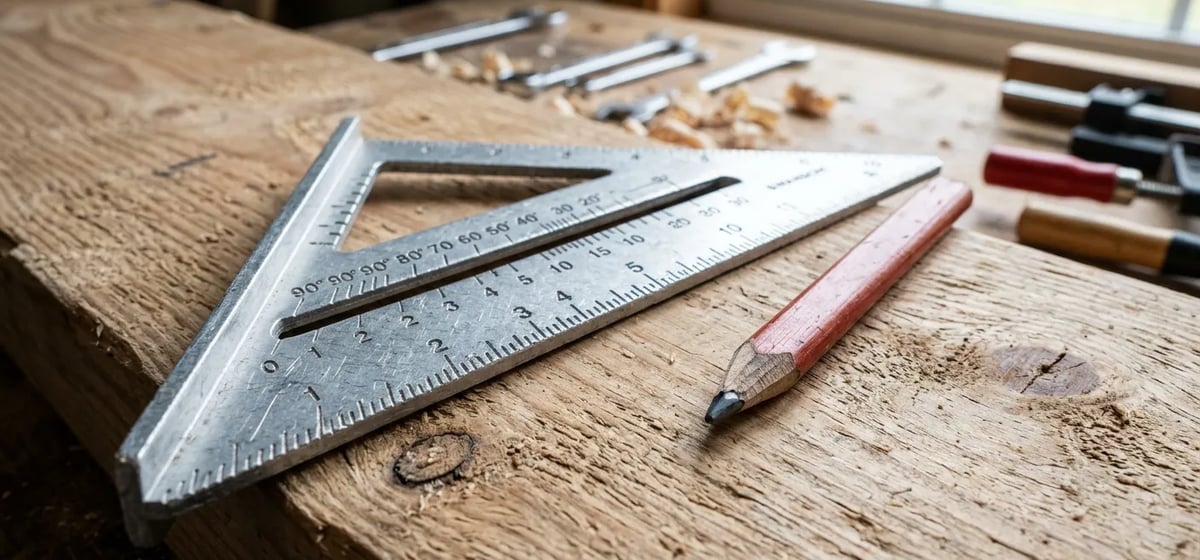
A speed square is a small metal triangle that carpenters use to mark straight lines and angles on wood. It features a thick lip on one edge. You can hook this lip quickly against a board to hold the square perfectly steady. Most are made of solid aluminum, but you can also find tough plastic versions. Albert Swanson invented and named this specific tool in 1925. He wanted a way to calculate roof angles much faster. The name stuck over the decades. Today, it's a common trade word for any rafter square. If you hire someone to frame a wall, you'll almost always see one of these sitting in their tool belt.
While professionals rely on them daily, they're also incredibly handy for homeowners. They combine several different measuring tools into one simple piece of metal. You get a try square, a miter square, a protractor, and a line scribe all in one compact tool. Because it has no moving parts, it never loses its accuracy. You can drop it off a ladder, and it'll still work perfectly.
How to use it for basic cuts
If you're cutting a piece of lumber, you need a straight line to follow. You just press the lip of the square against the edge of your board. Then, you draw a pencil line along the straight edge. This gives you a perfect 90 degree angle every single time. It takes only a second to line up.
You can also use it to mark 45 degree angles. The long diagonal edge of the triangle is perfectly set for this. You just slide the lip against the board and draw your line along that diagonal side. This is great when you're cutting trim or making basic frames. Many people also use the thick edge as a physical guide for their circular saw. You hold the square tightly against the wood and run the base of your saw right against the metal edge. This helps you make perfectly straight crosscuts without needing a large table saw. If you're weighing DIY vs. Hiring a Pro for a small backyard project, having this tool makes the DIY route much easier.
Understanding the markings
When you look closely at a speed square, you'll see a lot of numbers and lines stamped into the metal. These can look confusing at first. The outer edge usually has standard ruler markings in inches. You can use this just like a normal ruler to measure short distances.
The inside cutouts and numbers are for finding specific angles. One common track is labeled for hip and valley roof rafters. Another track is labeled for standard common rafters. Professionals use these numbers to figure out exactly how to cut wood so a roof fits together tightly. You might not build a roof yourself, but these markings are good to know about if you ever need to patch a shed roof. If you hire a professional for Roofing repairs, they use these exact same math principles. You'll also see a pivot point marked in the corner. You can hold a pencil at a specific inch mark, pivot the square, and draw a long straight line down the length of a board.
Buying one for your home
You don't need to spend a lot of money to get a high quality speed square. Prices vary by brand and material, but a standard 7 inch metal square usually costs 10 to 20 dollars. When shopping for one, keep these points in mind:
- Choose solid aluminum over plastic because it won't bend or melt in the sun.
- Look for a matte finish so the sun doesn't glare off the metal while you work outside.
- Make sure the lip is thick enough to grab the edge of slightly rounded lumber.
You can also find larger 12 inch versions. These usually cost 20 to 35 dollars. A larger square is helpful if you're marking wide boards or working on big landscaping timbers. However, the 7 inch version is the most common and practical choice for everyday home repairs. You can find them at any local hardware store or home center. Whether you're building garage shelves or working on projects related to your Exterior: Siding, Garage & Decks, this inexpensive tool will save you a lot of time and frustration.