What is the stack effect?
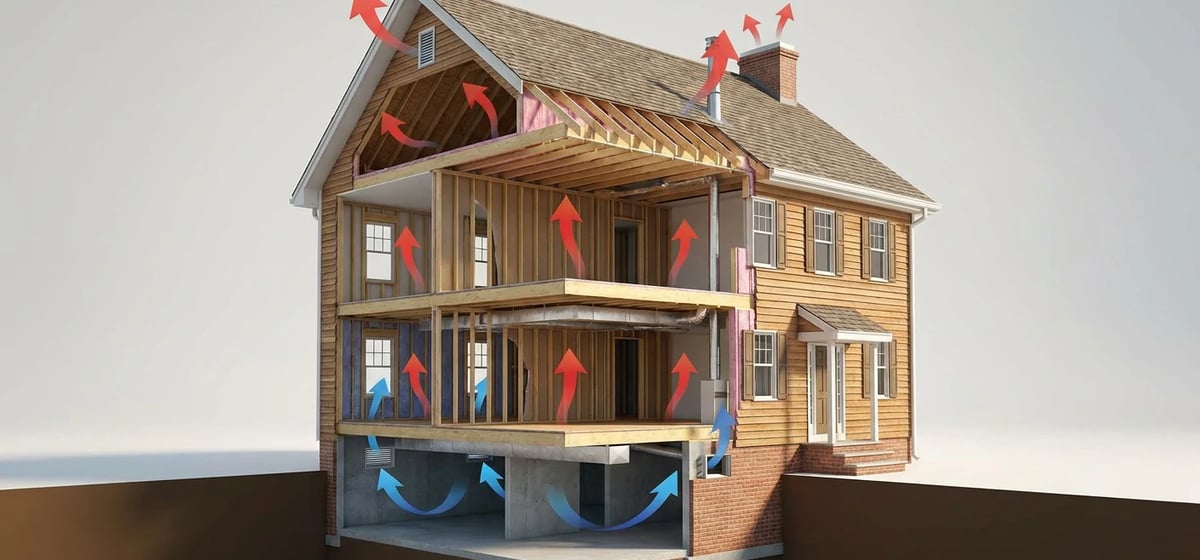
The stack effect is the way air moves through your home like a chimney. Warm indoor air rises and escapes through leaks in your roof or attic. This upward movement pulls cold outdoor air inside through gaps in your basement or ground floor. It happens because warm air is lighter than cold air. During the winter, your heating system warms the air inside. That warm air floats to the top of your house. If your attic has cracks or gaps, the warm air leaks outside. Your house then acts like a giant vacuum. It sucks in freezing outside air through the bottom of your house to replace the air you just lost.
The term comes from the word smokestack, which is a tall pipe used to exhaust smoke. Builders and scientists adopted the phrase in the early 1900s to describe the natural draft created by temperature differences inside tall buildings. Today, we know it happens in normal houses too.
Why it matters to your wallet
This invisible cycle costs you money. When warm air leaks out the top of your house, your heater has to work overtime. It must heat the new cold air that just got sucked in through the basement. This constant cycle drives up your utility bills. It also puts extra wear and tear on your heating equipment. You can learn more about keeping your system running well in our guide to HVAC & Climate Control.
The stack effect also makes your home less comfortable. You might feel cold drafts near your floors. Your upstairs rooms might feel stuffy or too hot. In the summer, the process reverses. Heavy cold air from your air conditioner sinks and leaks out the bottom of your house. This pulls hot, humid outside air into your attic and upper floors.
Where you run into it
You will notice the results of this air movement in a few specific places. The bottom and top of your house are the most important zones.
- The attic: Warm air escapes around recessed lights, attic hatches, and plumbing pipes that go through the ceiling. You might also lose air through vents in your Roofing.
- The basement and crawlspace: Cold air gets pulled in where the house frame meets the foundation. It also sneaks in around dryer vents and outdoor faucets.
- Windows and doors: Older frames often have worn weatherstripping. This lets air rush in or out depending on what floor you are on. Upgrading these seals is a common fix covered in Windows & Doors.
How to fix the problem
You can't stop warm air from rising. But you can stop it from escaping. The best way to fight the stack effect is to seal the leaks. Professional air sealing usually costs between $300 and $1,500. Prices vary based on the size of your home and how easy it is to reach your attic. You can also do a lot of this work yourself with a few tubes of caulk and some spray foam.
Look for dirty spots on your attic insulation. Insulation acts like an air filter. When air moves through it, it leaves behind dust. A dark patch of insulation usually means there is an air leak right below it. Move the insulation aside and seal the gap with expanding foam. Next, head to your basement. Seal the gap between your concrete foundation and the wooden frame of your house. By sealing the top and bottom of your home, you break the chimney effect and keep your conditioned air inside where it belongs.