What is a wall stud?
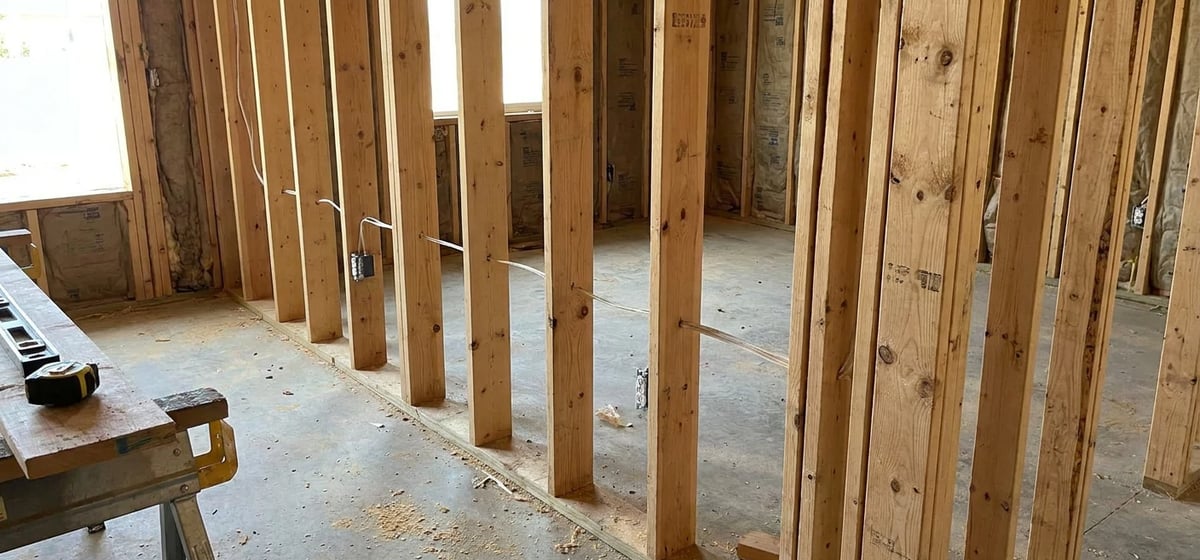
A wall stud is a vertical piece of wood that makes up the skeleton of your home walls. These boards stand straight up and frame the shape of your house. Builders attach your exterior siding to the outside edge of the studs. They attach your drywall to the inside edge. If you look at a house while it is being built, the studs look like a wooden cage.
Most homes in the United States use wood boards for studs. These are usually two-by-four or two-by-six boards. Builders space them out evenly. The standard spacing is 16 inches from the center of one stud to the center of the next. Some homes have studs spaced 24 inches apart. This spacing creates a strong frame that can hold up the weight of your roof and your upper floors. Older homes might have studs made of true rough-sawn lumber, which is slightly larger than modern lumber. Some newer homes or apartment buildings use metal studs instead of wood. Metal studs are fireproof and perfectly straight, but they require special screws when you want to hang something on the wall.
Why wall studs matter to you
Wall studs do two main jobs. First, they hold your house up. They carry the heavy loads from your roof down to your foundation. You can read more about how your home supports itself in our guide on Foundation & Structure. Second, studs give you a solid place to attach things to your walls.
Drywall is weak on its own. If you try to hang a heavy flat-screen television or a large mirror on just drywall, it'll likely rip out and fall. You need to drive your screws directly into a wood stud. The wood grips the screw tightly. This allows you to safely hang heavy items like kitchen cabinets, bookshelves, and large pieces of art.
How to find a wall stud
Since your studs are hidden behind drywall, you need a way to locate them. You have a few simple ways to do this.
- Use a stud finder: This is a small battery-powered tool. You slide it across the wall and it beeps when it senses the wood behind the drywall.
- Use a magnet: A strong magnet can find the metal screws that hold the drywall to the stud. When the magnet sticks to the wall, you know a stud is right there.
- Look at your outlets: Electricians nail electrical boxes directly to the side of a stud. If you find an outlet, there's almost always a stud on the left or right side of it.
- Measure from a corner: Since builders usually space studs 16 inches apart, you can often measure out from a corner in 16-inch steps to find the next stud.
- Knock on the wall: If you tap on the wall with your knuckles, a hollow sound means you're just hitting drywall. A solid, dull thud means you're tapping directly over a wood stud.
What to watch out for
Wall studs are usually out of sight and out of mind. However, things can go wrong inside your walls. Water leaks from a roof or a bad pipe can soak the wood. Over time, wet wood will rot. Rotted studs lose their strength and can cause your walls to bow or sag. Termites and carpenter ants also love to eat wood studs. If you see crumbling drywall or soft spots, you might have damage to the frame underneath.
You also need to be careful when doing home projects. Your home plumbing and Electrical systems run right through the middle of your wall studs. Builders drill holes through the wood to pass wires and pipes across the room. If you drill a long screw blindly into a wall, you could pierce a water pipe or hit a live wire.
What it costs to fix or add studs
The wood itself is cheap. A standard two-by-four board costs about $3 to $10 at a local lumber yard. If you're building a new wall, the labor costs much more than the wood. Hiring a carpenter to frame a basic interior wall usually costs $15 to $30 per linear foot.
Replacing a rotted stud is a bigger job. A contractor has to cut away the drywall, support the ceiling, remove the bad wood, and install a new board. Then they have to patch and paint the wall. This type of repair often costs $300 to $800 depending on the damage. Keep in mind that ranges vary based on your local area and the going rates for labor.