Solar Battery Backup Costs: Is It Worth It in 2026?
With the federal tax credit gone in 2026, the math on a solar battery backup has changed. Here is how to calculate if the true cost and ROI still make sense for your home.
Full guide Solar Panels Learn what solar panels cost, how they work, and if they make financial sense for your home.Homeowners are increasingly looking for ways to keep the lights on during grid outages, leading many to search for a solar battery backup. But with the expiration of the federal residential clean energy tax credit at the end of 2025, the financial math has changed drastically for 2026. If you are wondering if adding a battery to your solar array makes financial sense without that federal safety net, you need to look closely at localized costs, utility rates, and your actual power needs.
For years, a 30% federal discount made the decision to add storage relatively easy. Now, you are paying full retail price for the hardware and the labor. To figure out if the investment still holds up, we have to strip away the marketing and look at the raw numbers.
What Does a Solar Battery Backup Cost in 2026?
Without the federal tax credit cushioning the blow, the true cost of a solar battery backup, typically ranging from $11,000 to $17,000 for a single installed unit, is entirely on the homeowner's shoulders, barring any state-specific rebates. The price you pay is split between the physical battery unit, the supporting electrical hardware (like a critical loads panel or hybrid inverter), and the labor to install it.
For a standard 10 kilowatt-hour (kWh) to 13.5 kWh battery—which is the most common size for residential backup—expect the hardware alone to cost between $8,000 and $12,000. Labor and permitting typically add another $3,000 to $5,000, depending on your local market and the complexity of your home's wiring. That puts the total fully installed cost between $11,000 and $17,000 for a single battery.
If you want to back up heavy appliances like a central air conditioner, electric water heater, or an EV charger, a single battery will not cut it. You will likely need two or three units, pushing the total installation cost well over $25,000. This high upfront cost is the primary reason homeowners must calculate their expected return on investment strictly based on their daily utility savings, rather than just treating the battery as an emergency insurance policy.
Solar Batteries vs. Gas Generators: Which Makes More Sense?
When grid unreliability is your main concern, you have to compare the solar battery backup against the traditional alternative: a standby gas or propane generator. Both systems will keep your refrigerator running and your internet on during a blackout, but they operate on completely different financial and mechanical models.
A standby generator is significantly cheaper to install. A 14-kilowatt standby generator usually costs between $5,000 and $8,000 fully installed. However, generators are loud, require regular mechanical maintenance (oil changes, spark plug replacements), and rely on a constant supply of natural gas or liquid propane. If a severe storm disrupts the local gas lines, your generator becomes a heavy lawn ornament.
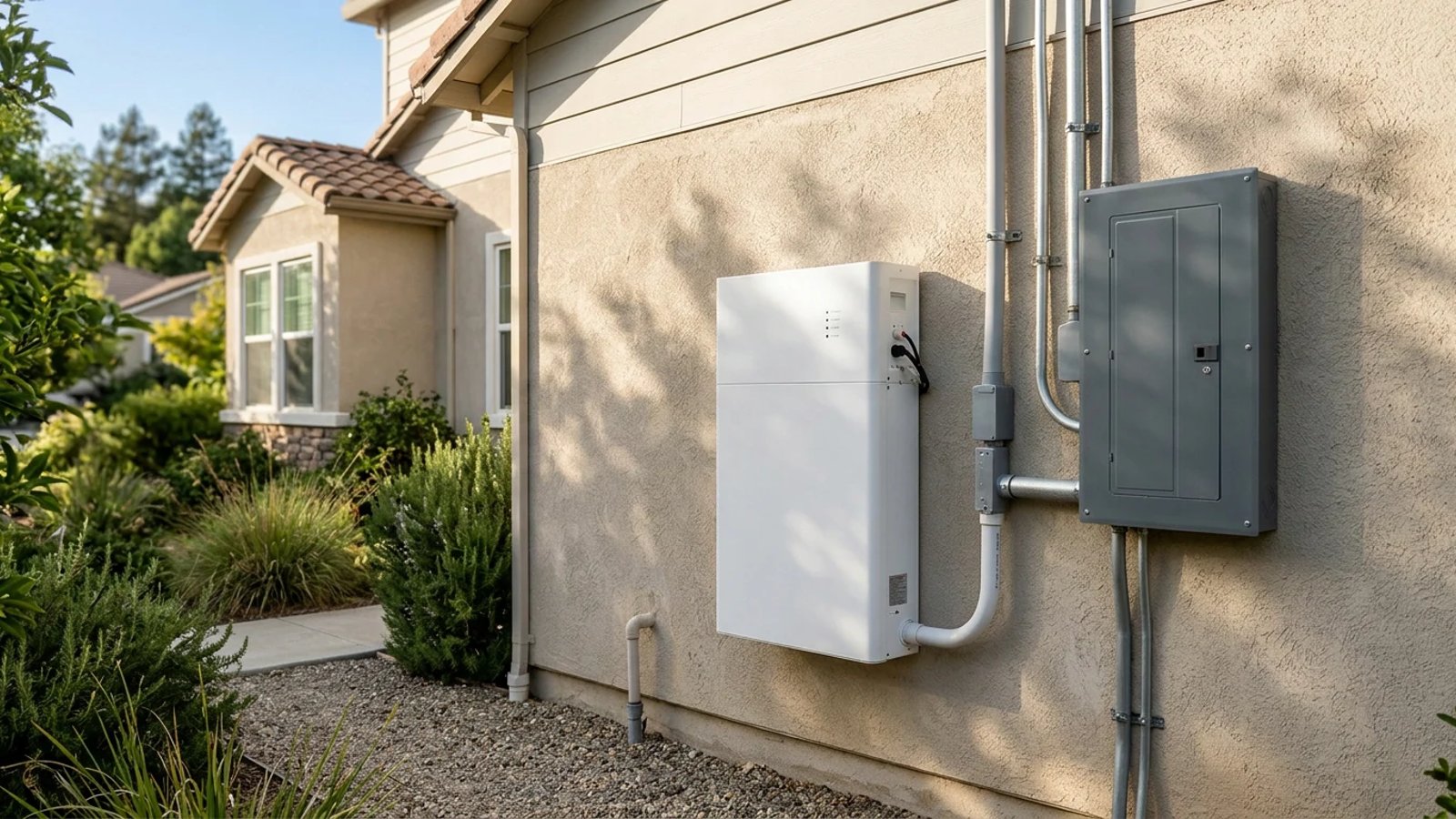
Solar batteries, on the other hand, are completely silent, require zero mechanical maintenance, and refuel themselves using the sun. Last year, I tracked the performance of a 13.5 kWh battery installed on a home in a high-Time-of-Use market. The homeowner paid $14,500 out of pocket. While the initial sting of the price tag was high, they never once had to worry about storing fuel, and the battery cycled silently in the garage every single day, shaving dollars off their evening power bill.
How Do Local Utility Rates Impact Battery Value?
The secret to justifying a solar battery in 2026 lies in how your utility company bills you for electricity. If you live in an area with flat-rate electricity and generous 1:1 net metering—meaning the utility pays you the same rate for the solar power you export as they charge you to buy power—a battery offers zero daily financial return. In that scenario, the grid is essentially acting as a free, infinite battery.
However, the utility landscape has shifted dramatically. Most major markets have moved away from 1:1 net metering. Instead, they buy your excess daytime solar power for pennies on the dollar, then turn around and charge you premium rates to buy power back in the evening when the sun goes down.
This is where a battery earns its keep. By storing your excess daytime solar power in your own battery, you avoid selling it to the utility at a steep discount. Then, when evening rolls around and utility rates spike, your home draws from the battery instead of the grid. Over a 10-year lifespan, this daily cycle of storing and self-consuming power can save you thousands of dollars.
How to Calculate Your Solar Battery ROI
To figure out if a battery makes financial sense for your specific house, you need to run a basic return on investment (ROI) calculation. Do not rely on the generic estimates provided by solar salespeople; run the numbers based on your actual utility bills.
- Check your net metering policy. Look at your utility bill or check your provider's website to see what they pay for exported solar energy. If they pay wholesale rates (often 3 to 5 cents per kWh), a battery will help you keep that valuable power.
- Review your Time-of-Use (TOU) rates. Identify the peak pricing hours on your bill. If electricity costs 45 cents per kWh between 4 PM and 9 PM, calculate how many kilowatt-hours your home uses during that five-hour window.
- Calculate daily savings. Multiply your evening energy usage by the peak TOU rate. If you use 8 kWh during peak hours at 45 cents, that is $3.60 saved per day, or roughly $1,300 per year.
- Divide the installation cost by annual savings. Take the total cost of the battery (e.g., $14,000) and divide it by the yearly savings ($1,300). In this example, the battery pays for itself in roughly 10.7 years.
Is Adding a Battery to Your Solar Array Worth It?
Deciding if a solar battery backup is worth the cost in 2026 comes down to balancing raw math with your personal tolerance for power outages. From a strict financial perspective, the loss of the federal tax credit makes the ROI timeline longer. If your payback period stretches past the 10-year warranty of the battery, the investment is tough to justify on savings alone.
However, if you live in an area with frequent grid instability—whether from winter storms, summer heatwaves, or aging infrastructure—the math changes. Losing a refrigerator full of food, having to book a hotel room, or losing days of remote work all carry distinct financial penalties. When you factor in the cost of those disruptions, the battery often pays for itself much faster.
Take the time to pull your last three utility bills, identify your peak usage hours, and map out exactly which appliances you consider critical during an outage. By understanding your true energy profile, you can confidently decide whether to invest in battery storage this year or wait for hardware prices to naturally drop in the future.
- Check your local net metering rules; if your utility buys back power at a fraction of the retail rate, a battery saves you money by letting you use your own stored power.
- Size your battery for critical loads—like the refrigerator, internet router, and a few lights—rather than trying to back up the entire house.
- Search for state and local utility rebates, which can still offset thousands of dollars even without the federal credit.