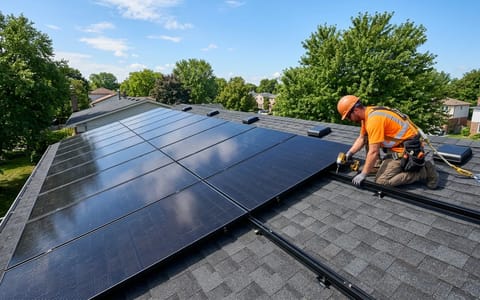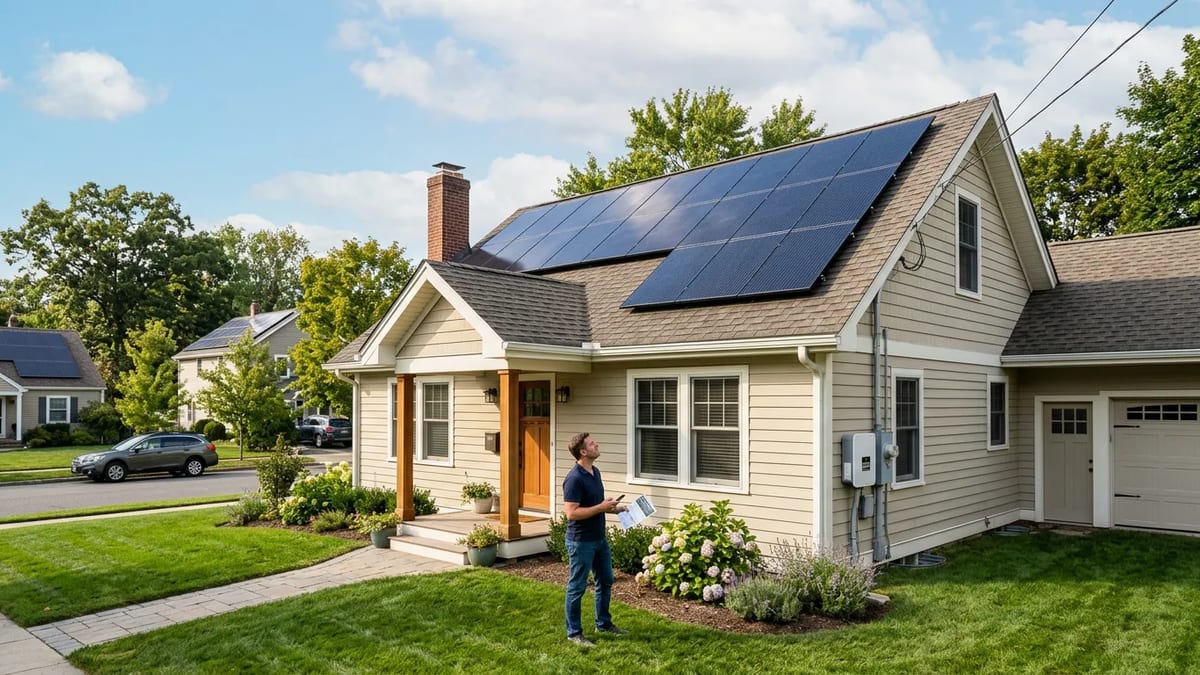
How Solar Panels Actually Work
Solar panels turn sunlight into electricity. The panels on your roof are made of silicon cells. When sunlight hits these cells, it knocks electrons loose. This creates an electrical current.
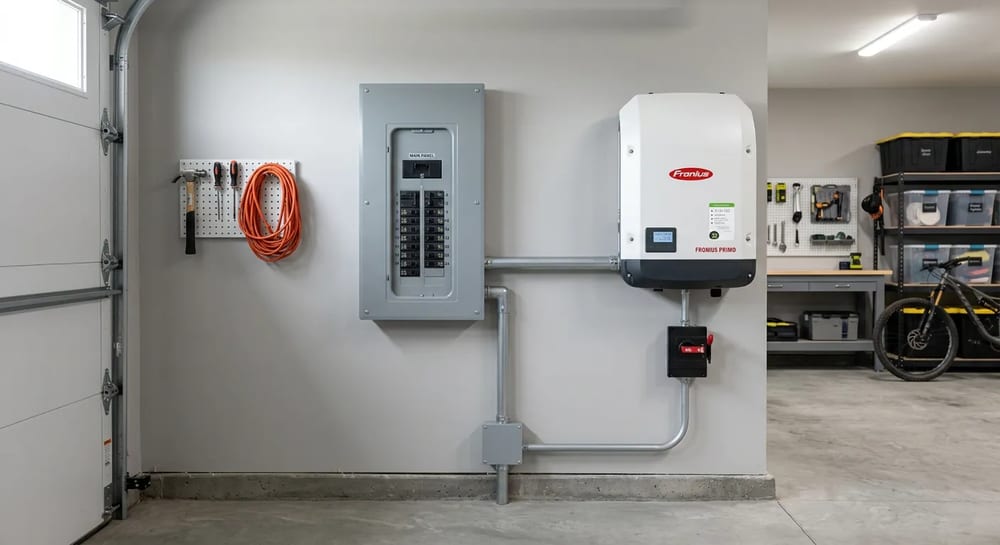
The current travels down a wire to a box called an inverter. The inverter changes the power into the type of electricity your home uses. From there, the power flows into your main breaker box to run your lights, appliances, and air conditioning.
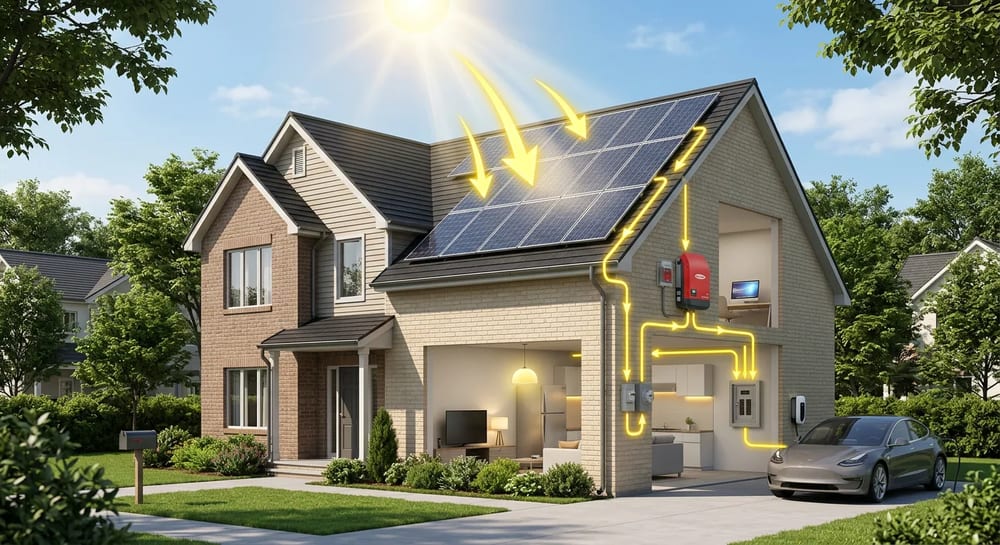
If your panels make more power than your house needs at that moment, the extra electricity goes back into the local grid. Your utility company often gives you a credit on your bill for this extra power. This process is called net metering.
The Main Parts of a Solar System
A home solar setup has four main pieces of equipment.
- Solar Panels: These sit on your roof and generate direct current electricity.
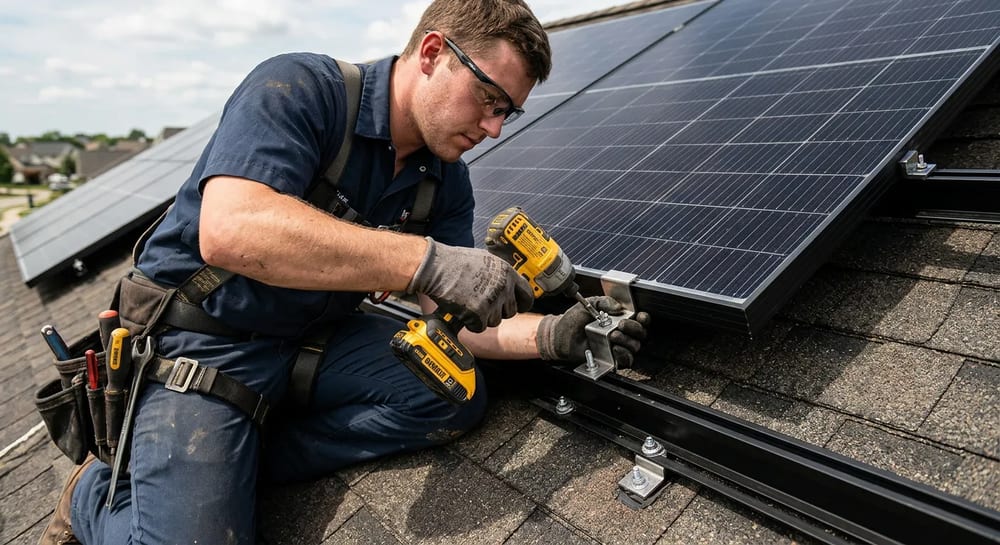
- Racking: This is the metal frame that holds the panels securely to your roof.
- Inverter: This box converts the direct current from the panels into alternating current for your house.
- Electrical Panel: Your existing breaker box distributes the solar power to your outlets. You can learn more about how your home handles power in our Electrical guide.
What Solar Panels Cost
Prices vary widely based on your region, the size of the job, and the age of your home. A typical home system costs $15,000 to $30,000 before any tax credits. Through 2025 buyers could claim a 30 percent federal tax credit, but that credit ended for installations completed after December 31, 2025 — today the price you negotiate is much closer to the price you pay, unless your state or utility chips in. Learn how home upgrades impact your taxes in our Property Taxes & Home Finances guide.
Here are some rough estimates for different system sizes.
| System Size | Average Cost Before Tax Credit | Cost After 30 Percent Credit |
|---|---|---|
| 5 kW (Small house) | $13,500 to $17,000 | $9,450 to $11,900 |
| 8 kW (Average house) | $21,600 to $27,200 | $15,120 to $19,040 |
| 12 kW (Large house) | $32,400 to $40,800 | $22,680 to $28,560 |
The chart below shows average total costs for common system sizes before any tax incentives are applied.
Are Solar Panels Worth It? Pros and Cons
The honest answer is that solar panels are worth it for many homes, but not all of them. Whether solar pays off for you depends on three things: how much you pay for electricity now, how much sun your roof gets, and what incentives your state and utility offer. Homeowners with high power bills and a sunny, south facing roof see the strongest returns. Homeowners in cloudy regions with cheap electricity often save very little.
Before you spend tens of thousands of dollars, weigh the real trade-offs. Here is an honest look at both sides.
| Pros | Cons |
|---|---|
| Lower or near-zero monthly electric bills | Large upfront cost ($15,000 to $30,000) |
| State and utility incentives in some areas (the federal credit ended after 2025) | Savings depend heavily on your local sun and rates |
| Protection from rising utility prices | Inverter needs replacing every 10 to 15 years |
| Often adds resale value to your home | A leased system can scare off home buyers |
| Clean power with very little maintenance | Won't keep the lights on in an outage without a battery |
To decide if solar is worth it for your specific house, work through these questions in order.
- Pull up your last 12 electric bills and find your average monthly cost. The higher it is, the more you stand to save.
- Check whether your roof faces south, east, or west and is mostly free of shade. North facing or heavily shaded roofs rarely pay off.
- Confirm your roof has at least 10 to 15 years of life left, or plan to replace it first. Removing panels for a new roof later is expensive.
- Look up your state and utility incentives, including net metering, which credits you for extra power you send to the grid.
- Get at least three quotes and compare each one's payback period against how long you plan to stay in the home.
Solar Installation Cost: What You Actually Pay For
When people search for how much solar costs, they usually want to know the install price, not just the panel price. The panels themselves are only about a third of your total bill. The rest covers labor, the inverter, mounting hardware, permits, and the installer's overhead. This is why two homes with the same size system can get very different quotes.
The clearest way to compare quotes is the price per watt. Most residential solar installs in the United States and Canada run $2.50 to $3.50 per watt before any tax credits. Multiply that by your system size in watts to estimate the total. A 6,000 watt (6 kW) system at $3.00 per watt comes to about $18,000 before the federal credit.
| Cost Piece | Share of Total | What It Covers |
|---|---|---|
| Solar panels | About 25 to 35 percent | The modules on your roof |
| Inverter | About 10 percent | Converts power for your home |
| Racking and wiring | About 10 percent | Mounting hardware and electrical parts |
| Labor and installation | About 20 to 25 percent | The crew on your roof |
| Permits, fees, and overhead | About 20 to 25 percent | City permits, inspection, company costs |
To estimate your own installation cost, follow these steps.
- Find your home's yearly electricity use in kilowatt hours, listed on your annual utility statement.
- Ask each installer what system size in kilowatts they recommend to cover that use.
- Multiply the system size in watts by a price of $2.50 to $3.50 per watt for a rough total.
- Subtract any state or utility incentives you actually qualify for — the 30 percent federal credit is gone for installs completed after 2025.
- Add a battery only if you need backup power, since batteries often add $10,000 to $15,000.
Understanding Kilowatts and Sizing Your System
Solar systems are measured in kilowatts, and your bill is measured in kilowatt hours. These two terms confuse most homeowners, but they are simple once you separate them. A kilowatt (kW) is a measure of power, or how much electricity something uses at one instant. One kilowatt equals 1,000 watts. A kilowatt hour (kWh) is a measure of energy used over time. Running a 1,000 watt appliance for one hour uses one kilowatt hour.
Your utility charges you per kilowatt hour. Your solar system, by contrast, is rated in kilowatts, which describes how much power it can produce when the sun is shining brightly. A 6 kW system does not make 6 kWh per hour all day. It only hits that peak in full midday sun, then produces less in the morning, evening, and on cloudy days.
To size a system, installers compare your yearly kilowatt hour use to how much sun your area gets. The table below shows roughly how much a system produces in a year, though real output varies with your roof and climate.
| System Size | Rough Yearly Output | Typical Home |
|---|---|---|
| 5 kW | 6,000 to 8,000 kWh | Small home, low usage |
| 8 kW | 10,000 to 13,000 kWh | Average home |
| 12 kW | 15,000 to 19,000 kWh | Large home, high usage |
Here is how to estimate the system size your home needs.
- Find your total yearly electricity use in kilowatt hours on your utility statement. A typical home uses 9,000 to 12,000 kWh per year.
- Divide that yearly number by about 1,300, a rough yearly output per kilowatt of panels in many regions.
- The result is the system size in kilowatts that would cover most of your power. For 11,000 kWh, that is roughly an 8.5 kW system.
- Ask installers to confirm the size with local sun data and your roof's exact angle and shading.
Does Your Roof Make Sense for Solar?
Not every house is a good fit for solar panels. You need a roof that gets plenty of direct sunlight. Large trees, tall buildings, or steep hills can block the sun and ruin your energy production.
The direction your roof faces also matters. In the United States, a south facing roof gets the most sunlight. East and west facing roofs work too, but they produce slightly less power. North facing roofs generally do not get enough sun to make panels worth the money.
Buying vs Leasing Solar Panels
You have two main ways to pay for a solar system. You can buy it or you can lease it.
Buying the system with cash or a solar loan is almost always the better financial choice. You get the federal tax credit, the panels add value to your home, and you eventually own the equipment free and clear.
Leasing a system means a company installs the panels for free, but they own the equipment. You buy the power the panels produce at a set rate. Leasing can cause big headaches later. Buyers often do not want to take over your lease if you decide to move. Check out our Selling Your Home guide for more tips on making your house attractive to buyers.
The Payback Period: Will You Save Money?
The payback period is the time it takes for your energy savings to equal the cost of the system. For most homes, this takes 6 to 10 years. After that period, the electricity your panels produce is essentially free.
To figure out your payback period, divide the total cost of your system by your yearly electricity savings. If you pay $20,000 for a system and save $2,500 a year on your power bill, your payback period is 8 years.
Finding a Good Installer
A good installer makes all the difference. Look for companies that have been in business for at least five years. Ask for references from local homeowners. Make sure the company handles all the permits and paperwork with your utility company.
Always get at least three quotes before you sign a contract. Compare the equipment they offer, the warranties, and the total cost per watt. For advice on vetting pros, read our Hiring Contractors & What Things Cost guide.
Do Solar Panels Work in Winter and on Cloudy Days?
Solar panels run on light, not heat. They still make power on a cold, bright winter day. In fact, cold air helps. Panels lose a little efficiency when they get very hot, so a clear freezing day can produce strong output as long as the sun is out.
Output does drop in winter, but not because of the cold. The days are shorter and the sun sits lower in the sky, so the panels get fewer hours of strong light. Clouds reduce output too. A heavily overcast day might cut production to a small fraction of a sunny day, but it rarely drops to zero. The panels keep working through thin clouds and haze.
Snow is the bigger issue. A thick layer of snow blocks the sun and stops production until it clears. Panels are dark and tilted, so they warm up and shed snow faster than the rest of your roof. Most light snow slides off within a day or two on its own.
What Affects Your Solar Output
Two homes with the same size system can produce very different amounts of power. Several factors decide how much electricity your panels actually make over a year.
- Roof direction and tilt: A south facing roof at a moderate slope captures the most sun in the United States and Canada. East and west roofs make less.
- Shade: Trees, chimneys, and nearby buildings that block the sun cut output sharply, even for part of the day.
- Season and daylight hours: Long summer days produce far more than short winter ones, so output swings through the year.
- Soiling: Dust, pollen, bird droppings, and ash build up on the glass and block light until rain or a rinse clears them.
- High heat: Very hot panels lose a small slice of efficiency, so peak summer output is slightly lower than the cool numbers suggest.
- Panel age: Panels slowly lose output as they age, usually around half a percent per year, so a 20 year old system makes a bit less than when it was new.
Maintaining and Cleaning Solar Panels
Solar panels need very little upkeep. They have no moving parts, and rain rinses off most dust and pollen on its own. For most homes, the panels look after themselves for decades.
You only need to think about cleaning in two cases. If you live in a dry, dusty region with little rain, or if heavy pollen, ash, or bird droppings coat the glass, a rinse can restore lost output. Spray the panels with a garden hose from the ground on a cool, cloudy day or early morning. Cold water on hot glass can crack it, so avoid the midday heat. Skip harsh soaps and pressure washers, which can damage the surface or the seals.
Keep an eye on your production through the monitoring app that comes with most systems. A sudden drop that rain does not fix can point to shading, soiling, or an inverter problem. The inverter is the part most likely to wear out, usually after 10 to 15 years, while the panels keep going for 25 years or more.
Solar Batteries and Backup Power
A standard rooftop system is tied to the grid, and it shuts off the moment the grid goes down. This is a safety rule. It stops your panels from feeding power into the lines while utility crews are working on them. So during a blackout, a normal solar home goes dark just like everyone else, even in full sun.
A battery changes that. It stores extra power your panels make during the day and releases it at night or during an outage. With a battery, your system can keep running on its own when the grid fails. You also get to use more of your own solar power instead of selling it back to the utility.
Batteries are not cheap. A home battery usually adds $10,000 to $15,000 to the project. You have two basic choices. A whole home setup backs up everything, including large loads like central air, but costs the most. An essentials setup backs up only key circuits, like the fridge, some lights, and outlets, which keeps the price and battery size down.