How to Clean a Dishwasher Filter (And Fix Bad Smells)
Fix foul odors and gritty dishes by learning how to locate, remove, and clean your dishwasher filter in under 10 minutes.
Full guide Appliances Learn how long your home appliances will last and when to repair or replace them.You just opened the dishwasher door expecting a rack of sparkling, squeaky-clean plates. Instead, you are hit with a smell resembling a wet dog mixed with old garbage, and your favorite drinking glasses are covered in a gritty, sand-like residue. If this sounds familiar, you aren't alone. Learning how to clean dishwasher filter assemblies is a maintenance task many homeowners miss entirely, leading to endless frustration and dirty dishes.
I've seen perfectly good appliances thrown out because the owner thought the motor was dying, when all it actually needed was a five-minute scrub. When your machine stops cleaning effectively, the filter is almost always the culprit. Let's look at why this happens, where to find the filter, and how to get your appliance back to washing dishes the right way.
Why Your Dishwasher Smells & The Importance of Cleaning the Filter
To understand why your dishwasher smells, you have to look at how appliance technology has changed. If you grew up with a dishwasher in the 1990s, you probably remember it sounding like a jet engine taking off in the kitchen. Those older models featured built-in hard-food disposers—essentially mini garbage disposals—that ground up food waste before sending it down the drain.
Homeowners hated the noise. To make modern dishwashers whisper-quiet, manufacturers removed the loud grinding motors and replaced them with manual mesh filters. This design change worked beautifully for reducing noise, but it created a new maintenance requirement.
You expect your dishwasher to clean your plates, but it can’t do that if it’s washing them with dirty, rotting food-water.
When you run a cycle, the machine continuously pumps water from the bottom of the tub, through the filter, and back out the spray arms. If that filter is clogged with congealed grease, stray noodles, and spinach leaves, the water pressure drops dramatically. Worse, the machine ends up recirculating that dirty, food-filled water right back over your plates. The rotting food sitting in the warm, damp bottom of the tub is exactly what causes that terrible garbage smell.
Signs Your Dishwasher Filter is Clogged
Before you start pulling parts out of your appliance, it helps to know the exact symptoms of a clogged filter. You rarely need to guess; the machine will usually tell you it is struggling.
Watch for these specific warning signs:
- Gritty residue: Glasses and bowls on the top rack feel like they are covered in fine sand.
- Stuck-on food: Plates on the bottom rack come out with food baked onto them, even after a heavy-duty cycle.
- Standing water: At the end of a cycle, there is a puddle of murky water sitting in the bottom of the tub that refuses to drain, often 1-2 inches deep.
- Foul odors: The appliance smells sour, musty, or like rotting food as soon as you open the door.
How to Clean a Dishwasher Filter (Step-by-Step Guide)
The good news is that you don't need any special tools for this job. Grab some Dawn dish soap, a soft-bristled toothbrush (an old one works perfectly), and a sponge. The entire process takes about 10 to 15 minutes.
- Empty the dishwasher. Remove the bottom dish rack completely and set it aside so you have clear access to the floor of the tub.
- Locate the filter assembly. Look at the very bottom of the tub, usually directly beneath the lower rotating spray arm. You will see a cylindrical plastic piece, often with arrows indicating which way to turn it.
- Unlock the main filter. Grip the top of the cylindrical filter and twist it counterclockwise. It should unlock with a quarter-turn. Lift it straight up and out.
- Remove the flat mesh screen. Beneath or around the cylinder, there is usually a flat, coarse metal or plastic mesh screen. Once the cylinder is out, this flat screen usually lifts right out with no twisting required.
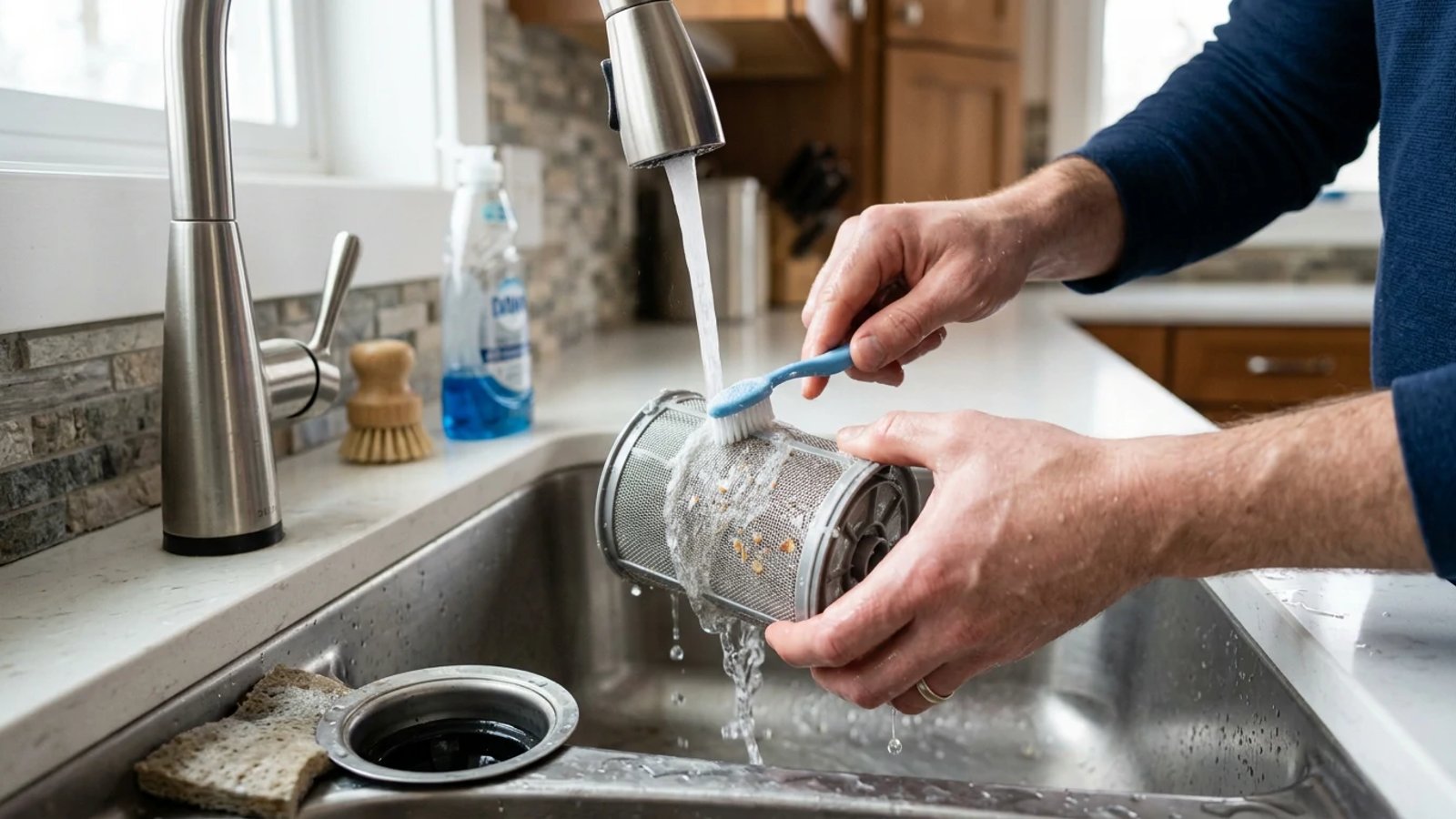
- Wash with warm soapy water. Take both pieces to the sink. Run them under warm water and use your soft toothbrush and dish soap to gently scrub away grease, calcium deposits, and food particles.
- Rinse the sump area. Take a damp sponge and wipe out the hole at the bottom of the dishwasher where the filter sits. You will often find stray popcorn kernels or bone fragments hiding here.
- Reinstall the flat screen. Place the flat mesh screen back into its recess at the bottom of the tub, ensuring it sits flush.
- Lock the cylinder in place. Drop the cylindrical filter back into the hole. Turn it clockwise until you feel it click or lock tightly into place. If the arrows don't align, it isn't locked.
What If the Filter is Covered in White Crust?
When I tested this on my neighbor's five-year-old Bosch dishwasher, the filter was entirely coated in what looked like wet, hardened cardboard. It was actually calcified grease and hard water scale. If soap and water aren't cutting through the grime, you need to break down the minerals.
Fill a small bowl with hot water and half a cup of white vinegar. Submerge the filter pieces in the vinegar solution and let them soak for 30 to 60 minutes. The mild acidity of the vinegar will dissolve the calcium and break down the stubborn grease, making it easy to wipe away with your toothbrush.
How Often Should You Clean It?
The frequency of this chore depends entirely on your dish-loading habits. If you are someone who washes your plates practically clean before putting them in the dishwasher, you won't need to do this very often. If you scrape the big chunks into the trash but leave the sauces and crumbs, you need a tighter schedule.
Here is a practical maintenance timeline:
- Once a month: If you only scrape your plates before loading, or if you run the dishwasher every single day.
- Every 3 to 4 months: If you rinse your plates lightly and run the machine a few times a week.
- Twice a year: If you thoroughly wash and rinse your plates before loading (though this defeats the water-saving purpose of the appliance).
The Vinegar and Baking Soda Deep Clean
Sometimes, simply cleaning the filter isn't enough to banish the bad smells. If the odor has permeated the walls of the tub or the drain hose, you need to flush the entire system. Once your freshly cleaned filter is locked back into place, perform a two-step deep clean.
First, place a dishwasher-safe bowl on the top rack of the empty machine. Pour one cup of plain white vinegar into the bowl. Close the door and run the machine on its hottest, heaviest cycle. The vinegar will steam through the appliance, breaking down soap scum and neutralizing odors.
Second, once that cycle finishes, open the door and sprinkle one cup of baking soda directly onto the floor of the dishwasher tub. Run a short, hot water cycle. The baking soda acts as a mild abrasive to scrub the internal hoses and leaves the stainless steel interior smelling incredibly fresh.
When to Call a Professional
While a clogged filter is the most common cause of dishwasher trouble, it isn't the only one. If you have cleaned the filter, wiped out the sump, and run a vinegar cycle, but your machine still refuses to drain, you have a bigger plumbing issue.
Taking care of your appliances doesn't have to be complicated or expensive. By spending just ten minutes a month maintaining your dishwasher filter, you protect the internal pumps, eliminate gross kitchen odors, and ensure you never have to eat off a gritty plate again.
- Locate the filter at the very bottom of your dishwasher tub, usually directly under the lower spray arm.
- Twist the cylindrical filter counterclockwise to unlock and remove it, then lift out the flat mesh screen beneath it.
- Never use a wire brush or harsh abrasive pads, as they will tear the delicate micro-mesh screen.
- Run a cycle with white vinegar after cleaning the filter to neutralize any lingering odors in the tub.