Know Your Home Shutoffs Before Disaster Strikes
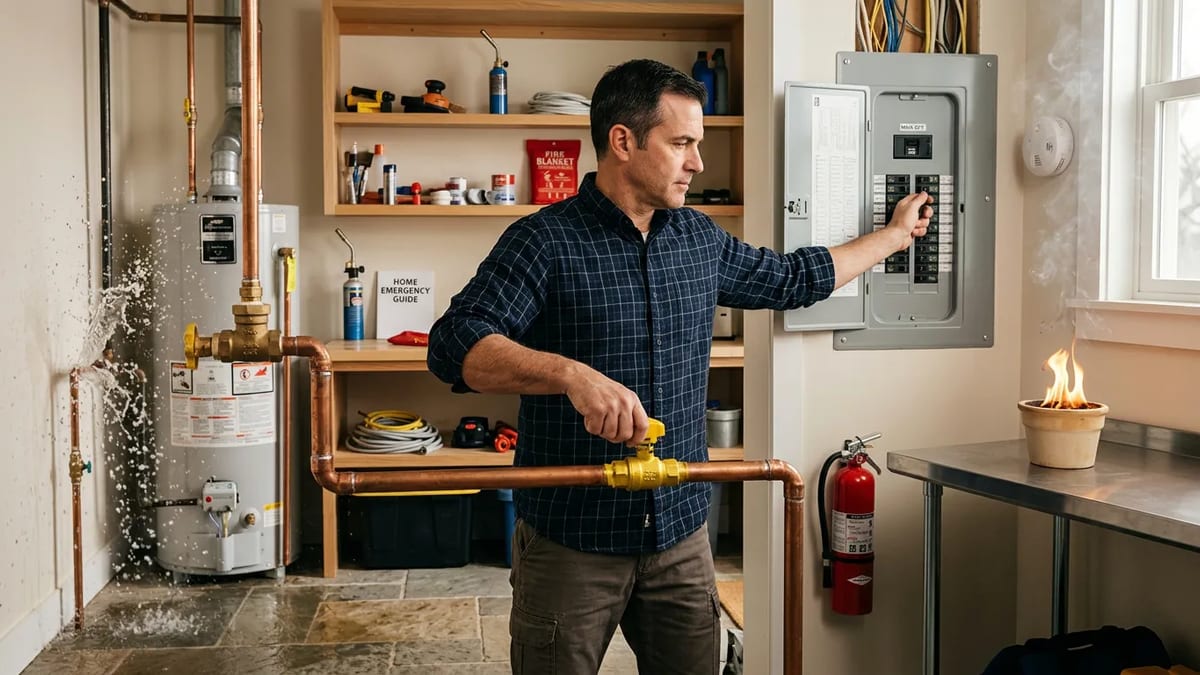
Every second counts when a pipe bursts or you smell gas. You need to know where your main shutoff valves are right now. Do not wait for an emergency to start looking. Walk around your house today and find your main water valve, gas meter, and electrical panel. Show everyone in your family where they are.
If you recently moved in, locating these valves is one of the most important steps in our New Homeowner Guide. Finding them in the daylight is easy. Hunting for them in the dark while water floods your basement is a nightmare.
How to Handle a Major Water Leak
Water destroys homes fast. If a pipe bursts or a toilet overflows and will not stop, you need to cut the water immediately. First, try the local valve. Look under the sink or behind the toilet. Turn the small oval knob clockwise to stop the flow.
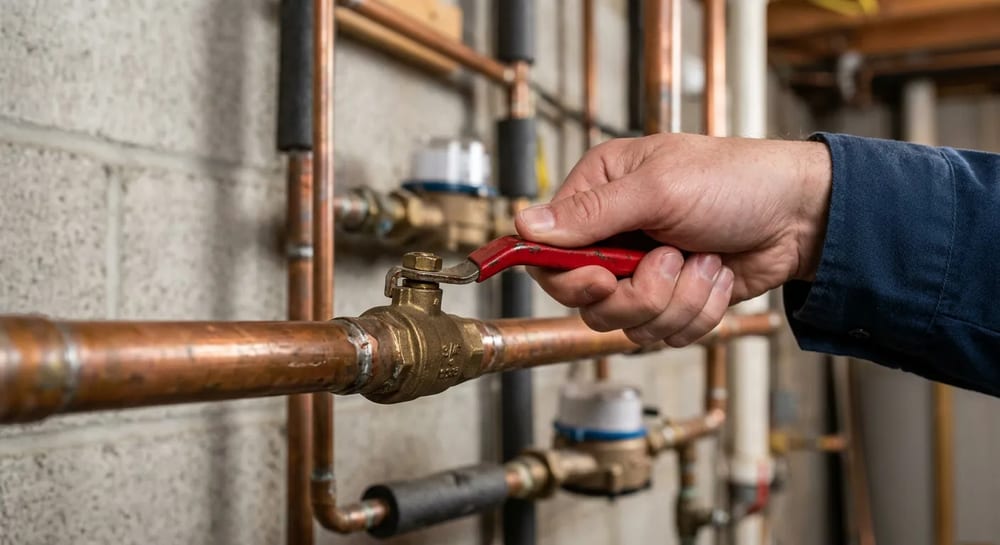
If that fails, or if water is pouring through the ceiling, go straight to the main water shutoff. You usually find this in the basement, in the garage, or outside near the street. If it has a straight handle, turn it perpendicular to the pipe. If it is a round wheel, turn it clockwise until it stops. You can learn more about finding and maintaining these valves in our Plumbing section.
What to Do If You Smell Gas
Natural gas smells like rotten eggs. If you notice this smell, do not mess around. A simple spark can cause an explosion. Do not flip any light switches. Do not use your phone inside the house. Do not unplug anything from the wall.
Get everyone outside immediately. Leave the doors open to let the gas vent out of the house. Once you are safely across the street, call 911 or your local gas company. If you frequently notice weird scents in your house that are not gas, check our guide to Smells & Odors to track them down.
If you know how and you have a wrench handy, you can shut off the gas at the meter outside. Use the wrench to turn the rectangular valve a quarter turn so it sits crosswise to the pipe. Never turn the gas back on yourself. The gas company must do that.
Power Outages and Electrical Emergencies
If your power goes out, look outside to see if your neighbors have lights. If the whole street is dark, call the power company. If only your house is dark, check your main electrical panel.
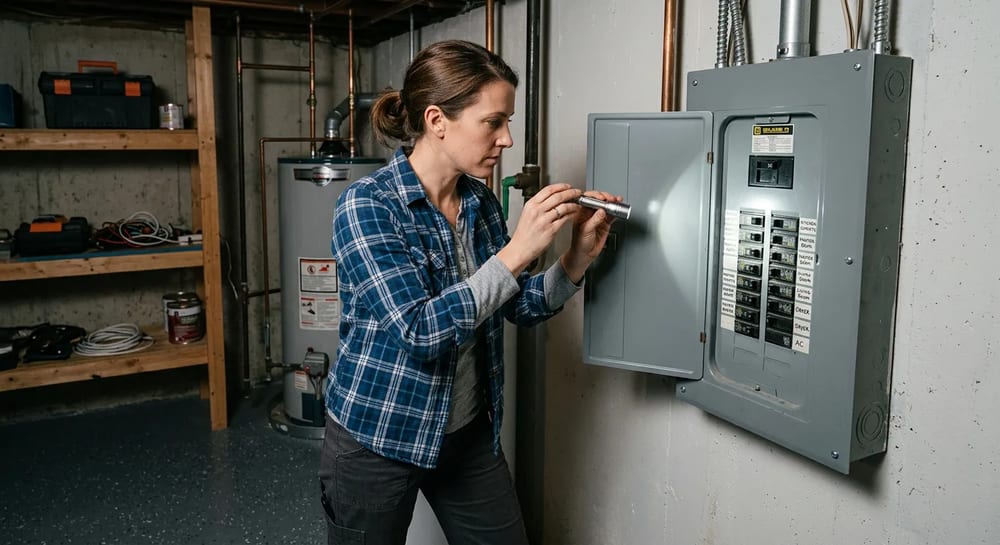
Sometimes a breaker trips because a circuit is overloaded. Open the panel and look for a switch that sits in the middle. Push it all the way to "off" and then snap it back to "on".
If you see sparks, smell burning plastic, or feel a hot outlet, you have a serious electrical emergency. Go to the breaker box and flip the main breaker at the top to "off". Call a licensed electrician right away. Read more about keeping your wiring safe in our Electrical guide.
Small Fires and When to Evacuate
You can put out a small grease fire in a frying pan by sliding a metal lid over it to smother the flames. Never throw water on a grease fire. Water makes the burning oil explode and spread across the kitchen.
Keep a fire extinguisher in the kitchen and on every floor. Use the PASS method. Pull the pin. Aim low at the base of the fire. Squeeze the handle. Sweep from side to side.
If a fire spreads beyond a small area, or the room fills with smoke, drop everything and get out. Call 911 from outside. Houses burn incredibly fast. Do not stay inside to save your belongings. You can review more home safety protocols in our Environmental Hazards section.
How to Clean Up a Flooded Basement or Crawl Space
A flooded basement or a flooded crawl space is one of the most common home emergencies, and it almost always traces back to one of a few causes: heavy rain overwhelming the soil, a failed sump pump, a burst supply line, or a sewer backup. Whatever the cause, standing water has to come out fast. Water that sits longer than 24 to 48 hours grows mold, ruins drywall, and warps framing. Acting quickly is the difference between a cleanup and a gut renovation.
Before you step into the water, stop and think about electricity. Water on a basement floor can be energized by a submerged outlet, an extension cord, or a running appliance. If the water is anywhere near outlets, the furnace, or the panel, do not wade in. Shut the power off at the main breaker first (see the electrical section above) or call an electrician. If you cannot safely reach the panel, call your utility.
Steps to Clean Up the Water
- Cut the power to the flooded area at the main electrical panel if there is any chance water has reached outlets or wiring.
- Find and stop the source. If it is a burst pipe, shut off the main water valve. If it is a backed-up sump pit, the pump may have failed.
- Remove the water. Use a submersible pump or a wet/dry shop vacuum for shallow water. For deep water, rent a higher-capacity pump.
- Pull out soaked rugs, cardboard, and furniture so they can dry separately or be discarded.
- Dry the space aggressively with fans and a dehumidifier running around the clock for several days.
- Disinfect hard surfaces, especially if the water came from a sewer line, with a diluted bleach solution.
- Photograph everything before you discard it. Your homeowners insurance may cover the damage.
A flooded crawl space follows the same logic but is harder to reach. Pump it out, then run a dehumidifier and check the vapor barrier. Persistent crawl space water usually means a drainage or grading problem outside the home, which our Foundation guide covers in depth. If water keeps returning to a basement, a working sump pump and proper exterior drainage are the long-term fix, not repeated cleanups.
| Water Source | First Move | Cleanup Caution |
|---|---|---|
| Burst pipe or appliance line | Shut off main water valve | Clean water, lower mold risk if dried fast |
| Failed sump pump | Pump out, check pump and float | May recur until pump is replaced |
| Sewer backup | Stop using all drains, call a plumber | Contaminated, wear gloves and disinfect |
| Groundwater after heavy rain | Pump out, address outside drainage | Likely to repeat without grading fixes |
How to Stop a Smoke Alarm From Beeping or Chirping
A smoke alarm that will not stop is one of the most maddening home situations, especially at 3 a.m. The good news is that a constant chirp almost never means a fire. It means the device needs attention. Knowing how to shut off a smoke alarm safely, without disabling your protection for good, takes about five minutes.
First, tell the difference between two sounds. A loud, continuous alarm means smoke or carbon monoxide may be present, so treat it as real and check the house. A single chirp every 30 to 60 seconds is a maintenance signal, usually a dying battery or an alarm that has reached the end of its life.
How to Silence a Chirping Alarm
- Press and hold the test button on the front of the alarm for several seconds to silence it temporarily.
- Remove the alarm from its mounting bracket by twisting it counterclockwise.
- Replace the battery, even if it seems fine. Use a fresh 9-volt or AA as specified on the back.
- Hold the test button for 15 seconds with the battery out to clear any residual charge that keeps the chirp going.
- Reinstall the battery, remount the alarm, and press test to confirm it sounds and then stops.
If a hardwired alarm keeps chirping after a fresh battery, the backup battery in the unit or the unit itself may be failing. Hardwired alarms are linked, so one bad unit can make the whole chain chirp. Check the manufacture date printed on the back. Any smoke alarm older than 10 years should be replaced entirely, not repaired.
Emergency Plumber and Electrician Costs
Calling a pro after hours costs extra. Plumbers and electricians charge emergency dispatch fees on top of their hourly rates. These ranges vary widely by region, the scope of the fix, and the age of your home.
| Service Type | Standard Dispatch Fee | After Hours Emergency Fee |
|---|---|---|
| Plumber | $75 to $150 | $150 to $350 |
| Electrician | $80 to $120 | $200 to $400 |
| HVAC Tech | $90 to $150 | $200 to $300 |
The chart below shows rough total cost estimates for common emergency repairs, including parts and labor.
Making a Family Emergency Preparedness Plan
Supplies are only half of emergency preparedness. The other half is a plan everyone in the house actually knows. When a storm knocks out power or a fire alarm goes off at night, there is no time to figure out who does what. A simple written plan, made calmly ahead of time, removes the panic and gets everyone out safely.
A good home emergency plan answers a few basic questions before an emergency ever happens. Walk through it with your whole household, including kids, and post a copy on the fridge.
- Two ways out of every room. Pick a primary and a backup escape route, usually a door and a window, for each bedroom.
- One meeting spot outside. Choose a safe landmark away from the house, like a neighbor's mailbox or a specific tree, where everyone gathers.
- One out-of-town contact. Local lines can jam in a regional emergency, so pick a relative or friend out of the area everyone can text.
- Who grabs what. Assign one adult to the emergency kit, one to any pets, and one to help small children.
- Where the shutoffs are. Make sure at least two adults know how to kill the water, gas, and power.
Practice the plan twice a year. Run a short fire drill from the bedrooms to the meeting spot, and let kids work the route so it is automatic. Tie the practice to a date you will remember, such as when you change your clocks, the same time you should be testing alarms and replacing batteries.
| Emergency Type | Immediate Action | Key Prep Item |
|---|---|---|
| House fire | Get out, meet outside, call 911 | Practiced escape routes and a meeting spot |
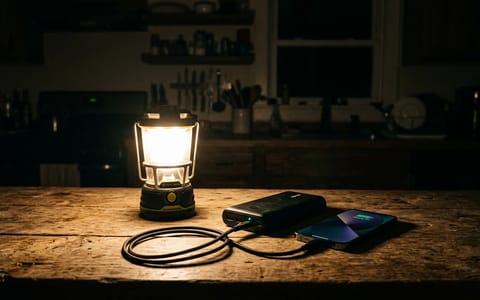
| Extended power outage | Use flashlights, keep fridge closed | Flashlights, batteries, weather radio |
| Severe storm or tornado | Move to an interior room on the lowest floor | Battery weather radio, water, first aid |
| Gas leak | Leave at once, call from outside | Everyone knows the meeting spot |
Once the plan is set, back it up with the right supplies. The kit below is what turns a plan on paper into a household that can ride out the first few days of almost any emergency. For a printable seasonal version, our regional seasonal home maintenance checklists include storm-prep tasks tuned to your area.
Building Your Home Emergency Kit
You need supplies ready before the power goes out or a storm hits. A good kit keeps your family safe and comfortable for a few days without outside help.
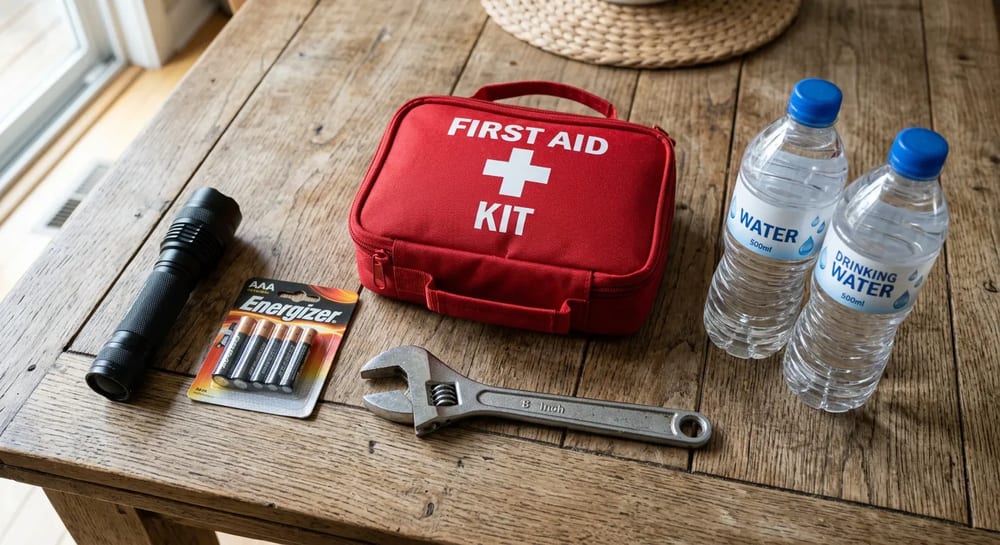
Store these items in a plastic bin near the front door or in a hall closet:
- Flashlights and extra batteries.
- A battery powered weather radio.
- A basic first aid kit with bandages and antiseptic.
- Bottled water, aiming for one gallon per person per day.
- A crescent wrench to shut off the gas meter.