Simple Wire Gauge Chart for Amperage: A Homeowner Guide
Using the wrong wire size for a circuit is a major fire hazard. This simplified homeowner guide explains how to match wire gauge to breaker amperage safely.
Full guide Electrical Learn how your home electrical system works and what parts are safe for you to handle.Homeowners tackling minor electrical updates or inspecting their home's wiring often hit a dangerous roadblock: choosing the right wire size. Understanding a wire gauge chart for amperage is crucial. Whether you are adding a new outlet to your garage or trying to figure out why a breaker keeps tripping, matching the wire to the breaker is non-negotiable.
Using the wrong gauge wire for amps is a massive fire hazard. But searching for an 'ampacity wire chart' usually brings up complex engineering tables meant for master electricians, filled with temperature ratings and conduit fill limits. This guide cuts through the technical jargon. We will look at a simplified, easy-to-read wire gauge chart for amperage specifically tailored for standard residential circuits.
Why Does Wire Gauge Matter So Much?
Electricity flowing through a wire acts a lot like water flowing through a hose. The wire gauge (thickness) determines how much electrical current (amps) can safely pass through it without creating excessive friction. For example, a 14-gauge wire is typically rated to safely handle 15 amps. In electrical terms, that friction is resistance, and resistance creates heat.
The American Wire Gauge (AWG) system is standard in North America. Counterintuitively, the smaller the AWG number, the thicker the wire. A 10-gauge wire is much thicker than a 14-gauge wire.
Circuit breakers exist to protect the wire, not the appliance plugged into the wall. If you try to pull 20 amps of current through a thin 14-gauge wire, the wire will heat up like the glowing orange coils inside a toaster. If the breaker is incorrectly sized at 20 amps, it will not trip because it thinks 20 amps is perfectly fine. The wire's plastic insulation will melt, igniting the wood studs inside your walls.
The Simplified Wire Gauge Chart for Amperage
For 95% of DIY residential electrical work, you are dealing with copper NM-B cable (commonly known by the brand name Romex) run inside hollow, dry walls. According to the National Electrical Code (NEC), NM-B cable is restricted to the 60°C temperature column for ampacity.
Here is the standard residential wire gauge chart for amperage using copper NM-B cable:
| Wire Gauge (AWG) | Maximum Breaker Size | Typical Household Uses |
|---|---|---|
| 14 Gauge | 15 Amps | Standard lighting, basic bedroom outlets |
| 12 Gauge | 20 Amps | Kitchen, bathroom, dining, and garage outlets |
| 10 Gauge | 30 Amps | Electric dryers, water heaters, heavy-duty window ACs |
| 8 Gauge | 40 Amps | Electric ranges, cooktops, small EV chargers |
| 6 Gauge | 55 Amps (Use 50A breaker) | Large electric ovens, hot tubs, large EV chargers |
| 4 Gauge | 70 Amps | Subpanels, whole-house electric heating |
Keep in mind this chart applies specifically to copper wire. Aluminum wire, which is sometimes found in older homes or used for heavy service feeders, is less conductive than copper and requires a thicker gauge for the exact same amperage.
What Gauge Wire Do You Need for Specific Amps?
Let's break down the most common household circuits and answer the specific sizing questions homeowners face most often.
The 15-Amp Circuit (14 Gauge)
Standard living room, bedroom, and hallway lighting circuits are usually 15 amps. They require 14-gauge wire. You can safely run LED lights, televisions, and computers on these circuits. Because 14-gauge wire is thinner, it is much easier to bend and tuck into small electrical boxes.
What Gauge Wire for a 20 Amp Breaker?
You must use 12-gauge copper wire for a 20-amp breaker. The 12 gauge wire ampacity is rated for exactly 20 amps. Modern building codes require 20-amp circuits in kitchens, bathrooms, laundry rooms, and garages because these areas host high-draw appliances like microwaves, hair dryers, and space heaters.
12-gauge wire is noticeably stiffer than 14-gauge. When wiring a kitchen remodel, wrestling thick 12-gauge wire into a GFCI outlet box requires a good pair of pliers and some patience.
The 30-Amp Circuit (10 Gauge)
Dedicated 30-amp circuits use 10-gauge wire. You will almost always see this setup running to large, single-appliance loads like an electric clothes dryer or a residential electric water heater. These are 240-volt circuits, meaning the cable will usually have two hot wires (black and red), a neutral (white), and a bare copper ground.
Heavy Lifters: 6 Gauge Wire Ampacity and 4 Gauge Wire Rating
When you get into heavy-duty home appliances, the wires become incredibly thick and difficult to bend.
The 6 gauge wire ampacity for standard NM-B cable is 55 amps. Because 55-amp breakers are exceedingly rare, you round down and put this wire on a 50-amp breaker. This is the standard size for a modern electric range or a Level 2 electric vehicle (EV) charger.
The 4 gauge wire rating for NM-B is 70 amps. You rarely see 4-gauge wire running to a specific appliance. Instead, it is usually used as a feeder wire to supply power to a smaller subpanel in a garage or an addition.
How to Identify Existing Wire Sizes by Color
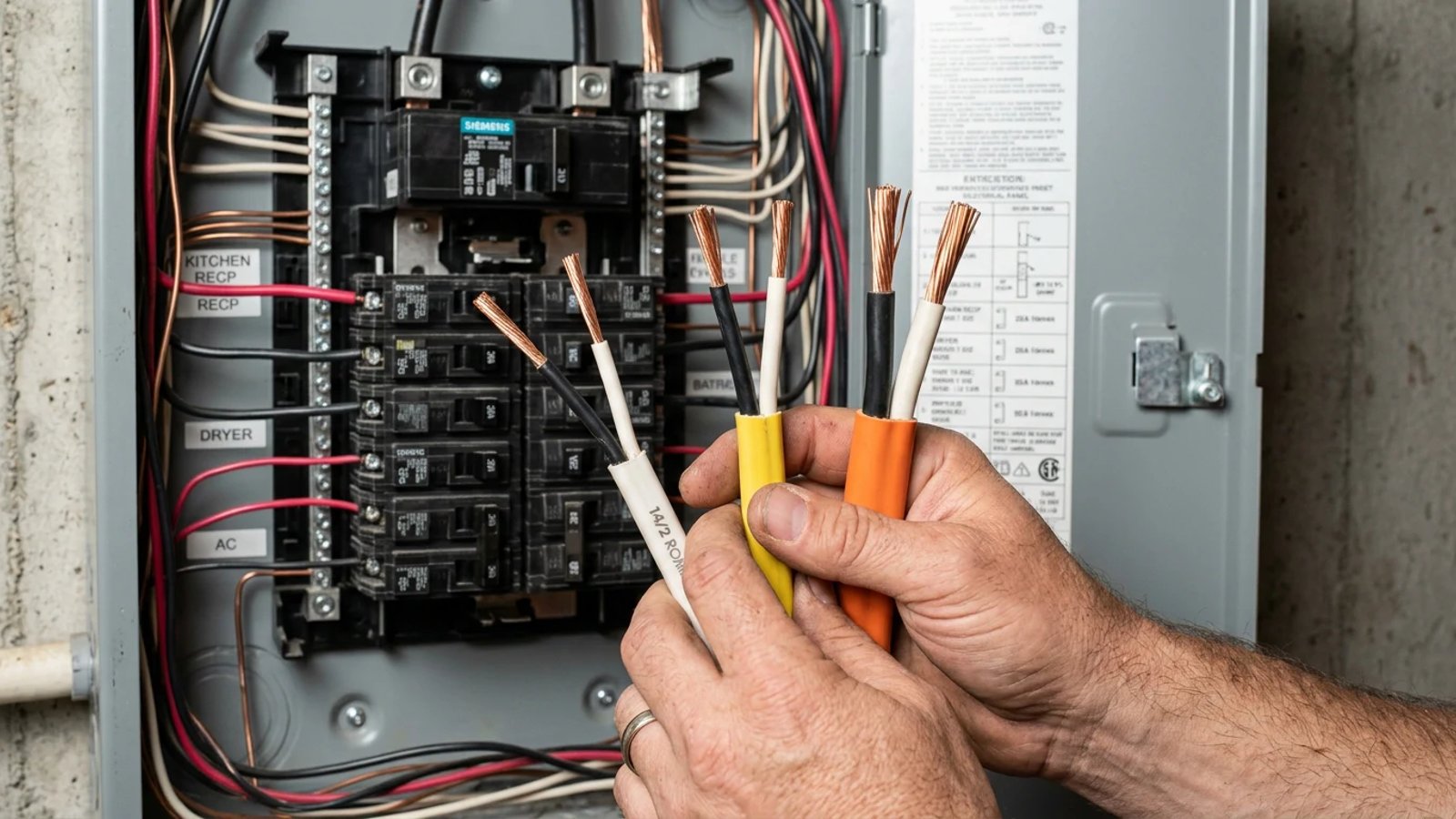
If you open an outlet box to replace a receptacle, you need to know what gauge wire is already in the wall. Thankfully, modern wire manufacturers made this easy by color-coding the outer plastic sheath.
- White Jacket: 14-gauge wire (15-amp circuits)
- Yellow Jacket: 12-gauge wire (20-amp circuits)
- Orange Jacket: 10-gauge wire (30-amp circuits)
- Black Jacket: 8-gauge or 6-gauge wire (40+ amp circuits)
When we replaced the outlets in my 1980s kitchen, all the old Romex jackets in the walls were white, regardless of the gauge inside. I had to wipe the dust off the sheath, read the faint factory stamping, and measure the bare copper with wire strippers to confirm they were actually 12-gauge wires on a 20-amp circuit. Never assume a white wire in an older home is 14-gauge.
The 80% Rule for Continuous Loads
There is a massive difference between plugging in a vacuum cleaner for ten minutes and plugging in an electric vehicle for ten hours. The NEC defines a "continuous load" as any load expected to run for three hours or more at maximum capacity.
For continuous loads, you can only load a circuit to 80% of its maximum rating. If you install a 50-amp EV charger that pulls exactly 50 amps for five hours straight, you cannot use a 50-amp breaker and 6-gauge wire. You must size the circuit to 125% of the continuous load (50 amps x 1.25 = 62.5 amps). You would need to step up to a 70-amp breaker and 4-gauge wire.
How to Check Your Wire and Breaker Compatibility?
If you want to verify that your home's wiring is safely matched to your breaker panel, follow this straightforward process.
- Turn off the main breaker. Always cut power to the entire panel before opening the metal cover to inspect wiring.
- Locate the target breaker. Look at the number stamped on the toggle switch (usually 15 or 20).
- Trace the wire. Follow the black hot wire leaving that specific breaker to where it exits the metal panel box.
- Read the jacket. Look at the plastic sheath just before the wires are stripped. It will have text stamped on it, such as "14/2 WG" or "12/2 WG".
- Match the numbers. Confirm that a breaker stamped "20" is holding a wire stamped "12". If a breaker stamped "20" is holding a wire stamped "14", you have a fire hazard that needs immediate correction.
A Note on Voltage Drop for Long Runs
The standard ampacity wire chart assumes your wire run is relatively short—usually under 100 feet. If you are running power to a detached shed or a landscape lighting transformer far away from your main panel, you have to account for voltage drop.
As electricity travels over a long distance, the natural resistance of the copper causes the voltage to sag. If you run a 12-gauge wire 150 feet to a heavy piece of machinery, the machine might only receive 105 volts instead of 120 volts. This will cause electric motors to overheat and burn out prematurely. For runs over 100 feet, you generally need to step up one wire size (e.g., use 10-gauge wire for a 20-amp circuit) to compensate for the distance.
Understanding your home's electrical system doesn't mean you have to memorize the entire code book. By respecting the basic rules of wire gauge and amperage, you can safely troubleshoot minor issues, plan your DIY upgrades accurately, and know exactly when a project requires a professional touch.
- Never put a 15-amp wire (14-gauge) on a 20-amp breaker.
- When wiring continuous loads like EV chargers, size the wire and breaker to 125% of the continuous load.
- Always check the printed text on the wire jacket to confirm the gauge, especially in homes built before 2001.
- If you increase a breaker size, you must pull new, thicker wire to match.