How to Shut Off Water to Your House (Find Your Valve Fast)
Don't wait until a pipe bursts to find your main water shut-off valve. Learn exactly how to locate and turn off your home's water supply in seconds.
Full guide Home Emergencies Learn exactly what to do and what to shut off during water, gas, power, and fire emergencies in your home.A pipe bursts inside a wall, a rubber washing machine hose snaps, or a toilet overflows endlessly. In these panic-inducing moments, every second counts. The problem is that most homeowners have no idea where their main water shut-off valve is located until they are already standing in an expanding puddle. Learning how to shut off water to your house is a fundamental skill that takes five minutes to master, costs nothing, and acts as your primary defense against catastrophic structural damage.
Whether you are dealing with an active plumbing failure, preparing your home for a deep winter freeze, or simply shutting down the house before a long vacation, you need to know exactly how to control your water supply. We are going to walk through the process of finding your valve, identifying the type of mechanism you have, and operating it safely without causing further damage to your plumbing.
Why Do You Need to Find Your Shut-Off Valve Fast?
Residential plumbing systems operate under significant pressure, usually ranging between 40 and 80 PSI (pounds per square inch). If a standard half-inch supply line ruptures, that pressure can force dozens of gallons of water into your living room in a matter of minutes. According to the Insurance Information Institute, water damage and freezing account for nearly one in four homeowner property casualty claims, with average repair costs frequently exceeding $12,000.
This is where the 10-Second Rule comes into play. If a pipe breaks, you should be able to reach your shut-off valve and stop the flow of water within ten seconds. Every moment the water continues to spray, it ruins drywall, warps hardwood floors, soaks insulation, and creates a breeding ground for mold. You do not have time to search for a flashlight, dig through boxes in the basement, or watch a tutorial video while water is actively destroying your home.
Where Is the Main Water Shut-Off Valve Located?
Plumbing codes dictate that the main shut-off valve must be located where the primary water line enters the home, but that location varies wildly depending on your climate and the type of foundation your house sits on. You will generally find the valve in one of four places.
Homes with Basements: Head down to the basement and look at the front foundation wall (the wall facing the street). The water line typically comes up through the concrete floor or through the wall itself. The valve will be located on this pipe, usually within three to five feet of where it enters the house. It is often near the water heater, furnace, or water softener.
Homes with Crawlspaces: The valve is likely located underneath the house. Check near the crawlspace access door or directly under the front spigot. You may have a secondary valve inside the house, often hidden in a utility closet or under the kitchen sink, but the primary shut-off will be down in the crawlspace.
Homes on Slab Foundations: In warmer climates where houses are built on concrete slabs, the main valve is usually located on an exterior wall. Walk the perimeter of your house, paying close attention to the side facing the street. Look for a pipe coming out of the ground and entering the brick or siding. The valve will be spliced into this exposed pipe. Occasionally, builders place this valve inside the garage near the water heater.
The Street-Level Meter Box: If you cannot find a valve inside or attached to the house, your only option may be the street-level water meter. This is usually located near the curb or sidewalk, housed in a concrete or plastic box set flush with the ground. It features a heavy iron lid that requires a tool to lift.
When we replaced the flooring in our 1960s split-level, I traced the main line for twenty minutes and finally found the gate valve hidden behind a fake wood panel in the laundry room, completely inaccessible without a screwdriver. I immediately cut an access hatch and tied a bright tag to the handle. Do not assume your valve is out in the open just because it should be.
How to Shut Off Water to Your House (Step-by-Step)
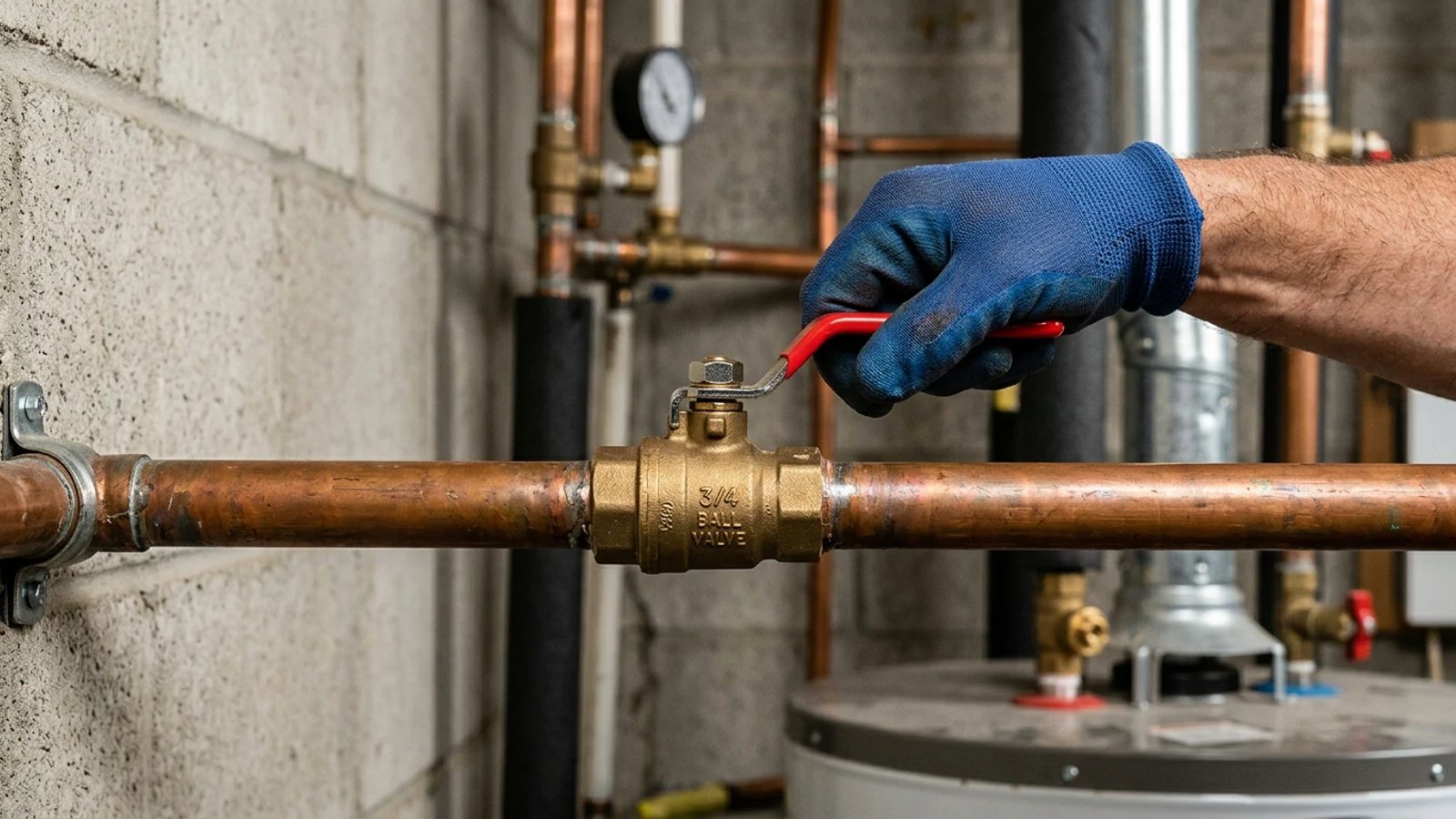
Once you locate the valve, you need to know how to operate it. Residential plumbing typically uses one of two valve types: a ball valve or a gate valve. They operate differently, and handling an older valve incorrectly can cause the pipe to snap.
Follow these steps to safely shut down your home's water supply:
- Clear the area around the pipe. Move any boxes, furniture, or debris so you have a clear, balanced stance and direct access to the valve.
- Identify the valve type. Look at the handle to determine if you are turning a straight lever (ball valve) or a round wheel (gate valve).
- Turn a ball valve 90 degrees. Grip the straight lever and push it a quarter-turn. When the handle is perpendicular (forming a T-shape) to the pipe, the water is fully off.
- Turn a gate valve clockwise. Grip the round wheel and turn it to the right (righty-tighty). It will take several full rotations to lower the internal gate. Stop turning as soon as you feel firm resistance.
Why Must You Relieve the Pressure After Shutting the Valve?
Turning off the main valve stops new water from entering the house from the city supply, but your pipes are still completely full of water. If you have a two-story house, that is dozens of gallons of water suspended in the pipes above you. If a pipe has burst on the first floor, that suspended water will continue to drain out of the break until the pipes are empty.
Turning off the main valve stops new water from entering, but opening a basement faucet empties the pipes before that water ends up on your floor.
To stop a leak instantly, you must break the vacuum in the plumbing system and give the trapped water a safe place to go. Immediately after shutting off the main valve, walk to the lowest point in your house—usually a basement utility sink or a first-floor bathtub—and turn on both the hot and cold taps. Then, go to the highest floor and open a faucet there. Air will enter the top faucet, allowing the trapped water to drain quickly and safely down into the lowest sink, rather than out through the broken pipe. This process typically takes about 5-10 minutes to fully drain the lines.
What to Do If Your Water Valve Is Stuck?
Older gate valves are notorious for failing. Because they sit unused for years at a time, minerals from hard water build up on the internal brass threads. When you finally try to turn the wheel during an emergency, it may feel completely seized.
If the valve will not turn using normal hand pressure, do not force it. Never put a pipe wrench, Channellock pliers, or a cheater bar on a stuck water valve. The brass housing is softer than you think, and applying excessive leverage will crack the valve body or snap the copper pipe entirely, turning a minor repair into a major flood.
If you cannot turn the valve inside the house, grab a $15 water meter key from your local hardware store and shut the water off at the street-level meter box instead. The city valve requires a quarter-turn so the two locking holes align. Once the street valve is off, you can safely have a plumber replace the faulty interior valve.
Finding your main water shut-off valve is a task you only have to do once, but it pays dividends for as long as you own the home. Take ten minutes this weekend to locate the valve, clear away any obstructions, and test it gently to ensure it moves freely. When a pipe eventually leaks, you will be able to handle the situation calmly and efficiently, saving your home from severe water damage.
- Locate and tag your main water shut-off valve today, before an emergency happens.
- If you have an older round-wheel gate valve, test it gently; they are prone to seizing and failing over time.
- Keep a water meter key in your garage if your primary shut-off is located at the street level.