Basement Musty Smell Won't Go Away? How to Fix It
Tired of a damp, earthy odor ruining your downstairs space? Learn how to track down hidden moisture, fix foundation leaks, and eliminate persistent basement smells for good.
Full guide Foundation & Structure Learn how to spot dangerous foundation cracks and protect your home from costly structural damage.As the weather warms up in late spring and transitions into summer, homeowners often face a frustrating reality: their basement smells musty, and the odor won't go away, no matter how many candles they burn, windows they open, or air fresheners they spray. In my experience, you walk down the stairs to grab your stored luggage or holiday decorations, and you are immediately hit with that heavy, damp, earthy odor. It smells like a wet forest floor, and it clings to cardboard boxes and fabrics.
That smell is not just a nuisance. It is a chemical signal. The odor comes from Microbial Volatile Organic Compounds (MVOCs), which are gases released by active mold and mildew as they feed and multiply. If you can smell it, fungi are actively growing somewhere in the room. Masking the scent with aerosol sprays is like putting a bandage on a leaky pipe. To permanently eliminate the odor, you have to starve the mildew by removing its only water source.
Finding that water source is the tricky part. Most basements do not have dramatic, ankle-deep floods. Instead, they suffer from slow, invisible moisture intrusion. We will walk through exactly how to diagnose your basement, find the hidden dampness, and apply permanent fixes to dry out the space and freshen the air for good.
The Best Way to Get Rid of a Musty Smell in Your Basement
When homeowners ask me how to eliminate that damp smell in the basement permanently, I always give them the same four-step protocol. This is the best way to get rid of a musty smell in the basement because it addresses both the root cause and the lingering airborne odor simultaneously.
- Stop the intrusion: Fix exterior grading and extend downspouts to keep groundwater away from the foundation walls.
- Dry the environment: Install a continuous-drain dehumidifier to lower the relative humidity below 50 percent, which instantly halts new fungal growth.
- Kill the source: Treat all affected concrete and wood surfaces with a penetrating enzymatic cleaner rather than surface-level bleach.
- Scrub the air: While you wait for the fungal source to die off, run a HEPA air purifier equipped with a thick activated carbon filter. The carbon actively absorbs the floating MVOC gases, removing the moisture smell in the basement within 24 to 48 hours while your structural fixes take hold.
Is It a Humidity Smell, Mildew, or Moldy Basement Smell?
Many people use these search terms interchangeably, but identifying the exact scent profile can tell you how severe your moisture problem is.
A humidity smell in the basement is usually the earliest warning sign. The air feels heavy and thick in your lungs, but it does not necessarily smell like rotting earth yet. This means micro-condensation is just starting to form on cold surfaces.
A mildew smell is the classic flat, damp, wet-sock odor. Mildew grows flat on surfaces and thrives on minor condensation. It is relatively easy to clean and stop.
A moldy basement smell is much stronger, sharper, and smells intensely of rotting wood or decaying leaves. If you notice a strictly moldy odor, you likely have active water damage, such as a leaking pipe inside a wall, a failing window seal, or saturated wood framing, rather than just high summer humidity.
Why Masking the Basement Musty Smell Never Works (The Micro-Condensation Trap)
Many homeowners assume their basement smells simply because it is underground and lacks fresh air. They plug in scented oil warmers or run standard fans, hoping to circulate the staleness away. This approach fails because it ignores the physics of basements, specifically the relationship between temperature and humidity.
During the warmer months, the air outside is hot and holds a massive amount of moisture. When you open a basement window to "air it out," you are actually pulling that warm, humid air into a cool underground space. The soil surrounding your home keeps your concrete foundation walls naturally chilled, often hovering around 55 to 60 degrees Fahrenheit.
If your basement smells in summer, this micro-condensation is usually the culprit. When warm, humid air hits a cold surface, it reaches its dew point. The air can no longer hold its moisture, and it dumps that water directly onto the cold surface. This creates micro-condensation. It is a microscopic layer of water that you cannot see with the naked eye, but it coats your concrete walls, exposed wood joists, and cold-water pipes. This invisible moisture is more than enough to sustain a massive colony of mildew.
You cannot out-clean a moisture problem. Until you dry the air and seal the leaks, the musty smell will always return.
This is why the basement musty smell won't go away even after a deep cleaning. You might scrub the walls and floors, but the moment warm air hits those cold walls again, the micro-condensation returns, the mildew regrows, and the odor comes right back.
Why Your Basement Smells Musty But You See No Mold
One of the most common complaints I hear is from homeowners who say their basement has a musty smell, yet the walls and floors look completely spotless. If your basement smells musty but no mold is visible, the fungi are simply hiding. Mold does not need light to thrive. It only needs moisture, oxygen, and a food source.
Start your search in these three hidden areas to uncover that flat damp smell:
- Behind finished drywall: If moisture seeps through the foundation behind a finished wall, the fiberglass insulation and paper drywall backing become a breeding ground. The basement smells like mildew long before you see dark spots on the paint.
- Under laminate or carpet: Concrete floors constantly wick moisture from the earth. If you lay carpet or cheap laminate directly over bare concrete without a dimpled vapor barrier, moisture gets trapped underneath.
- Above drop ceilings: Leaky cold-water pipes drip onto the top side of acoustic ceiling tiles, creating hidden colonies overhead.
What If It Is an Ammonia Smell in the Basement?
Not every basement odor is a musty, earthy scent. If you notice a sharp ammonia smell in the basement, you are dealing with a completely different issue. This pungent odor is rarely mold. Instead, it usually points to one of two problems: sewer gas or pest activity.
Most basements have a floor drain or a utility sink. These plumbing fixtures have a curved pipe underneath called a P-trap, which holds a small amount of water to block sewer gases from entering your home. If you do not use that sink or drain often, the water in the trap simply evaporates. Once the trap is dry, raw sewer gas flows directly into your basement, which often smells strongly of ammonia or sulfur.
The fix is incredibly simple. Pour one gallon of water down every floor drain and unused sink in your basement. This refills the P-trap. To prevent it from drying out again quickly, pour two tablespoons of mineral oil down the drain right after the water. The oil floats on top of the water and stops evaporation. If the plumbing traps are full and the ammonia smell persists, check for signs of mice or rats. Rodent urine creates a very strong ammonia odor in enclosed spaces, requiring careful trapping and sanitization.
How Do I Find the Hidden Water Source?
Before you buy expensive equipment or tear up drywall, you need to know exactly where the water is coming from. Moisture enters a basement in two primary ways: it either seeps through the porous concrete from the wet soil outside, or it condenses out of the humid indoor air. You can figure out which problem you have using a few simple diagnostic steps.
I tested this specific diagnostic process on a damp 1970s split-level home in the summer of 2025. The homeowners were convinced they had a cracked foundation, but a quick walk around the property and a foil test revealed the real culprits in under an hour.
- Inspect the exterior grading. If your basement smells musty after rain, the issue is almost certainly exterior water intrusion. Walk around the perimeter of your house. The soil should slope away from your foundation walls, dropping at least 6 inches over the first 10 feet. If the soil is flat or slopes toward the house, rainwater is pooling against your foundation and seeping through the concrete.
- Check your downspouts. Gutter downspouts are notorious for dumping hundreds of gallons of roof water directly next to the foundation. Ensure every downspout has an extension that carries water at least 5 to 6 feet away from the house.
- Examine the rim joists. Go down to the basement and look up at the perimeter ceiling where the wood framing meets the top of the concrete wall. Look for dark water stains, cobwebs holding moisture, or actual white fuzzy growth. This area is a common entry point for humid outside air.
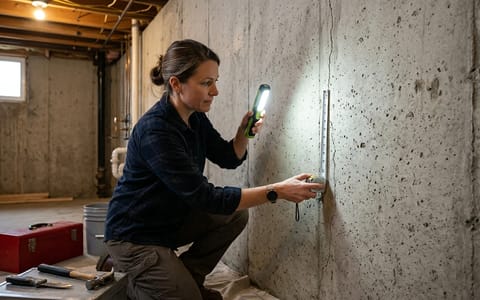
- Perform the aluminum foil test. Cut a 12x12 inch square of heavy-duty aluminum foil. Use silver duct tape to tape all four edges securely to a bare concrete wall or floor. Leave it completely undisturbed for 24 hours.
After 24 hours, peel the foil off the wall and inspect it. If the side of the foil facing the room is wet with condensation, your problem is high indoor humidity. If the side of the foil facing the concrete is wet, your problem is moisture seeping through the foundation from the outside soil. Often, homes have a combination of both.
Fixing the Exterior Foundation Grade
If your foil test revealed moisture pushing through the concrete, or if you noticed poor grading during your exterior inspection, you must address the outside of the house first. No amount of interior waterproofing paint will hold back the hydrostatic pressure of saturated soil pressing against your foundation.
Start by cleaning your gutters thoroughly. Clogged gutters overflow, dropping a heavy curtain of water right next to the foundation walls. Once the gutters are clear, verify the downspout extensions are attached and functioning.
Next, build up the soil around the house. You want to use a dense, clay-based soil for this, not loose topsoil or mulch. Topsoil and mulch absorb water like a sponge, holding it against the house. Clay-based soil sheds water. Pack the soil tightly against the foundation, creating a gentle ramp that forces rainwater to run out into the yard. Tamp it down firmly with a hand tamper or the back of a shovel.
Tackling Musty Basements in High-Rain Climates
If you live in an area known for heavy, persistent rainfall, standard grading fixes might not be enough. For example, search queries for a "Bellingham musty basement smell" frequently pop up from homeowners in the Pacific Northwest. In coastal or heavy-rain regions, the groundwater table naturally sits very high.
When the soil is perpetually saturated for six months of the year, hydrostatic pressure forces water up through the center of your concrete floor slab. If you live in a high-rain climate and your basement smells musty every winter and spring, you will likely need to install an interior perimeter drain system (often called a French drain) connected to a heavy-duty sump pump. As of 2026, professionally installing an interior drainage system typically costs between $4,000 and $8,000, but it is often the only permanent way to stop the musty smell in basements built below the water table.
Setting Up Proper Dehumidification
If your foil test showed moisture on the room-facing side, or if you want to combat the summer humidity, a high-quality dehumidifier is your best defense. A small, cheap dehumidifier designed for a closet will not handle an entire basement. You need a unit built for the cubic footage of the space.
For most standard basements up to 2,000 square feet, purchase a 50-pint compressor dehumidifier. (Note that as of recent 2026 Department of Energy appliance standard updates, you should verify the unit is rated for at least 50 pints under the newest testing guidelines). Place the unit in a central location, away from walls or large furniture that might block the airflow. Set the target relative humidity to between 45% and 50%. This is dry enough to stop mold growth completely, but not so dry that it damages wood furniture or framing.
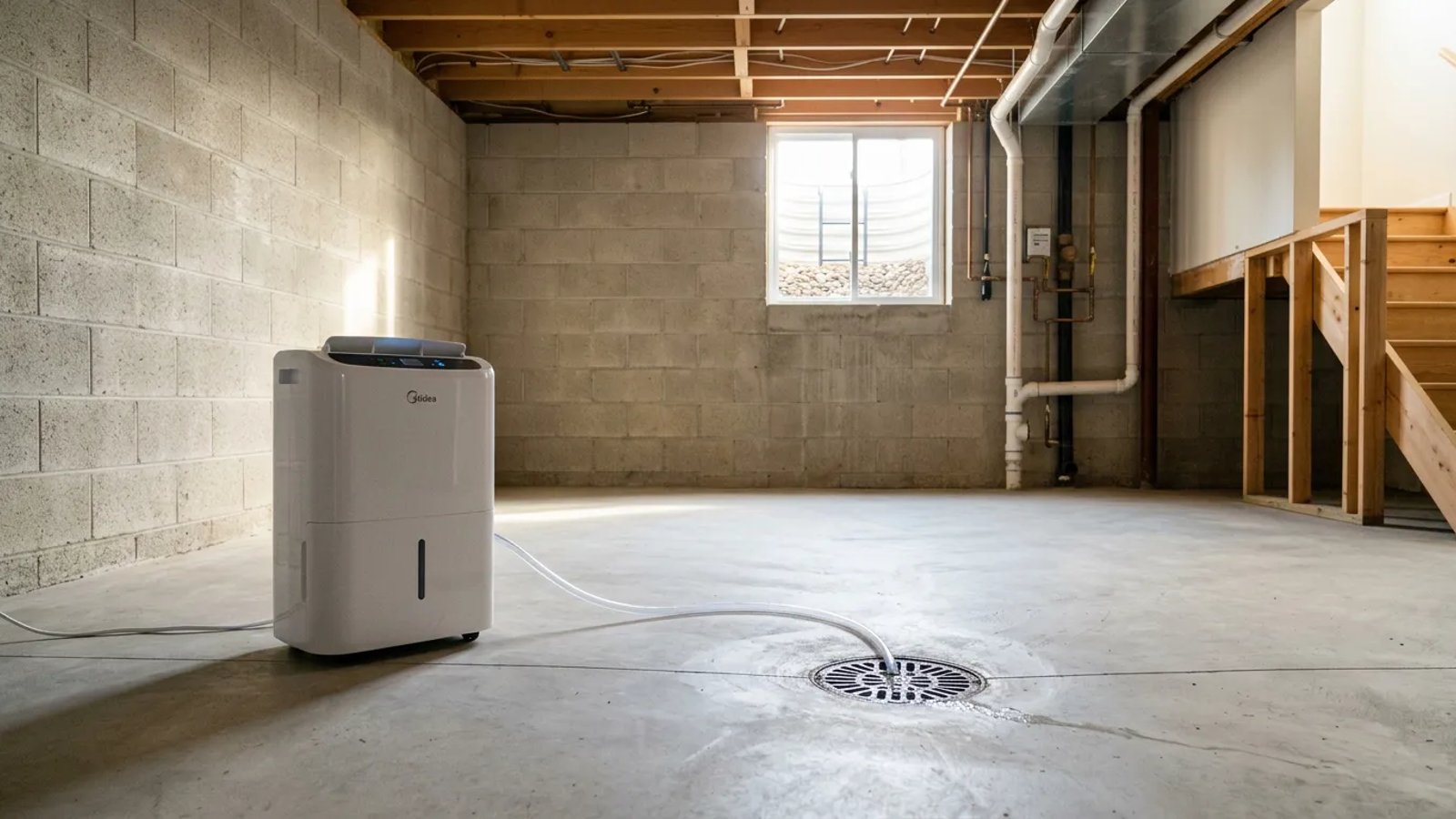
The biggest mistake homeowners make is relying on the dehumidifier's internal bucket. When the bucket fills up, which can happen in just 12 hours during a humid summer, the machine shuts off. While you are at work or sleeping, the humidity spikes again, and the mildew resumes growing. To prevent this, set up a continuous drain.
Most modern dehumidifiers have a port on the back for a standard garden hose. Attach a short, heavy-duty hose and run it directly into a floor drain or a sump pump pit. Elevate the dehumidifier on a sturdy wooden box or cinder blocks to give the hose a steep downward slope. Gravity will pull the water away continuously, allowing the machine to run 24/7 without any intervention from you.
How to Handle Basement Odors After Flooding
A slow leak is one thing, but if your basement smells after flooding, you are racing against the clock. Mold begins germinating within 24 to 48 hours of a standing water event. If you had an inch of water on the floor from a failed sump pump or a massive storm, basic dehumidification is not enough for proper basement odor control.
First, you must remove the ruined porous materials. Carpet padding acts like a giant sponge and can almost never be saved after a flood. Rip it out and throw it away. If the water touched finished walls, you need to cut away the drywall and insulation at least two feet above the highest water line. This exposes the wood studs so they can dry properly.
Once the wet materials are gone, rent commercial air movers (high-velocity fans) and place them every 10 to 15 feet along the walls, blowing in a circular pattern around the room. Pair these with your 50-pint dehumidifier. Keep this drying setup running continuously for at least three to four days before attempting to rebuild or paint.
Should I Seal Foundation Cracks Myself?
During your inspection, you might find small, visible cracks in the concrete walls where moisture is actively weeping in. Hairline cracks are common as houses settle, but they provide a direct highway for groundwater.
You can repair minor, non-structural cracks yourself. Do not use standard caulk, as it will peel away under water pressure. Instead, use hydraulic cement for larger gaps or a polyurethane injection kit for thin, hairline cracks. Hydraulic cement is specifically designed to expand as it cures, locking tightly into the pores of the concrete and stopping active leaks within 3 to 5 minutes.
To apply it, use a stiff wire brush (similar to 120-grit sandpaper in abrasiveness) to aggressively scrub the crack. Vacuum away all the concrete dust. Mix a small batch of hydraulic cement with water according to the package directions, and press it firmly into the crack using a masonry trowel. Work quickly, as the cement hardens incredibly fast.
How Should I Clean Embedded Odors Safely?
Once you have stopped the water from entering and the dehumidifier is keeping the air dry, you need to deal with the lingering odors trapped in the building materials. The instinct for most people is for basement musty smell removal by grabbing a bottle of bleach and starting to scrub. Put the bleach away.
Bleach is highly effective on non-porous surfaces like glass or tile, but it is terrible for porous materials like wood framing, drywall, or concrete. Bleach is mostly water. When you spray it on wood, the chemical chlorine stays on the surface and bleaches the mold white, making it invisible. However, the water soaks deep into the wood, feeding the microscopic roots of the fungi. A few weeks later, the mold returns stronger than before.
Instead of bleach, use an enzymatic cleaner or a registered antimicrobial solution (like Concrobium or commercial-grade hydrogen peroxide). Enzymatic cleaners contain specific proteins that actively break down and digest the organic matter causing the odor. Spray the cleaner heavily onto the affected concrete or wood and let it sit. Dwell time is critical. Read the label, but most enzymatic cleaners need 10 to 15 minutes of wet contact time to fully penetrate the pores and destroy the roots.
For extensive cleaning advice and safety protocols, the EPA guide on mold and moisture offers excellent, science-backed instructions on how to protect your lungs and home during cleanup.
Achieving a fresh, dry basement requires a bit of detective work and some sweat equity, but the results are entirely worth it. By grading the exterior soil, extending your downspouts, running a properly sized dehumidifier on a continuous drain, and cleaning with the right enzymatic products, you can reclaim your downstairs space. Once you take away the water, the mildew dies, the gases stop, and your basement will finally smell like the rest of your home.
- Use the aluminum foil test to determine if moisture is seeping through the concrete or condensing from the indoor air.
- Extend all exterior downspouts at least 5 to 6 feet away from your foundation.
- Maintain basement humidity levels between 45% and 50% using a properly sized dehumidifier.
- Avoid using bleach on porous surfaces like wood or concrete; use enzymatic cleaners instead to destroy odor-causing roots.